
Clouds and ‘seasonal weather’ exist on Saturn’s ‘Earthlike’ moon Titan, NASA says
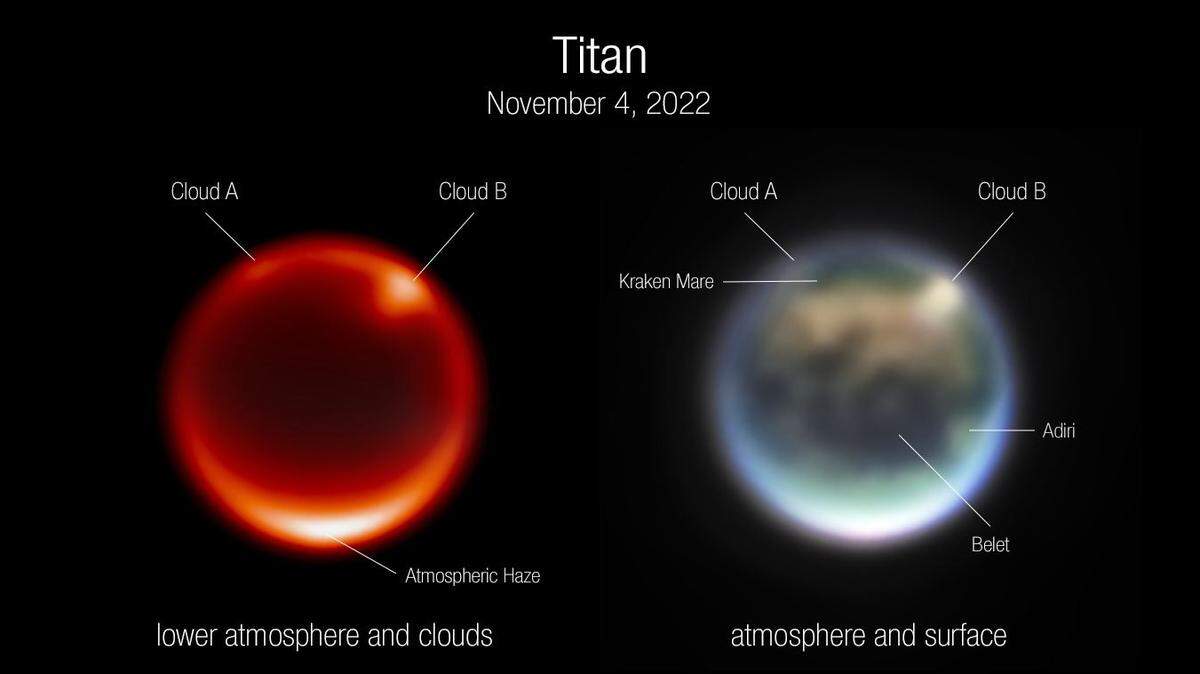
Large, shifting clouds have been identified on Saturn’s moon Titan, confirming its frigid surface has “seasonal weather patterns” not unlike Earth, NASA says.
The discovery is credited to infrared technology used by the recently activated James Webb Space Telescope, according to preliminary findings reported Dec. 1 by NASA.
“Detecting clouds is exciting because it validates long-held predictions from computer models about Titan’s climate, that clouds would form readily in the mid-northern hemisphere during its late summertime when the surface is warmed by the Sun,” NASA reported.
“Titan is the only moon in the solar system with a dense atmosphere, and it is also the only planetary body other than Earth that currently has rivers, lakes, and seas. Unlike Earth, however, the liquid on Titan’s surface is composed of hydrocarbons including methane and ethane, not water.”
Infrared technology was required because Titan’s atmosphere is so thick and hazy, it “obscures visible light reflecting off the surface,” experts say.
The images, taken Nov. 4, showed mysterious “bright spots” on the surface, which were determined to be clouds, NASA says.
Further evidence was provided two days later by the Keck Observatory in Hawaii, which used its telescope to find “clouds at the same positions, looking like they had changed in shape,” NASA says.
“We can’t be sure the clouds on November 4th and 6th are the same clouds, but they are a confirmation of seasonal weather patterns,” Juan Lora, an Assistant Professor of Earth & Planetary Sciences at Yale University, said in the news release.
Titan is Saturn’s largest moon and has long intrigued scientists because it is believed to be “one of the most Earthlike places in the solar system, albeit at vastly colder temperatures and with different chemistry.”
It is nearly 50% wider than Earth’s moon and has “standing bodies of liquid, including rivers, lakes and seas, on its surface,” NASA says.
However, the temperature is a deadly negative 290 degrees Fahrenheit, which makes ice as hard as rock, experts say. “Titan may have volcanic activity as well, but with liquid water ‘lava’ instead of molten rock,” NASA says.
This story was originally published December 5, 2022 at 9:18 AM with the headline "Clouds and ‘seasonal weather’ exist on Saturn’s ‘Earthlike’ moon Titan, NASA says."