
What cases will the Supreme Court hear this session? A look at four contentious issues
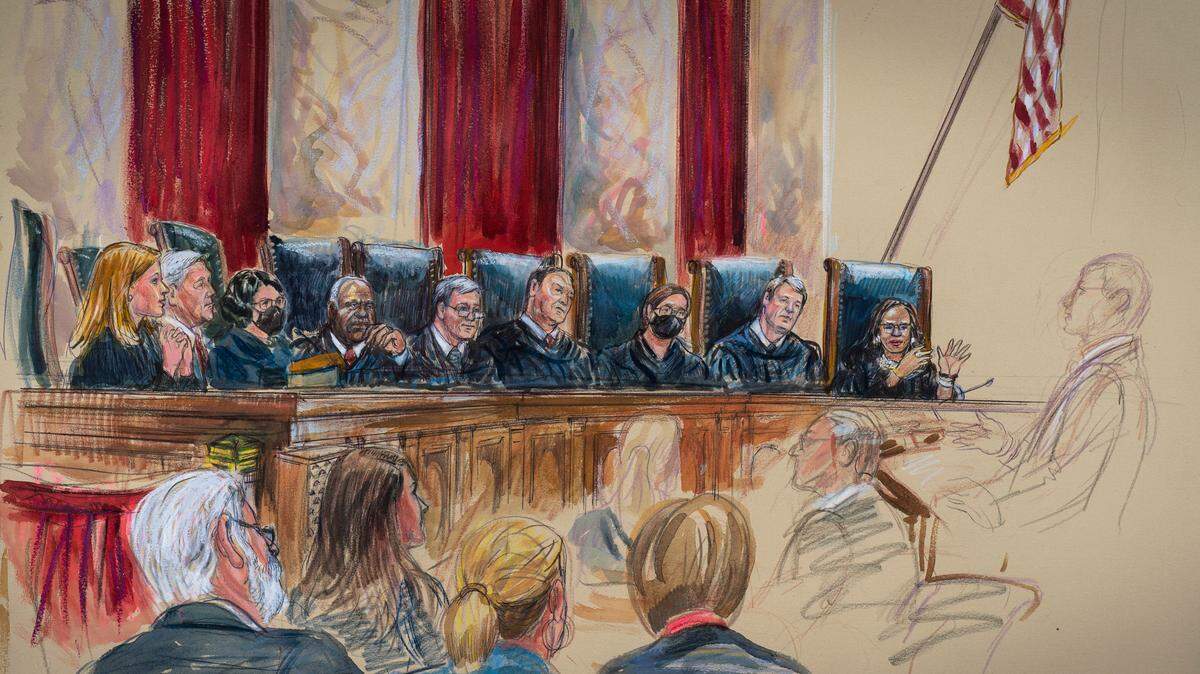
The U.S. Supreme Court reconvened on Monday, Oct. 3, to begin its 2022-2023 term with a new member, Justice Ketanji Brown Jackson, and a return to tradition: oral arguments will once again be open to the public for the first time since 2020.
The high court, which has a 6-3 conservative majority, has agreed to hear 36 arguments so far on topics ranging from environmental law to university admissions procedures.
The new session, which is expected to run until June, follows a 2021-2022 term marked by controversy surrounding the elimination of the Constitutional right to an abortion. The decision sparked nationwide protests and is seen as a major factor in souring public opinion toward the court.
Trust in and approval of the court has plummeted to record lows over the past year, with a record-high percentage of people calling it “too conservative,” according to a Gallup poll. Several justices have publicly voiced their reactions to this dip in confidence.
“The way the court retains its legitimacy and fosters public confidence is by acting like a court, is by doing the kinds of things that do not seem to people political or partisan,” Justice Elena Kagan, who dissented in the abortion case, said in July, according to Reuters.
Chief Justice John Roberts, said, “simply because people disagree with an opinion is not a basis for criticizing the legitimacy of the court,” while speaking to a group of judges and attorneys in September, according to The Washington Post.
As the next term begins, here are four issues to watch:
Environment
One of the first cases on the docket is Sackett v. Environmental Protection Agency, slated for arguments on Monday, Oct. 3. The case is the culmination of a 14-year legal battle stemming from an EPA directive ordering an Idaho family to remove gravel and sand from their property because they claimed it was subject to EPA regulation under the Clean Water Act.
The EPA argued the Sackett’s lot contained wetlands that qualify as “navigable waters,” which are regulated by the act, according to an online Supreme Court archive. Attorneys for the Sacketts have argued that their land contains no “streams, oceans, rivers, [or] lakes.”
The court’s ruling “could have significant implications for the EPA’s efforts to regulate wetlands more broadly,” according to SCOTUSblog, a news site devoted to coverage of the court.
University admissions
At the end of the month, the court will hear arguments for Students for Fair Admissions Inc. v. President & Fellows of Harvard College and Students for Fair Admissions v. University of North Carolina. At issue is whether colleges can use race as a factor in admissions, a process that was upheld by the court in 2003 in the landmark Grutter v. Bollinger case, according to SCOTUSblog.
Students for Fair Admissions is a group “of more than 20,000 students, parents, and others who believe that racial classifications and preferences in college admissions are unfair, unnecessary, and unconstitutional,” according to the group’s website.
The court’s ruling could overturn the “decades-old practice of affirmative action,” according to Forbes.
LGBTQ discrimination
The court will hear arguments for 303 Creative LLC v. Elenis, which involves the owner of a graphic design company in Colorado who sought to create wedding websites, but opposed making them for same-sex weddings on religious grounds. However, a state law barred businesses from discriminating against gay people, so Smith challenged the law in federal court, according to SCOTUSblog.
In a similar case in 2018, the court declined to “either bolster the right to same-sex marriage or explain how far the government can go in regulating businesses run on religious principles,” leaving the door open on the question of whether businesses can discriminate against gay people on First Amendment grounds, according to The New York Times. Instead of sidestepping the question, the court may provide a more conclusive ruling this time.
The case “presents a long-anticipated clash between two recent trends in the court’s jurisprudence, which has expanded equality for LGBT Americans while also reading broadly First Amendment guarantees of free speech and religious exercise,” according to the Wall Street Journal.
Elections
On Oct. 4, the court will hear arguments in Merrill v. Milligan, a case brought by the state of Alabama challenging a lower-court ruling requiring it to redraw a Black-majority district, according to SCOTUSblog.
After the 2020 census, Alabama created a redistricting plan where only one in seven new districts has a Black majority, despite roughly 27% of the state’s residents being Black, according to SCOTUSblog.
A ruling in Alabama’s favor would “potentially boost the power of state legislatures to draw political districts that favor the majority party,” according to the Wall Street Journal.
“Civil rights leaders fear the court will weaken federal protections about redistricting decisions that disadvantage minority communities,” according to The Washington Post. “But Alabama, joined by other Republican-led states, says the Constitution forbids an extended consideration of race in drawing voting districts.”
This story was originally published October 3, 2022 at 3:42 PM with the headline "What cases will the Supreme Court hear this session? A look at four contentious issues."