
Haitian migrants try to break out of Border Patrol bus, South Texas sheriff says
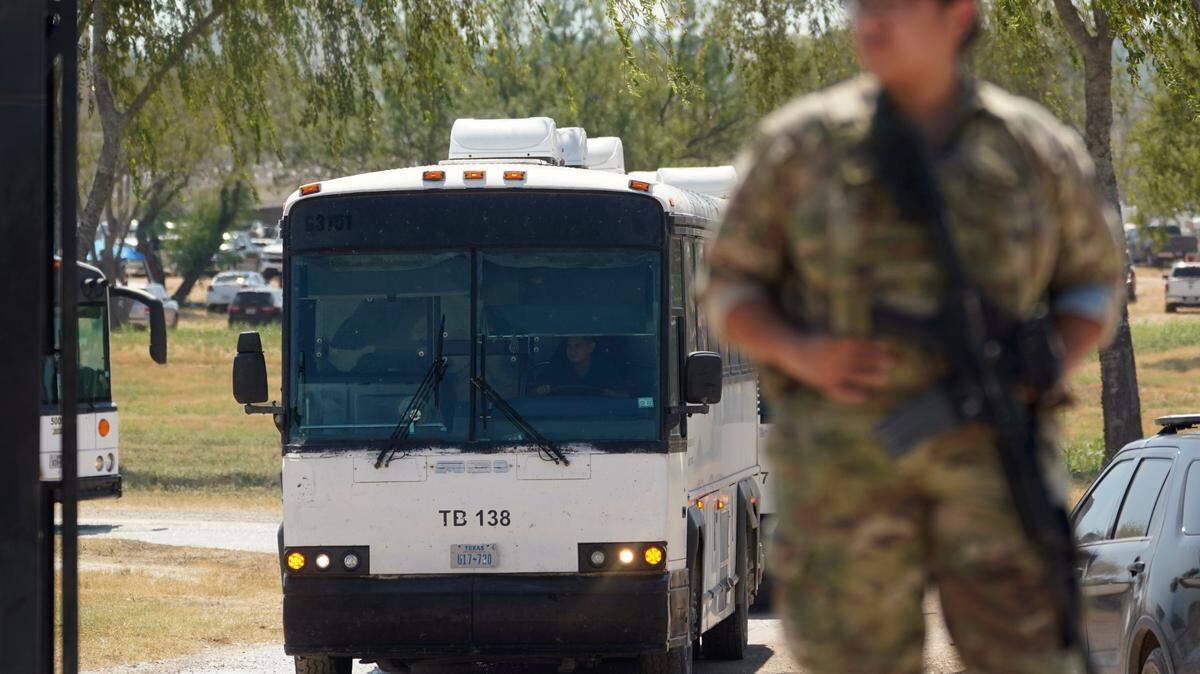
A group of Haitian migrants attempted to escape a Border Patrol bus transporting them from Del Rio to Brownsville, Texas, on Monday, according to Kleberg County Sheriff Richard Kirkpatrick.
Kirkpatrick told KIII-TV that Border Patrol agents were transporting the migrants on Highway 77 when they began fighting with agents to get off the bus.
The incident occurred around 4:30 p.m. on Monday, when the bus was about 25 miles outside of Kingsville. Border Patrol agents called local law enforcement for help, and the Kleberg County Sheriff’s Office were among the agencies that responded, KIII-TV reported.
“Well, I believe in an attempt to abscond into the brush or leave the area, these individuals were able to assault federal agents on the bus in an attempt to escape,” Kirkpatrick told KIII-TV.
He said a chase ensued after that, where authorities detained the migrants who escaped and put them on another prisoner transport bus. From there, the migrants were transported to Brownsville, KIII-TV reported.
Gov. Greg Abbott addressed the situation in Del Rio in a news conference Tuesday, saying that Texas is taking “unprecedented steps” to address the influx of migrants.
“We are arresting and jailing anyone who comes across the border illegally and trespasses on private property or on public land,” Abbott said, according to CBS DFW.
At the same news conference, National Border Patrol Council President Brandon Judd mentioned the migrants’ attempt to flee the bus and attributed the conditions in Del Rio to “catch and release,” a pejorative term to informally describe the practice of releasing migrants from U.S. custody while they await immigration proceedings instead of deporting or detaining them.
“Had we taken the proper steps, we wouldn’t be discussing this right now, today,” Judd said.
Immigration and Customs Enforcement, U.S. Customs and Border Protection, the Department of Homeland Security and the Kleberg County Sheriff’s Office did not immediately respond to requests for comment.
The incident comes days after the Biden administration announced plans to mass-deport Haitian migrants attempting to enter the U.S. through the port of entry in Del Rio.
Last week, thousands of migrants, mostly from Haiti, were gathered in a makeshift camp underneath a bridge in the border town of Del Rio, waiting to be processed by U.S. immigration officials.
In a statement issued Saturday, DHS said CBP would direct hundreds of agents and officers to the area, and that ICE and the Coast Guard would work with Border Patrol to move migrants to other processing locations.
The statement also said DHS would accelerate the process of deporting migrants by securing additional transportation to do so, including removal flights to Haiti and other destinations.
Federal immigration law states that anyone who is physically in the United States and is not a U.S. citizen is allowed to file for asylum within one year of arrival. However, migrants are still being expelled from the country under the Centers for Disease Control and Prevention’s Title 42 authority, which makes an exception to the asylum rule by saying that the Department of Health and Human Services can create and enforce regulations on which health conditions may make migrants inadmissible to the U.S.
Those who are not determined to have a legal basis to remain in the country and who cannot be expelled based on Title 42 will be placed in expedited removal proceedings, the statement from DHS said.
Title 42 has allowed expulsions to continue under the claim that they are helping mitigate the spread of COVID-19, BBC reported.
However, some experts have refuted the idea that unlawful immigration is boosting the spread of the virus, saying that, given the already extensive transmission of the virus within the U.S., adding immigrants to the picture is “akin to pouring a bucket of water into a swimming pool,” according to PolitiFact.
“It’s hard to measure and pretty trivial,” William Schaffner, a professor of preventive medicine at Vanderbilt University, told PolitiFact in August.
Haitian migrants hoping to enter the U.S. may now have to choose between attempting to remain in the U.S. and potentially being deported or returning to Mexico to await asylum proceedings. That’s a protocol the Biden administration attempted to dismantle earlier this year, but the U.S. Supreme Court let stand a judge’s order to reinstate the policy, The Associated Press reported.
This year has seen close to a 20-year high in the number of migrant apprehensions at the southern border, according to data released last week by CBP.
The increase in attempted migration to the U.S. may be triggered by destabilizing events and difficult conditions in the countries migrants are coming from, including Haiti, Venezuela, Ecuador, Brazil and others.
In particular, thousands of Haitian migrants have come to the U.S. not directly from Haiti, but from South American countries that they settled in following the country’s devastating 2010 earthquake, which killed as many as 300,000 people, The Washington Post reported.
Those migrants may now be leaving those countries because of the challenges they’ve faced there, including racism, poverty and language barriers, Houston Public Media reported.
Other migrants may have made the journey from Haiti because of significant events of the last few months, including the assassination of the country’s president in July and a 7.2 magnitude earthquake in August that killed more than 2,000 people and severely damaged multiple cities.
Non-Haitian migrants coming from countries like Venezuela, Ecuador and Brazil may be driven to do so because of “long-running economic devastation marked by blackouts and shortages of food and medicine” in their home countries, the AP reported in June.
This story was originally published September 21, 2021 at 5:27 PM.