
The US just had its coldest February in 30 years, data shows. Here’s how it happened
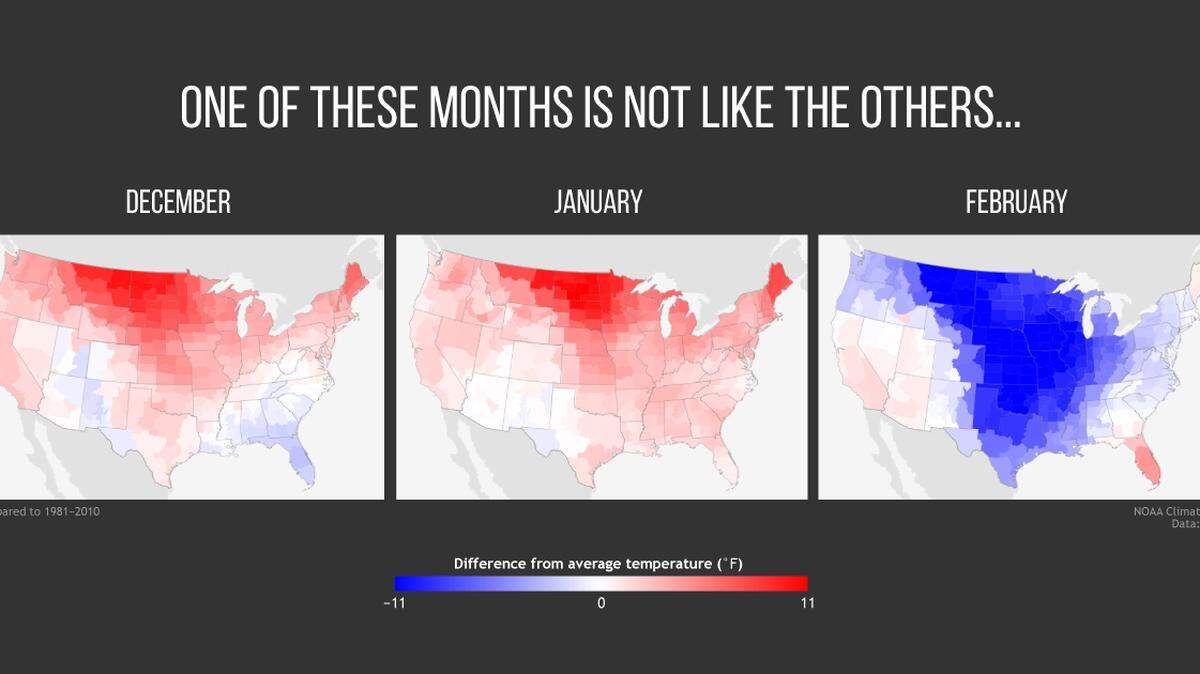
The United States just endured its coldest February in 30 years, and the National Oceanic and Atmospheric Administration blames a disruption in the jet stream that dropped temperatures to a brutal minus-50 degrees in some areas.
At one point (on Feb. 16), more than 73% of the lower 48 states had snow cover, topping “the historical record” set in October 2003, NOAA’s National Centers for Environmental Information reported this week
“During February, the average contiguous U.S. temperature was 30.6°F, 3.2°F below the 20th-century average,” the agency reported. “This ranked as the 19th-coldest February in the 127-year period of record and was the coldest February since 1989.”
Six states reported temperatures among their 10 coldest on record, including Nebraska, Iowa, Kansas, Missouri, Oklahoma and Arkansas, the report said.
The report singled out Texas as being among the hardest hit areas as a result of a winter storm that crossed the state Feb. 10-19. The region saw snow, ice and power outages impacting nearly 10 million people, the report noted. Austin and Waco “broke records for the longest freezing streak with temperatures below freezing between six and nine consecutive days,” NOAA reported.
Experts say the cold was driven by a “polar vortex” (known as an “Arctic Oscillation”) that brought a circulation of arctic air down across the lower 48 states, the report states.
“This may have been the result of a sudden stratospheric warming event that occurred in January,” the report states. “A blocking pattern disrupted the jet stream, which prolonged the duration of this cold event.”
Temperatures were 25 degrees below average Feb. 7-21 in the central part of the country, the report states. Among the coldest spots was Ely near Minnesota’s Canadian border, which saw −50 degrees Feb. 13- 14. “Several other stations in northern Minnesota reported low temperatures in the −40°F range,” the report said.
Even with the brutal cold, NOAA noted an overall trend of warmer winters is continuing. Taking December and January into account, the “average winter temperature was 33.6 degrees Fahrenheit, which is 1.4 degrees F warmer than average,” NOAA.gov reported.
Overall, the winter of 2020-21 ranks “in the warmest third of winters on record,” NOAA.gov said.
This story was originally published March 10, 2021 at 11:41 AM.