
Ancient amphibian revealed in horrific detail as eye sockets uncovered in Arizona lab
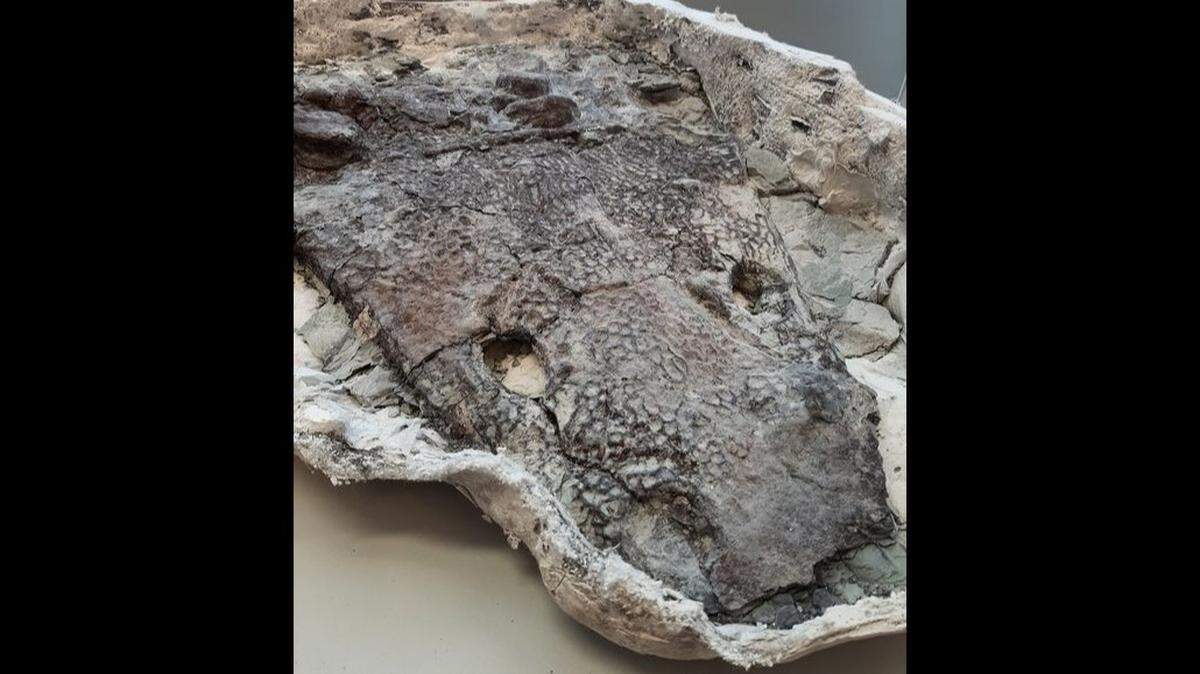
The well-preserved head of a giant Triassic Period amphibian came to life in horrific detail, when experts in an Arizona lab peeled away debris to find its mouth, nose and empty eye sockets.
Scarier still, the fossil skull has a texture resembling leathery skin.
“The eye sockets, or orbits, of this metoposaur skull were recently uncovered and suddenly the past was staring right back at us!” Petrified Forest National Park wrote on Facebook.
A photo shared by the park shows the fossil looking frighteningly like a dehydrated alligator, right down to the scales.
Metoposaurs were an “enormous, flat-headed, carnivorous amphibian” that grew to about 6 feet and roamed Arizona 200 million years ago, according to the National Park Service. “Though they dominated the Early to Middle Triassic rivers, most forms were extinct by the end of the period,” experts say.
Hundreds have reacted to the park’s photo, some expressing amazement at the skull’s life-like appearance, particularly the “skin texture.”
“I’ve always said that amphibians would be terrifying if they were human-sized. Then I ... saw the metoposaur,” wrote one commenter one the park’s Facebook page.
As for that “skin,” park officials noted looks are deceiving. “This is the bone itself,” the park wrote. “Unfortunately skin is not preserved but presumably (skin) sat over the bone and may have shown this texture.”
The skull was collected in 2017 from the park’s Blue Mesa Member site and “fossil preparators have slowly been removing the rock from the skull, vertebrae, and ribs,” officials wrote. The eyes were uncovered fully on Jan. 2. Park officials say it is one in a series of metoposaur skulls that have turned out to have clearly preserved eye sockets.
The Blue Mesa Member is made up of mudstones and sandstone beds dating 220-225 million years, the National Park Service says.
Petrified Forest National Park is well known for an abundance of plant and animal fossils from the Triassic Period. The park is about 110 miles southeast of Flagstaff.
“Exposed at Petrified Forest is one of the most continuous sections of Triassic-aged rocks anywhere in the world,” the NPS says. “These rocks were deposited by enormous rivers between 208 and 228 million years ago.”
New species are frequently discovered at the park, experts say. In October, it was announced that a strange “new species of a 220 million-year-old burrowing reptile known as a drepanosaur” had been found. Fossils of the species show it had “enlarged second claws, bird-like beaks, and tails ending with a claw.”
This story was originally published January 15, 2021 at 1:25 PM with the headline "Ancient amphibian revealed in horrific detail as eye sockets uncovered in Arizona lab."