
Mysterious lake that formed atop Hawaii volcano dies dramatically during eruption
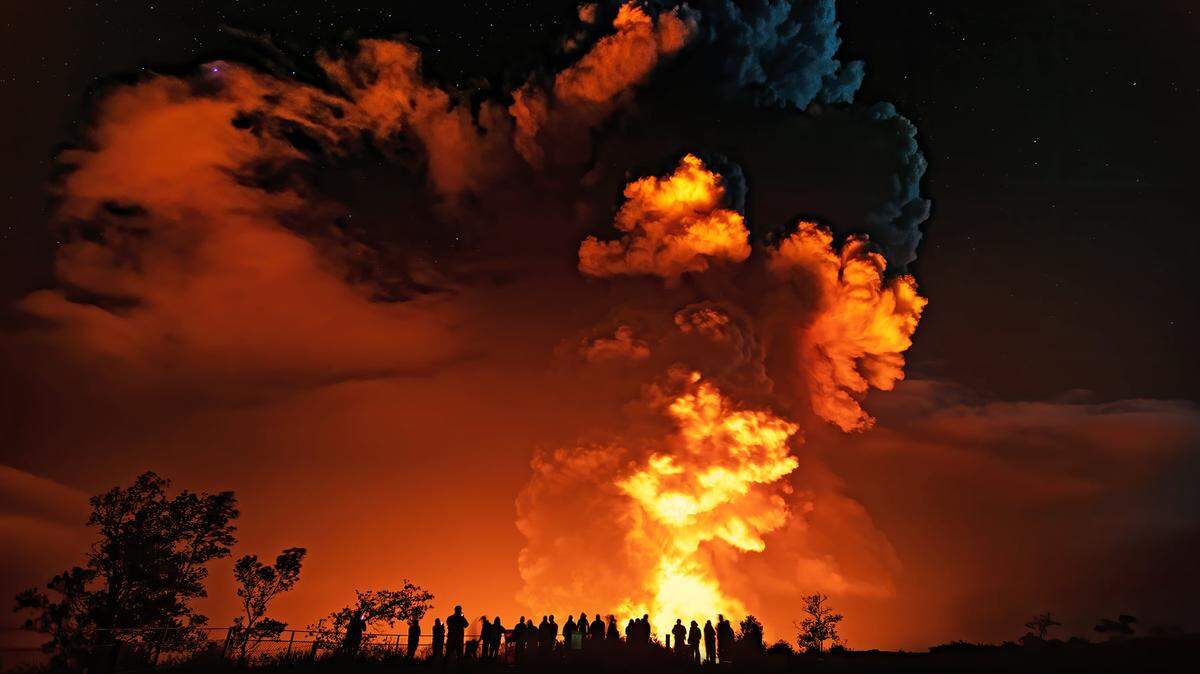
A mysterious super-heated lake that grew atop Hawaii’s Kilauea summit is no more, and its final moments were dramatic, with earthquakes and massive fountains of lava.
Kilauea’s summit erupted late Sunday, and the scalding water was quickly replaced with a 33-acre lake of lava, the U.S. Geological Survey reported early Monday.
It happened around 9:30 p.m. in Hawaii, when at least three fissures opened in the walls of Halemaumau crater, the USGS said. A thermal camera on the western end of crater showed the water exploded into flames.
“The lava cascaded into the summit water lake, boiling off the water and forming a new lava lake at the base of the crater,” the USGS reported.
“Lava coverage is deeper by 10 m (32 ft) or larger. ... The easternmost vent is currently exhibiting fountains up to approximately 50 m (164 ft) high. ... Occasion blasts of uncertain origin are occurring from lava lake surface.”
In all, 295 feet of lava has filled the base of crater by midday Monday, officials said.
The volcano is within Hawaii Volcanoes National Park. However, volcanic gas and ash particles are traveling downwind into neighboring areas. Warnings have been issued for people to stay indoors to avoid exposure.
Photos shared by the USGS on Facebook show “a steam and gas plume” rising from the crater as the lava “boiled off the summit water lake.” Earthquakes of 4.4 magnitude preceded the eruption.
On Wednesday, scientists reported “the lava lake rose 3 meters in 3.5 hours” and had filled about 440 feet of the bottom of Halemaumau crater. “This is more than double the depth of the water lake that was in the crater until the evening of Dec. 20 when it was vaporized,” the USGS reported..
The main part of the volcano’s caldera sank by nearly two inches during the eruption, suggesting the magma drainage came from a shallow reservoir “within a few kilometers of the surface,” experts say.
The water lake
The crater’s lake of water began forming 17 months ago after a 2018 eruption, and was considered one of the world’s deadliest bodies of water: 154 feet deep and a skin-scalding 185 degrees. To put that in perspective, water at 154 degrees “instantaneously” scalds human skin, according to Hotwaterlab.com.
It baffled scientists who recently noted the water was changing color by the minute and showing signs of motion — traits some experts attributed to a possible eruption on the horizon, McClatchy News reported last month.
Scientists theorized the lake was growing because the crater’s floor fell low enough to put it below the water table, NASA says.
Crater lakes are worrisome because “magma interacting with near-surface water can, in some circumstances, trigger steam-blast explosions,” the USGS reports.
This story was originally published December 21, 2020 at 5:40 AM with the headline "Mysterious lake that formed atop Hawaii volcano dies dramatically during eruption."