This Texas A&M Russia expert worked with Gorbachev and met Putin. What he says about Ukraine
If a Russian babushka notices her young neighbor wasting away, there’s a good chance she will try to feed him.
That’s how an Iranian-American teenager living in Israel in 1990 became one of the preeminent scholars of Russian legal culture by the time he finished law school in 1997.
Well, it’s not the whole story, but that’s how it started.
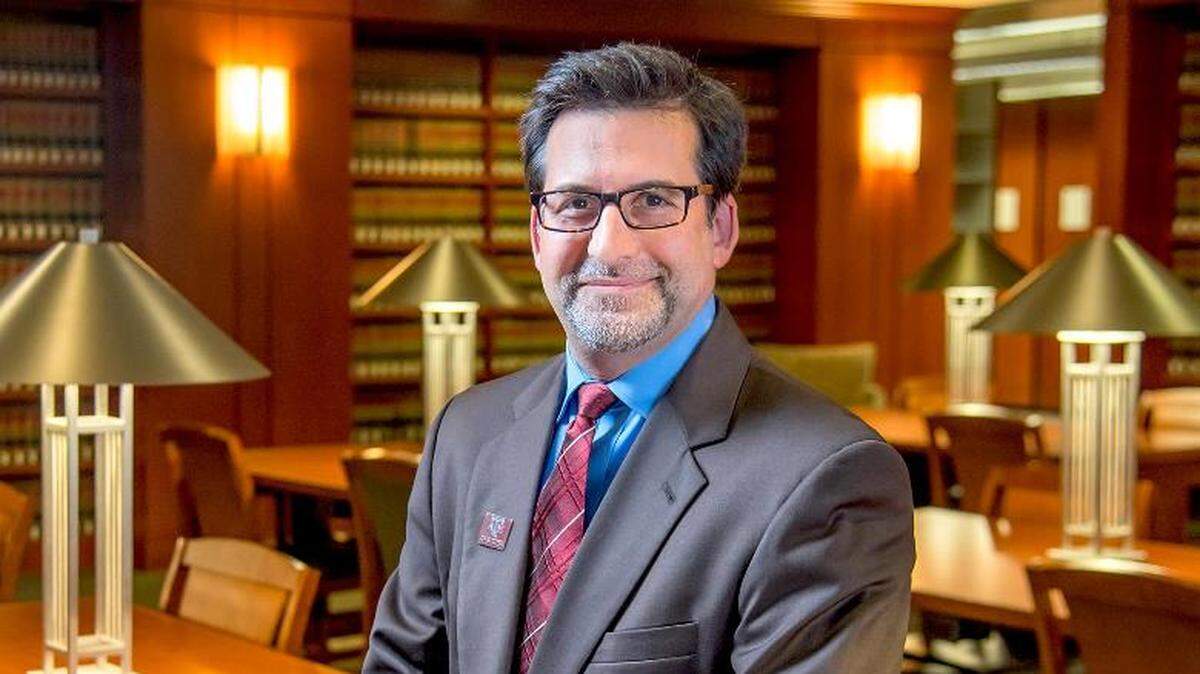
Robert Ahdieh, 50, now the Dean and Anthony G. Buzbee Endowed Dean’s Chair of Texas A&M University Law School, traveled to Israel after graduating high school where he lived among Russian Jews emigrating from the Soviet Union.
It was his first time living away from home, and he didn’t know how to cook. He quickly lost weight, and his neighbors noticed.
Sustained by bowls of homemade borscht and his first experience of Russian hospitality, he learned some Russian and eventually fell in love with the country at a critical juncture in its history.
He loved the people, their warmth, their sense of humor, the fact that anyone with a Russian education could recite some Pushkin.
Ahdieh’s “don’t assume you can’t” approach to his studies of Russian and Soviet life — along with some timing and luck — resulted in his brushing shoulders with some of the country’s most notable and notorious people, including Mikhail Gorbachev and Vladimir Putin.
His love of Russian culture and Russian people never waned, but his professional interest in the country’s legal system did as it became clear that power, rather than law, would form the basis of society in this fledgling country.
Twenty-five years later from his office in Fort Worth, he’s watching the consequences of early Russian state-making play out in Ukraine.
The fall of 1991
Ahdieh’s arrival in Moscow for his first semester as a Princeton student coincided with a failed coup to take control of the government from then-president Mikhail Gorbachev.
When Ahdieh flew back to the states in December, the Soviet Union no longer existed.
Understanding the significance of the live history he witnessed, he asked the young Soviet soldier at customs if he could have the passport stamp of the now-defunct country. The officer said yes.
At the time of the attempted coup, Gorbachev was multiple years into introducing capitalist market principles into Soviet life.
In an economy dictated by central planning, perestroika brought increased automation and allowed farmers and manufacturers to determine output and set their own prices, which many Soviets could not afford.
“He wanted to instill within a structure values that the structure itself would spit out,” Ahdieh explained.
Aimed at increasing Soviet economic efficiency, perestroika -- and by extension, Gorbachev -- was instead credited with creating food shortages and precipitating the collapse of the Soviet empire.
“He’s a complicated guy,” Ahdieh said. “He was not trying to destroy the Soviet Union. That was not the aspiration. He was trying to reform it.”
Despite the extreme hubris necessary to believe he and the system could accommodate such radical change, Ahdieh noted, “Everything I saw of him, and I’m saying this from a distance, was quite sincere.”
Ahdieh’s insight into Gorbachev’s motivations is in large part owed to his working relationship with the final Soviet leader starting in 1993.
Getting in with Gorbachev
One of Ahdieh’s Russian teachers at Princeton once told him he would never fully learn the language.
A few years later, a signed photograph of her student and Mikhail Gorbachev hung on the wall in her office. In his note, Gorbachev assured the teacher that Ahdieh’s command of Russian language was excellent.
During his undergraduate studies, Adhieh spent about every other semester in Moscow studying at MGIMO, Moscow State Institute of International Relations.
Most international students at the time likely studied at MGU, Moscow State University. But MGIMO was like “the last bastion of the right wing,” Ahdieh described.
“And so I thought, ‘Hell, if I’m going to go, those are the people I want to talk to.’”
Ahdieh set his sights on an internship at former president Gorbachev’s foundation, but struggled to get an in with his translator, Pavel Palazhchenko.
Back at Princeton, he learned Gorbachev had a speaking engagement at the University of Pennsylvania and drove the hour to try to get some face time with him at the event. He managed to get through security and found the last Soviet leader alone, backstage.
He left with Gorbachev’s personal fax number.
Slavic superstate
As an intern at the Gorbachev Foundation, Ahdieh conducted interviews with prominent politicians and researched the country’s transition to legalism.
When Ahdieh met Vladimir Putin in the mid-1990s, the world’s most famous 21st century despot “wasn’t a thing.”
He was a strangely formal reformer espousing the benefits of a “middle way,” akin to Gorbachev’s attempt to restructure Soviet society from within.
Fast forward 25 years, and he’s playing out a crisis of sovereignty on the world stage.
Of course, the invasion of Ukraine in February 2022 isn’t Putin’s first violation of sovereignty.
Putin invaded Georgia in 2008; two Georgian regions remain occupied by Russia. He invaded and annexed Ukrainian Crimea in 2014.
In fact, Putin has described the fall of the Soviet Union in December 1991 as “the disintegration of historical Russia.”
His goal of, as Ahdieh described it, “a Slavic superstate” is the predicate of a sentence that began with the fall of the Soviet Union.
It’s the balm to a shared national wound of humiliation, the public shame of a rapid collapse. The country’s right wing was able to harness this collective grievance and put a spin on it: “They have taken our dignity from us.”
After the collapse of the Soviet Union, Ahdieh said, “A Russian would say, ‘They have made us into Ghana.’”
Implications of invasion
In light of this powerful sentiment, Russia experts and armchair political sciences are currently debating on Twitter whether the invasion of Russia’s eastern neighbor was inevitable.
But, Ahdieh maintains, “the trouble with the moment is that there is almost no coherent theory.”
“Not a lot of people who know Ukrainian history and who have followed how it played out during World Wars would have said, ‘Ukraine will roll over,’” said Ahdieh. “The idea that they would put up a hell of a fight? I don’t think that was rocket science.”
Rather, the rational, predictable part of this conflict was that it would be bloody and reflect poorly on Russia, he said.
Not only does the invasion publicly flout the notion of sovereignty, but it also spells trouble for Russia’s vulnerable neighbors.
“If it’s not rational -- and to be clear, it would be utter insanity for Russia to move into Estonia, Lithuania, Latvia -- how is that different from the current moment?” Ahdieh asked.
‘Back to the Stone Age’
In Ahdieh’s second year of law school, his undergraduate thesis on Russian legal culture was published as a book.
In Russia’s Constitutional Revolution: Legal Consciousness and the Transition to Democracy, 1985-1996, a hopeful Ahdieh argued the development of Russian legal culture is critical to the success of the country’s transition to democracy.
Russia’s constitutionalism will only result from an “evolution from below,” he concluded.
That’s not what happened.
When constitutional institutions were rapidly introduced, “People had no experience of the law as a tool for leveling. Their only experience of the law is as a tool for abuse. The law is used against you,” he said.
As the dean of a Texas law school, Ahdieh doesn’t get many opportunities to practice his Russian these days.
While he loves to travel back to the complicated civilization that stole his heart in the early 1990s, his love of Russia quickly diverged from his professional path to legal education.
When Putin came to power, “law was less and less the coin of the realm,” he said.
But, Ahdieh said, unlike China, Russia has experienced relative freedom for more than 30 years. Until recently, Russians had fairly unfettered access to apps like Instagram and WhatsApp. On the other hand, Russians who remember the vision of the Soviet Union are now middle-aged.
He asks, where is the glory in being unable to access the internet, use banking systems and travel abroad?
Due to restrictions imposed as a result of the invasion of Ukraine, “they’re literally going back to sort of the Stone Age,” said Ahdieh.
With a population “more willing to die” as Ahdieh described the Russians, “if it continues in the direction it’s going, I’ve got to believe that this has the potential to be a wake-up call that we are perhaps going astray.”
This story was originally published March 17, 2022 at 5:30 AM.