
Feds propose rules for the era of drones
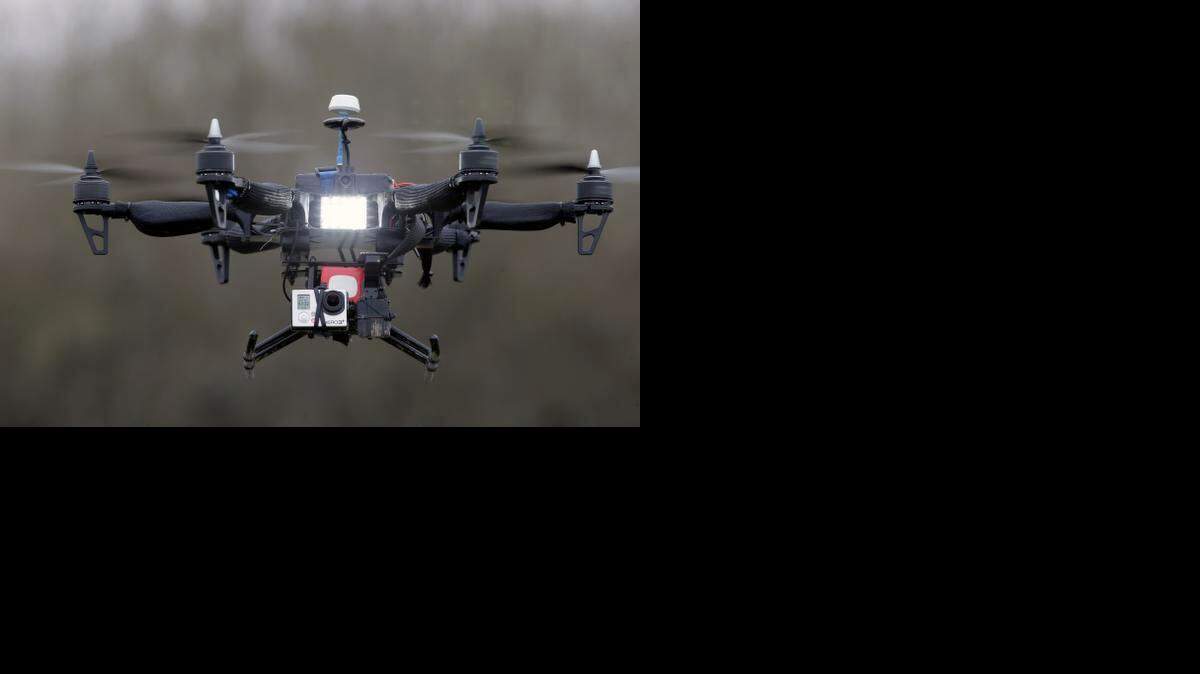
Drone on, the government says.
Just not through the night sky. Or close to an airport. Or out of the operator’s sight.
Long-anticipated rules proposed Sunday will open an era in which small (under 55 pounds) commercial unmanned aircraft perform routine tasks – crop monitoring, aerial photography, inspections of bridges and cell towers, and much more.
But not right away. Final rules are probably two to three years away.
And when they are in place, they may include a separate category with fewer restrictions for very small drones, likely to be defined as less than 4.4 pounds.
The Federal Aviation Administration released a variety of proposed requirements for commercial operators to meet, such as passing a knowledge test administered by the agency as well as a federal security check.
The small drones could travel as fast as 100 mph, at altitudes of 500 feet or lower. Flights over crowds would be prohibited.
“We have tried to be flexible in writing these rules,” FAA Administrator Michael Huerta said. “We want to maintain today’s outstanding level of aviation safety without placing an undue regulatory burden on an emerging industry.”
The agency is researching technology that he hopes will eventually enable small drones to fly safely beyond the sight of operators, Huerta said.
He emphasized that introduction of commercial drones into the national airspace will be a staged process. The government is also looking ahead to how larger drones might be allowed to fly in airspace shared by manned aircraft, for example, he said.
One of the key safety concerns is that without a human on board the ability to “see and avoid” other aircraft is limited.
Another concern is that the link between the operator and a remote control aircraft can be broken, causing the drone to fly away until it loses power or collides with something.
Cases of flyaway drones getting stuck in trees or hitting buildings are commonplace. Last month, a drone that its operator lost control of flew over the White House fence and crashed on the lawn before Secret Service agents could block it.
Even with the proposed safety restrictions, drones can transform urban infrastructure management, farming, public safety, coastal security, military training, search and rescue, disaster response and more, the White House said in a presidential memorandum on privacy released in conjunction with the rules.
The memorandum lays out measures federal agencies must follow to guard against abuse of data collected in their drone flights.
Among other steps, the order requires agencies to review privacy and civil-rights protections before deploying drone technology and to adhere to a range of controls.
Personally identifiable information collected in drone flights is to be kept no longer than 180 days, although there are exceptions.
It’s questionable whether such steps will satisfy civil liberties advocates, who’ve objected strongly to the government’s vigorous use of digital surveillance in the name of national security.
But drone advocates were generally happy with the proposal, although they disagreed with some of the details.
“I am very pleased to see a much more reasonable approach to future regulation than many feared,” said Brendan Schulman, a New York attorney who unsuccessfully challenged FAA restrictions on drone flights.
The agency currently bans commercial drone flights except for a few dozen companies that have been granted waivers. That ban will stay in place until regulations become final, but FAA officials plan to continue granting waivers case by case. About 300 waiver requests are pending, and new requests are being filed almost daily.
The proposed rules are “a good first step” bringing the U.S. closer to realizing the benefits of drone technology, said Brian Wynne, president and CEO of the Association for Unmanned Vehicle Systems International, a trade group.
A look at proposed drone rules
Some highlights of rules proposed Sunday on routine flights by small commercial drones and on privacy protections when the government uses drones to collect information:
Drone flights
▪ Proposed Federal Aviation Administration regulations would permit commercial operation of remote-controlled aircraft weighing less than 55 pounds. They would be permitted to fly up to 100 mph and up to 500 feet in altitude.
▪ Operators would have to pass an FAA test of aeronautical knowledge and a Transportation Security Administration background check.
▪ Only one operator would be required instead of an operator and a spotter to keep watch for other aircraft, another concession.
▪ Operators would have to keep drones within eyesight at all times, which significantly limits the distance they can fly. The restriction would probably prevent drone delivery as proposed by Amazon.
▪ Flights would be prohibited within 5 miles of an airport and over crowds
▪ Drones would not be required to have an FAA airworthiness certificate similar to those required of manned aircraft, another concession. However, they would have to be registered with the FAA and would receive an “N number” for identification purposes similar to the numbers on airplane tails.
Privacy
▪ A presidential memorandum requires federal agencies to ensure that policies are in place to protect against any abusive use of government drones.
▪ The policies should “prohibit the collection, use, retention, or dissemination of data in any manner that would violate the First Amendment or in any manner that would discriminate against persons based upon their ethnicity, race, gender, national origin, religion, sexual orientation, or gender identity, in violation of law.”
▪ Agencies must publish information within one year describing how to access their drone policies and procedures.
— The Associated Press
This story was originally published February 16, 2015 at 8:10 AM with the headline "Feds propose rules for the era of drones."