
Fort Worth adds urban parks to draft master plan
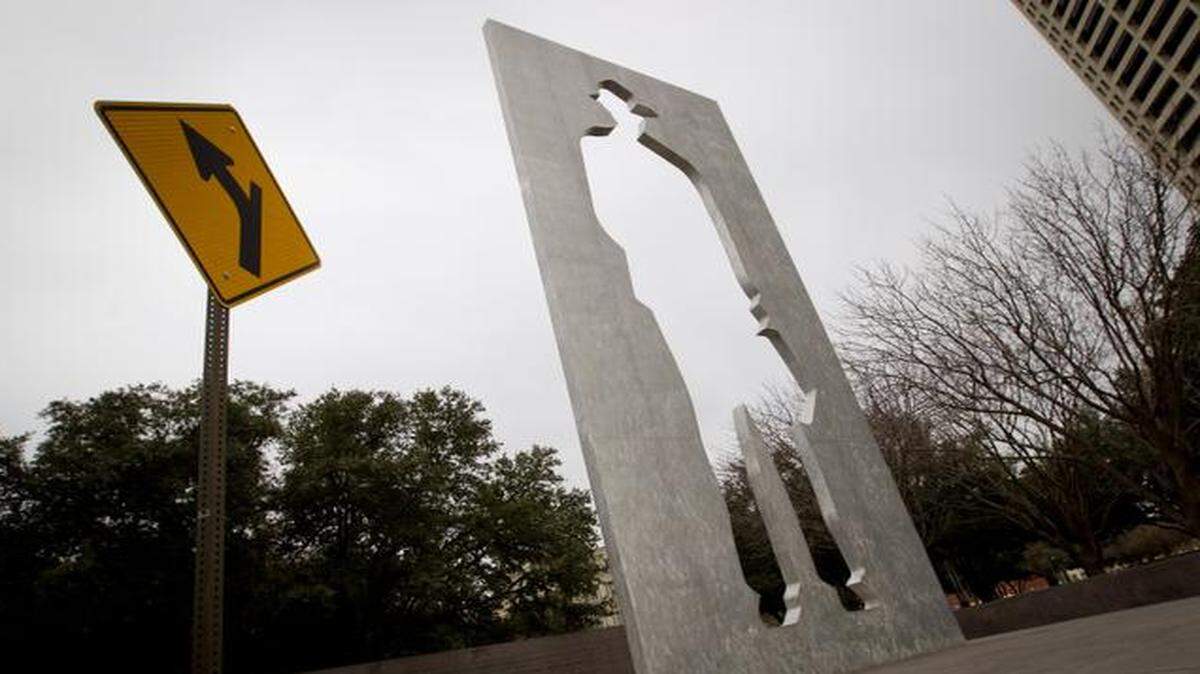
On a pretty day, little Burnett Park — surrounded by high-rise office buildings and bustling streets downtown — is brimming with people seeking a little calm.
Men and women in business suits crowd the bistro-style tables and the long granite benches during lunchtime, soaking up a few minutes of sunshine on a busy workday.
Kids play on the nearby jungle gym under the cover of shade trees. A lawn, used for concerts, as a launching spot for community bike rides, and for yoga and other events, is in the center of the 3-acre park.
Burnett Park, a classic example of an urban park, is the newest type of social gathering place the city hopes to develop in coming years, said Joel McElhany, capital projects and infrastructure manager for the parks department.
“It is just hard to get 5 acres — or even 1 acre — in the central city, with the higher cost of land and the scarcity of land,” McElhany said.
Urban parks, which aren’t limited to green space but can include plazas and be as small as a residential lot, are the newest type of park defined in Fort Worth’s 2015 draft parks master plan.
Previously, the smallest size for a park in the master plan was a “pocket park,” between 1 and 5 acres. That mini-size park was added to the city’s plans in 2004, but even it wasn’t small enough to meet the needs of the city’s densest areas.
The central city — everything within Loop 820 — needs an additional 480 acres of neighborhood parks, or the smaller parks of up to 30 acres. The central city is overserved in larger community parks, like Gateway Park, which is 635 acres, and Trinity Park, which is 252 acres.
Mike Brennan, director of planning for Fort Worth South Inc., was an advocate for adding the urban park designation to the plan to develop more parks in the central city.
“In our more dense urban village areas, a 1-acre park is still a very large facility,” Brennan said. “We need for the city’s parks policy to acknowledge the key role that these urban parks play and open up the possibility for the development of additional urban parks.
“Without that definition included, we don’t really see the possibility of partnering with the city on future development of these key urban parks.”
Though privately owned, Sundance Square Plaza is a “gold-plated example” of an urban park, he said.
“It is just an excellent space, but if a similar space were to be proposed elsewhere in the central city and be developed as a public plaza, the current park policy wouldn’t allow for the development of that type of space,” Brennan said.
Councilwoman Ann Zadeh, who represents downtown, the near south side and other central-city areas, said another advantage of the new classification is the broad definition of an urban park, which is more about “having a sense of place.”
“When you think of a park, you think big, green open space. But a park doesn’t have always to be big and green. It can be a small plaza or some other place for the community to gather,” she said.
One park redesignated as an urban park in the draft plan is the 2.5 acres in the middle of Blue Bonnet Circle. Zadeh’s hope is for that green space to be utilized more by making the traffic circle pedestrian-friendly.
Councilwoman Gyna Bivens, who has been advocating for more parkland in east Fort Worth, which is under-served, said she hopes the new designation will make it easier for the city to scatter more parks in her district.
“It brings back to me the days and times when I grew up in the 1960s and everyone knew everyone. We all gathered at Bunch Park, and we no longer have that,” Bivens said. “Parks just have so many benefits — socialization, getting to know your neighbors, being able to walk around in your neighborhood, health.”
The city has an acquisition policy meant to keep pace with rapid development: 2.5 acres for neighborhood parks per 1,000 people in a development and 3.75 acres for community parks per 1,000 people. The developments are required to front the initial fees to get the parks ready.
For inner-city developments, in lieu of acreage, the fee is $500 per dwelling to acquire and develop land.
But the parks department is still behind, according to the draft master plan.
Outside of Loop 820:
▪ To the south, residents need 61 more acres of parkland in 2015. With the expected population boom in that area, it will need 329 more acres by 2025.
▪ To the west, the city is ahead in parkland. The area needs to acquire 10 more acres by 2025.
▪ To the east, residents need 179 more acres of land and will need 245 more by 2025.
▪ To the north, the city needs 55 acres of parkland now and will need 409 more acres by 2025.
“Like transportation with the growth of the city, it is hard to keep up,” Councilman Danny Scarth said when the plan was presented to the council. “I think our city has outgrown, in some cases, our ability to provide recreational opportunities.”
Also in the draft plan, set to be approved by the council Jan. 27, the city has added dog parks, skate parks, swimming pools and universal playgrounds to each of the five park planning districts — the central city and north, south, east and west Fort Worth.
Caty Hirst, 817-390-7984
This story was originally published January 10, 2015 at 11:27 AM with the headline "Fort Worth adds urban parks to draft master plan."