
Former TCU professor, Masonic Home Mighty Mite dies
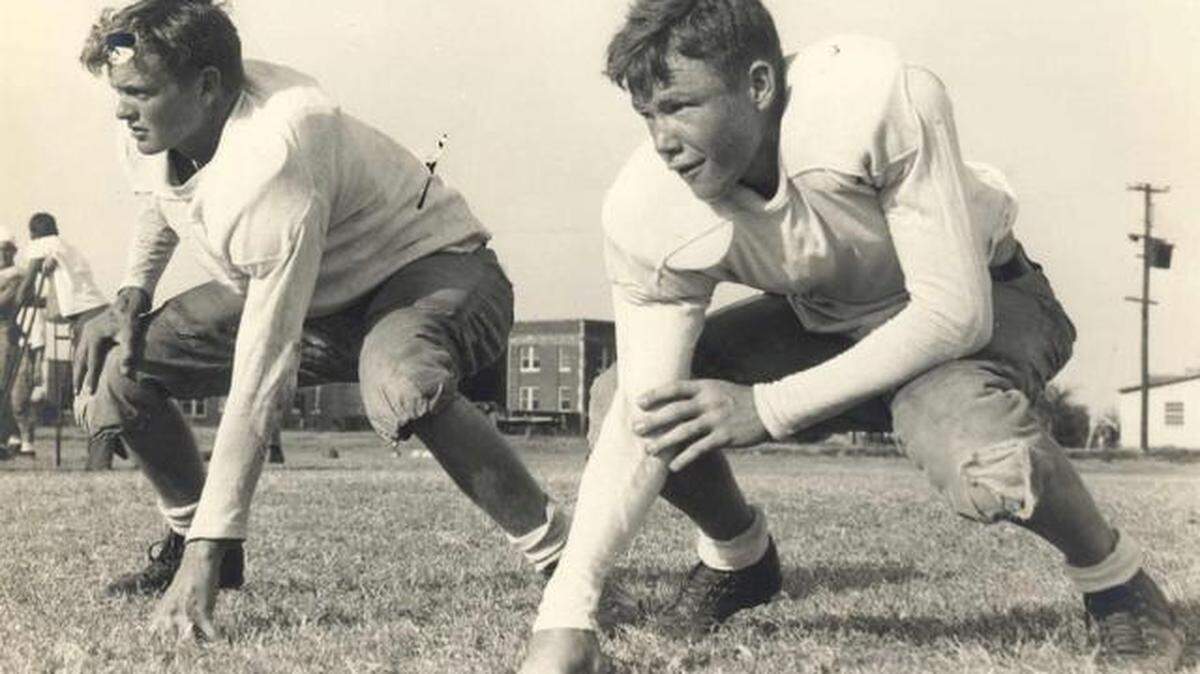
When he was a few months away from high school graduation, Miller Moseley’s football coach wrote him a letter.
You have a bright future, young man. Everyone is pulling for you.
For the next 75 years or so, Mr. Moseley, who died Wednesday at age 92, would make a prophet of his mentor. A talented mathematician, he was valedictorian of his class at the Fort Worth Masonic Home, then went to TCU on scholarship and finished at the top of his class there, too.
He took his undergraduate degree in physics and chemistry to the University of North Carolina at Chapel Hill and began working toward a doctorate under the guidance of Nathan Rosen, a collaborator of Albert Einstein’s. When Einstein asked Rosen to join his team for the Manhattan Project, Rosen took his prized pupil with him.
After the war, Mr. Moseley finished his doctorate and returned to Fort Worth, where he landed a job teaching at TCU. Except for a year’s sabbatical doing research at Oak Ridge National Laboratory in 1957-58, he would hold the job until his retirement in 1990.
None of it might have happened if not for that football coach, Rusty Russell, the legendary leader of the Masonic Home’s “Mighty Mites,” who, playing on undersized but overachieving squads, went toe-to-toe with the state’s powerhouses in the 1930s and early ’40s, capturing the nation’s heart along the way.
Mr. Moseley was 7 when his father died and his mother sent him and his brother and sister to live at the home on the city’s southeast side.
Growing up there would be a “transformative experience” for the siblings, who were from the Wichita Falls area, said Tom Kellam, Mr. Moseley’s nephew and the archivist for the Tarrant County College District.
“It was a huge thing that changed their lives,” said Kellam, whose mother was Mr. Moseley’s sister. “They never would have had the opportunities they had without it. They probably wouldn’t have been able to go to college.”
Mr. Moseley, who even among a roster of smaller players was one of the smallest, at 5-foot-8 and 124 pounds, was one of Russell’s favorite players, according to Jim Dent’s 2007 bestseller Twelve Mighty Orphans.
“You might just be the toughest football player in the state,” Russell wrote in that same letter to Mr. Moseley. “But what is most impressive about you is your drive in the classroom. Teachers at the Masonic Home have never seen a brighter student. I doubt you will find a better math student anywhere than Miller Moseley.”
On the field, Mr. Moseley was a nimble end, Dent wrote, who “slashed between defenders as if his feet were strapped to roller skates.”
He was often the target in the short passing game that Russell devised to help his diminutive players gain an advantage over larger opponents.
Mr. Moseley was diagnosed with Parkinson’s disease several years ago, relatives said, and his health had been deteriorating for about eight months.
Though he wasn’t one to draw attention to himself, said stepdaughter Karen Messick of Hurst, he would talk about the home and his playing days when asked. Mostly his wife and children knew him as a loving parent who “never raised his voice, never cussed and was always calm and level-headed,” she said.
He “provided a safe, secure home for us after our father died,” Messick said. “He never tried to take his place in our lives.”
Later, when Mr. Moseley became a doting grandfather, he “really came alive,” she said. “He was [his grandchildren’s] only Pop-Pop, and they loved him dearly.”
On Wednesday, Dent described Mr. Moseley as “one of the most remarkable people in the history of Fort Worth, Texas.”
“Without this man, some of the nation’s history might not have happened,” Dent said. “He was just deep.”
Survivors include his wife of 47 years, Doreen Moseley; sister, Dorothy Kellam; stepdaughters Denise Burgess and Cheryl Castells; six grandchildren; two great-granddaughters; and one great-great-granddaughter.
This story was originally published September 11, 2014 at 12:19 PM.