Cesar Chavez Day events cancelled across US after ‘crushing’ sexual abuse report
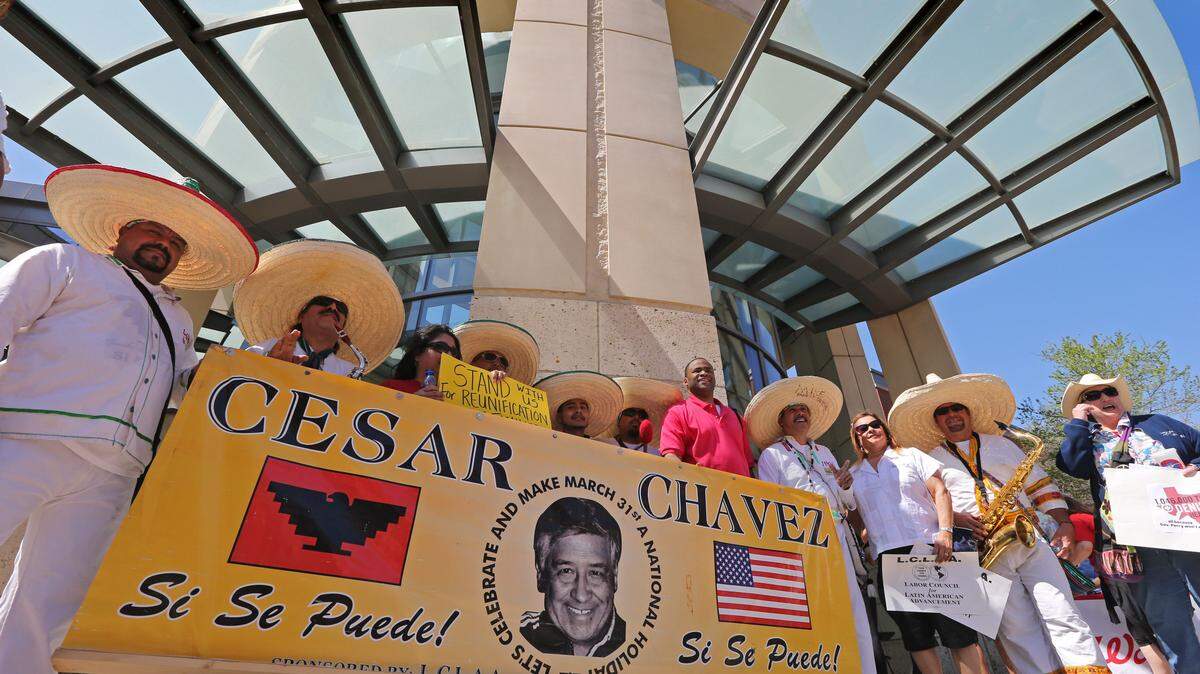
Newly uncovered allegations that Cesar Chavez, the farming labor leader, sexually assaulted minors decades ago are prompting cancellations of annual celebrations of his March 31 birthday, which is a federal holiday.
United Farm Workers, the union he and Dolores Huerta founded, said this week it will not take part in any Cesar Chavez Day activities due to the “deeply troubling” abuse allegations. A New York Times investigation published Wednesday revealed Chavez, who died in 1993, groomed and assaulted girls for years who were connected to the movement. Huerta told the newspaper she was assaulted by Chavez in the 1960s.
The union said it doesn’t have direct reports or firsthand knowledge of the allegations.
“However, the allegations are serious enough that we feel compelled to take urgent steps to learn more and provide space for people who may have been victimized to find support and to share their stories if that is what they choose,” the statement said.
In Fort Worth, the Cesar Chavez & Dolores Huerta Committee of Tarrant County formed in 2016 with a mission to promote education, social justice, the community and civil rights. On Thursday, the organization — led for the most part by women — said it will continue its work “rooted in integrity, dignity, innovation, and a Sí Se Puede attitude.” It is removing Chavez from its name.
“We support survivors and reject abusers in any form in our movement. Until we have time to permanently rebrand our organization, we will be temporarily represented as the ¡Sí Se Puede! Committee of Tarrant County,” the group posted on social media.
In Texas and across the country, Chavez’s name is on schools, streets, neighborhoods, buildings, universities and parks. Fort Worth has Cesar Chavez Primary School in Diamond Hill. Downtown Dallas has a boulevard. In Texas, Cesar Chavez Day has been considered an optional state holiday, though Gov. Greg Abbott said Wednesday that’s coming to an end.
Huerta issued a statement Wednesday morning:
“I am telling my story because the New York Times has indicated that I was not the only one — there were others. Women are coming forward, sharing that they were sexually abused and assaulted by Cesar when they were girls and teenagers,” she said. “The knowledge that he hurt young girls sickens me. My heart aches for everyone who suffered alone and in silence for years. There are no words strong enough to condemn those deplorable actions that he did. Cesar’s actions do not reflect the values of our community and our movement.”
“I have kept this secret long enough. My silence ends here,” she added.
Chávez was born in Yuma, Arizona, as a first-generation Mexican American.
After leaving the Community Service Organization in 1962, Chavez and Huerta helped found the National Farm Workers Association, which later merged with the Agricultural Workers Organizing Committee to become the United Farm Workers.
United Farm Workers aims to empower migrant workers through nonviolent tactics to have livable wages and safe working conditions.
A strike by grape growers in Delano, California, that began in 1965 was a major victory. It lasted for five years, and workers endured a 340-mile march from Delano to Sacramento to draw attention to their plight. By 1970, 26 grape growing corporations signed contracts with the United Farm Workers, resulting in better wages, working conditions, unemployment insurance, paid vacation days and other benefits.
It led to the California Agricultural Labor Relations Act of 1975, the first law guaranteeing collective bargaining for farm workers.
Chavez died on April 13, 1993, and in the following year was posthumously awarded the Presidential Medal of Freedom, the highest civilian award of the United States, by President Clinton.
In 2018, Fort Worth ISD voted unanimously to add a new holiday, César Chávez-Dolores Huerta Day, which is observed annually on the Monday before Chávez’s birthday on March 31.
This story was originally published March 18, 2026 at 11:33 AM.