Fort Worth leaders decry hate as report finds ‘unprecedented’ levels of antisemitism
Antisemitism in the United States reached new highs in 2024, according a report from the American Jewish Committee.
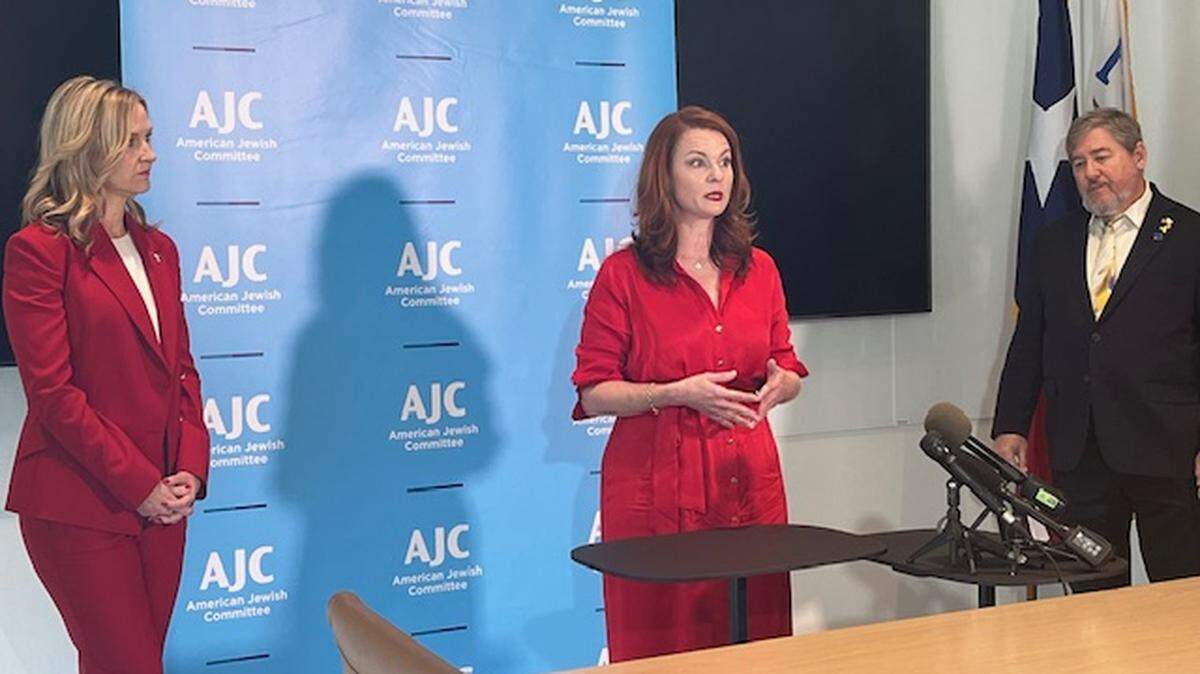
The committee presented its annual State of Antisemitism in America 2024 Report during a press conference March 5 at Fort Worth City Hall. The report, released in February, highlighted a significant rise in antisemitic incidents in the U.S. since 2019.
“Antisemitism in America has reached new unprecedented levels,” Joel Schwitzer, American Jewish Committee Dallas Director, said. “For the first time in the history of our State of Antisemitism in America Report, a majority of American Jews, 56%, report changing their behavior out of fear of antisemitism.”
The report found that 77% of American Jews say they feel less safe as a Jewish person in the U.S. because of the Oct. 7, 2023, Hamas terrorist attacks. It also found 90% of American Jews say antisemitism in the U.S. has increased at least somewhat since the attacks and 33% of American Jews say they have been the personal target of antisemitism.
The report found that 4 in 10 (41%) American Jews 18 to 29 said they have been the target of antisemitism at least once in the past 12 months. The report says 35% of American Jewish college students report experiencing antisemitism at least once during their time on campus.
Schwitzer added 48% of U.S. Jewish college students report changing their behavior out of fear of antisemitism. This means they’re not wearing yarmulkes or the Star of David or they’re avoiding certain campus events, whether it’s religious services or just general campus gatherings.
The report stated 81% of American Jews say that caring about Israel is central to their Jewish identity. Additionally, 85% of American Jews and the general public believe the statement “Israel has no right to exist” — the foundational core of anti-Zionism — is antisemitic.
Fort Worth Mayor Mattie Parker and city council members Elizabeth Beck and Carlos Flores attended to show their support of the Jewish community.
“There is no room for antisemitism, no matter how small or how large a gesture it may be,” Parker said. “The statistics in this AJC report should be sobering to us.”
Beck, who is Jewish, said it hasn’t always been the case for her to to openly practice her faith.
When she served in Iraq in 2005 as an Army reservist, every denomination communicated its services by flyers on bulletin boards across the base. This was not the case for the Jewish faith, she said, because United States military didn’t think it could keep Jewish people safe if they advertised where they worshiped. This is not the case for Fort Worth, Beck said.
“In Fort Worth, Texas, I can stand next to my rabbi, I can proudly go to services on a Friday night and know that I’m going to be OK,” Beck said. “And the reason that we have that here in Fort Worth is because we have a mayor and council and leaders that speak out against antisemitism, because what we know is that hate against one is hate against all.”
Schwitzer says antisemitism had been on the upstick before Oct. 7. He brought up antisemitic attacks in the last few years such as the Poway synagogue shooting in 2019 that killed one person and injured three in Poway, California, a Austin synagogue being set on fire in 2021, and the Colleyville synagogue hostage crisis at Congregation Beth Israel in 2022.
Schwitzer mentioned at the end of the press conference that this is not a zero sum game. People can be supportive of both the Jewish community and their Arab, Muslim or Palestinian community. They can be against a woman who tried to drown Palestinian children in Euless while also condemning people protesting with swastikas and Nazi regalia outside of Temple Emanu-El, one of the largest synagogues in the South.
“It is important to debunk this myth that you have to choose a side, the side is humankind and standing against hate,” Schwitzer said.