
At TCU, the ‘best of the best’ cowboys are learning the ins and outs of ranching
Fort Worth may be Cowtown, but you’d be hard pressed to find much agrarian about it these days.
The population is booming, and commercial and residential developments are popping up like wildflowers on the once-virgin prairie. But in a small brick-and-stone building at the intersection of Stadium Drive and Cantey Street, in the midst of the hubbub and growth on TCU’s campus, students are keeping an age-old — and very Fort Worth — way of life going, albeit with a forward-thinking approach.
Since its inception in 1956, TCU’s Ranch Management program has helped develop generations of livestock producers. Many of the students over the years have come to Fort Worth from ranching families, long on cow sense but short on business sense, at least the kind it takes to turn a profit in a notoriously tough, volatile industry.
Matthew Garcia, the ranching school’s director, said the nine-month certificate program prides itself on giving students like that the tools they need to operate a successful ranch in the 21st century, which is of critical importance.
According to the U.S. Department of Agriculture, an average of 34% of midsize to large farms and ranches operate at a profit margin of less than 10%, putting them at high risk. Another 25% are at medium risk, reporting profit margins between 10% and 25%
Less than 2% of the U.S. population is involved in agricultural production, and as we’ve seen around Fort Worth, the balance is shifting from arable land to developed land across the country. At the same time, our nation’s food demands are increasing. If ranches fail, or ranchers can’t make a decent living, it could spell trouble.
26 students in Ranch Management cohort
The TCU Ranch Management 2024-25 cohort comprises 26 students. While most have some sort of ranching background, not all do. U.S. Army veteran Ross Tolleson’s father has a Ph.D. in rangeland ecology, and Tolleson has long understood the science behind raising cattle, but it wasn’t until he moved to his wife’s family ranch in Jack County, northwest of Fort Worth, that he experienced the actual day-in-day-out challenges ranchers face.
“It became very apparent very quickly that I didn’t know what I didn’t know,” said Tolleson. “If I was going to be anything more than overpaid manual labor, I needed to get a little education.”
Tolleson enrolled in the fall, and the epiphanies came quickly. Two weeks after classes began, Tolleson called his wife. “I said, ‘If they kicked me out today, I can come home and we can do things differently.’”
Eight months in, Tolleson has learned to calculate and analyze financial ratios and manage livestock options like a commodities trader. He’s also learned to better market his beef and maximize his profit margin, with an eye on growing the family herd in the years to come.
“All these different things that — we make the joke in class — was all fairy dust before I came here,” Tolleson said. “It’s about understanding how real it is and the impact it has, and how you can use those things to benefit the operation.”
Abby Schraeder, from Windthorst, and Creed Carlisle, from Seminole, are among the younger students in the Ranch Management program this year. Both graduated high school in 2024, and both are now preparing to head back home after finishing up at TCU.
Carlisle will help his dad run the family ranch, then, hopefully, take it over one day himself and “run it as good, if not better, than what it is,” he said.
Carlisle learned at a young age how to be a cowboy, but now he knows how to be a businessman, too. Ranching life is a hard one, added Carlisle, and having a head for figures is just as important as how many head of cattle you own.
“Kind of what this whole program is about is showing us how to run the numbers to figure out if you’re making money,” said Carlisle. “You’re able to, before you start something, look into it and know if it’s going to make you money, which is a huge thing in today’s world.”
Carlisle contrasted that approach with the trial-and-error approach to ranching he’d previously been exposed to. Likewise, Schroeder said she’d learned to do things how they’d always been done on the ranch back in Windthorst. Now, she has a new perspective thanks to the field trips the Ranch Management students take to livestock operations around the country.
Schroeder is applying for ranching jobs now, and wherever she ends up, she’ll bring a firm belief in flexibility when it comes to managing livestock.
“How you do it is not necessarily going to work for everybody else,” she said. “Nowhere’s going to be the same, and you gotta adjust everywhere you go.”
Selective process for TCU Ranch Management
Talking to Ranch Management students, it’s hard to not be impressed by the dual sparks of curiosity and intelligence they all seem to possess. That is by design.
Garcia said the school remains purposely small, and it only admits the most promising, passionate students.
“We have 36 seats, but we aren’t in the business of filling 36 seats,” he said. “We are structured very similar to Harvard Business School. We are looking for the best of the best. We have a standard to uphold, when you look at our alumni, and we want the right students.”
Ranching is way of life, not just a living
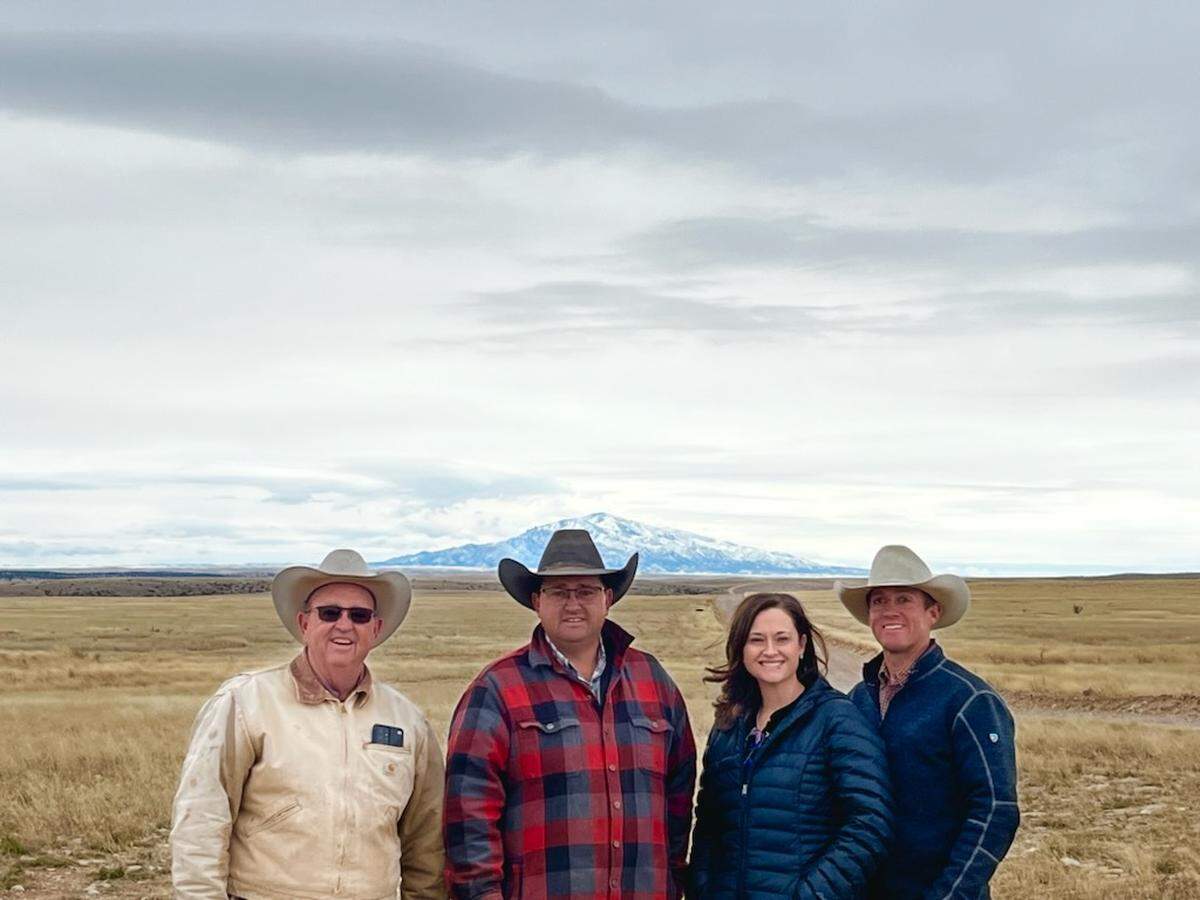
Mike Corn, his son, Bronson Corn, and his daughter, Jessica Corn Cowden, are among the Ranch Management program’s distinguished alumni. Jessica married classmate Craig Cowden, and they operate Cowden Land and Livestock in Canadian. Mike and Bronson operate the 42,000-acre Corn Ranch near Roswell, New Mexico, where they raise cattle and sheep. In fact, the Corn Ranch is renowned for its wool, which is used to make things like blankets and clothing.
The Corn family has been ranching in New Mexico since the 1870s, and Mike is a fourth generation rancher. Still, he said, he had a lot to learn when he enrolled at TCU in 1977.
“The best grades I made in my entire life were there at TCU, because they were all topics of interest to me,” Corn said. “I could see how I could implement what I was learning. I was never a language guy or a history guy or a geometry guy. I knew that I wanted to go back to the ranch and be on the land. I needed to learn range science. I needed to learn animal nutrition. I needed to learn estate planning. All kinds of stuff that I knew I was going to come across.”
Beyond the education, Corn said, it was the relationships he formed in the Ranch Management program that benefited him most. He met other ranchers who he could call on for advice or just call up for a laugh.
“The best part about that program, as far as I’m concerned, is I made the best friends of my life there at TCU in those nine months.”
Gaining knowledge about ranching doesn’t necessarily make the work any easier, nor does it remove the risks associated with a business largely governed by unpredictable weather and grocery consumer whims. Corn said living off the land is great, but it’s an awfully stressful way of making a living.
Still, for the students who wouldn’t — maybe couldn’t — have it any other way, TCU is there to help them live the dream of making a profitable home on the range.
“It’s a way of life you just can’t get away from,” Corn said. “Once you’ve grown up out in the country and raised a baby calf and dogie lambs — raised them and protected them and fed them — it’s just something you can’t get away from.”
This story was originally published May 5, 2025 at 1:36 PM.