Can’t afford to buy a house in Fort Worth? This plan might put a home within reach
A new opportunity will soon be available in Fort Worth to help make home ownership a more realistic possibility for people of modest incomes.
Concerns regarding affordable housing, housing demand, and neighborhood stability helped lay the foundation for the formation of the Fort Worth Community Land Trust in 2023. The organization was formed in partnership with the Rainwater Charitable Foundation, the city and the Housing Finance Corp., the housing development arm of the city.
In a land trust model, a family or individual purchases a home but the land trust retains ownership of the ground on which the home is built, effectively reducing the price of the home. Home owners agree that if they later sell their homes, they will do so at a restricted price to keep the home affordable.
Becky Gligo, executive director for Fort Worth Community Land Trust, explained the concept in a meeting with about 30 people at Nueva Esperanza Church in the Rosemont neighborhood in February.
“We’re trying to preserve affordability for the long haul but we also want to be in community with you,” Gligo told the group. “We’re going to be a part of your neighborhood, we want to get to know you, get to know what you need, get to know how we can best serve the people who live and work in the area.”
The Fort Worth Community Land Trust has plans for two housing developments in Fort Worth. One will be in what was once a section of student housing at the Southwestern Baptist Theological Seminary and another will be in the Renaissance Heights community, on the southeast side of the city.
The problem of affordable home ownership in Fort Worth was highlighted in a 2023 report of the city’s Neighborhood Conservation Plan and Housing Affordability Strategy. It showed that a family making the median income in Fort Worth cannot afford the median priced home in most areas of the city.
In 2021, the median household income in Fort Worth was $64,567, and the maximum home price that household could afford was $246,000, even though the median sale price for a single family home was $296,000, according to the report.
Residents in neighborhoods that are still affordable for someone who makes the median income are at risk of displacement due to rising housing costs. These neighborhoods include the Historic Southside, Stop 6, Worth Heights, Eastern Hills and Rosemont.
The home affordability problem is magnified for Black and Hispanic people. In 2024, the median income in Fort Worth was up to $77,082, according to the city, but for Black families it was $55,317 and for Hispanic families it was $68,874. The median income for white families in Fort Worth was $94,421, the city said.
Sarah Geer, a principal with the Rainwater Charitable Foundation, said the foundation saw an opportunity to form a land trust to invest in what will be an added option to address housing affordability.
“I think our mission and our toolbox can offer and can support this idea of keeping neighborhoods affordable,” Geer said. “Allowing families to stay in place, because it really is about providing a different kind of force into the housing market.”
Land purchased from seminary
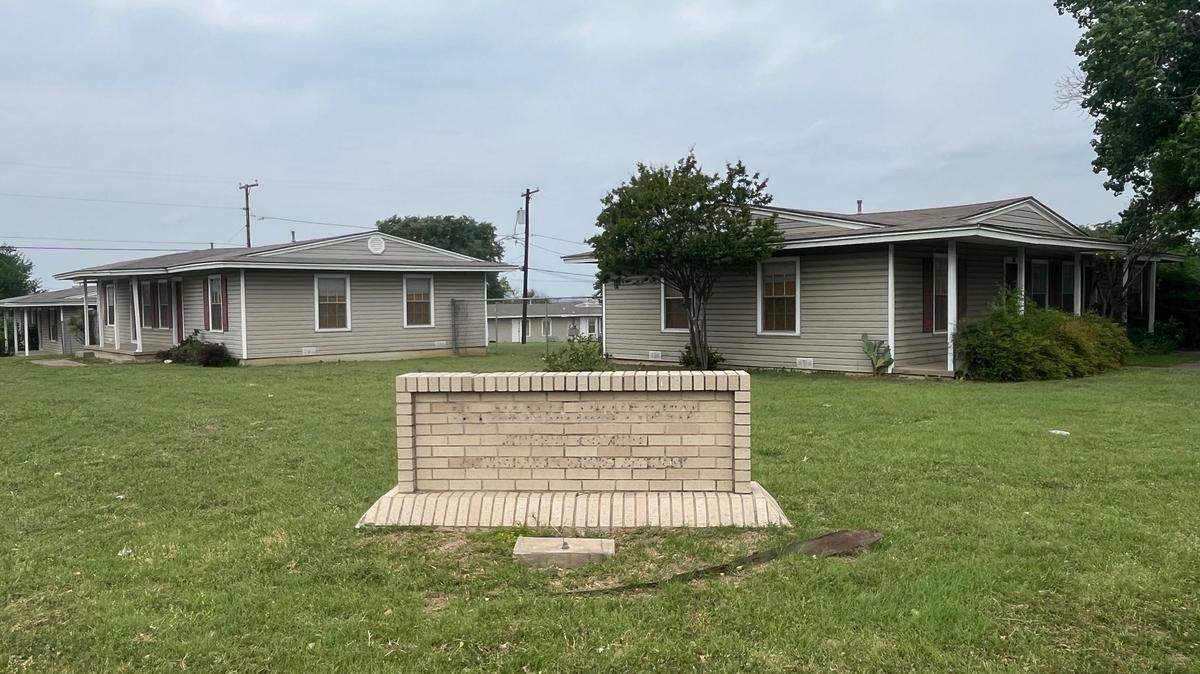
In August 2023, the city and the Rainwater Charitable Foundation worked together to buy 15 acres of what had been student housing from Southwestern Baptist Theological Seminary on West Drew Street and McCart Avenue, an area known as Carroll Park. The city contributed $4 million and Rainwater contributed $7 million to the $11 million purchase.
The land trust will partner with Fort Worth’s Housing Channel, a housing nonprofit organization, to develop 200 homes on the property — 145 new homes and the renovation of 55 existing homes.
Construction is expected to begin in late spring or early summer and end by 2029. The goal is to have the first set of homes to be available by September. Homes will be completed in phases, and residents will move in as other homes are being built or finished.
The Fort Worth Community Land Trust will have a stewardship manager on its team to support families, refer them to other programs that could help, provide guidance on finances and more.
Housing Channel, outside of redeveloping and building homes, will assist potential home buyers through the application process to access the Fort Worth’s Homebuyer Assistance Program, which provides up to $20,000 in down payment and closing cost assistance. Housing Channel will also provide home ownership classes to teach participants about qualifying for a mortgage, homeowner insurance, how to save money, and how to maintain their homes.
Eligible buyers will include families and individuals who earn between 60% and 120% of the median income.
Housing Channel, in partnership with the Fort Worth Community Land Trust, purchased 27 acres of vacant land close to U.S. 287 near East Berry Street between Vaughn and Mitchell Boulevards in the Renaissance Heights community. The goal is to develop over 230 single family homes.
They hope to break ground this fall on site work development, streets and the installation of utilities. Construction on the homes could start in early summer of 2026. Eligible buyers for this property will be between 80% and 120% of the median income.
Donna VanNess, president of Housing Channel, says the land trust is an an affordable way for lower income people or people who have historically been left out of the housing market to enter it and begin building generational wealth.
“There are a lot of distressed properties, primarily in lower income neighborhoods and under-served neighborhoods,” VanNess said. “And so it’s important that people know up front how to maintain a property so that they can continue to hand that property down to future generations and their family.”
Origins of community land trusts
The origins of community land trusts in the United States date back to 1969 when New Communities Inc. was established in Georgia as “a nonprofit organization to hold land in perpetual trust for the permanent use of rural communities.”
The idea was developed based on communal or cooperative communities in Israel and was implemented to help Black sharecroppers in Southwest Georgia who were being forced off their land by white farmers because of their participation in the Civil Rights Movement.
New Communities Inc. purchased over 5,700 acres of farm and woodland outside of Albany, Georgia, in 1969, which is regarded as the first community land trust in the United States. Over 1,800 acres of the property was used for farming.
Some families were able to move into existing buildings on the land. Hope for a more extensive residential community on the land was stalled as Lester Maddox, the segregationist governor of Georgia, vetoed a grant from the Office of Economic Opportunity that had been promised to subsidize construction of the neighborhoods. Thus, no new residential communities were built.
Over a decade long battle ensued, and after years of racism, government harassment and debt, New Communities sold 1,300 acres in the early 1980s and by 1987 sold the rest.
Despite the loss of New Communities, the model inspired others around the country to use the land trust model to promote land ownership and community empowerment.
Houston Community Land Trust
Ashley Allen, executive director of the Houston Community Land Trust, said Houston’s land trust was needed to provide affordable homes and preserve predominantly Black neighborhoods from gentrification that would displace residents.
In 2018, Houston’s city council allocated around $60 million to help the Houston Community Land Trust create 1,100 affordable homes within five years. The land trust would provide for individuals and families making less than 80% of the area median income to buy homes.
The initial program was a partnership between the land trust, the Houston Land Bank, and the city of Houston. The city of Houston built homes on land bank lots and gave people the option to buy through the land trust, using the Community Land Trust Model, or buy traditionally.
When it was discovered the city couldn’t build homes fast enough to meet demand, the land trust created its Home Buyer Choice Program. The program provided a $150,000 subsidy to home buyers, who found properties on the market that met their needs.
The city of Houston later cut $28 million from the land trust to provide housing for a broader range of people, according to The Texas Tribune.
Currently, there are 200 homeowners through the programs, 33 from the original development plan and 167 from the Home Buyer Choice Program.
Allen views housing as a human right. It is related to more stable mental health, better educational attainment, better economic opportunities, and the ability to pass property down generations. The goal is to re-frame how people think about housing, Allen said.
“It can’t just be, ‘We’re doing affordable housing,’ it’s, ‘We are trying to change the dynamic of how we do housing so we can actually stabilize housing costs and that it’s accessible to all people.’ That’s what we’re trying to do,” Allen said.
Limits on resale values
Gligo, executive director for Fort Worth Community Land Trust, attended the Rosemont Neighborhood Association meeting in February as an effort to engage with people who might not ordinarily be able to afford to buy a home. One resident was concerned about the artificially low appreciation rate applied to the land trust homes regarding resale.
The land trust is still in the planning phase regarding appreciation rates but will cap appreciation value at 1.5% per year, which is agreed upon with the resident, to keep the home affordable if the resident decides to sell it.
Gligo acknowledged that home ownership through the program is not for everyone.
“We know that home values in Fort Worth are going through the roof, and you potentially could invest and walk away with a lot more than you could,” Gligo said. “This is not that, this is a more fixed market, and so it’s going to be steadier, less risk, but less potential at the back end.”
Editor’s note: The Rainwater Charitable Foundation provides financial support for the Fort Worth Star-Telegram’s Crossroads Lab. The Star-Telegram retains independence in all news coverage decisions.
This story was originally published April 25, 2025 at 5:00 AM.