Plans for a new data center in south Fort Worth get mixed city and public reactions
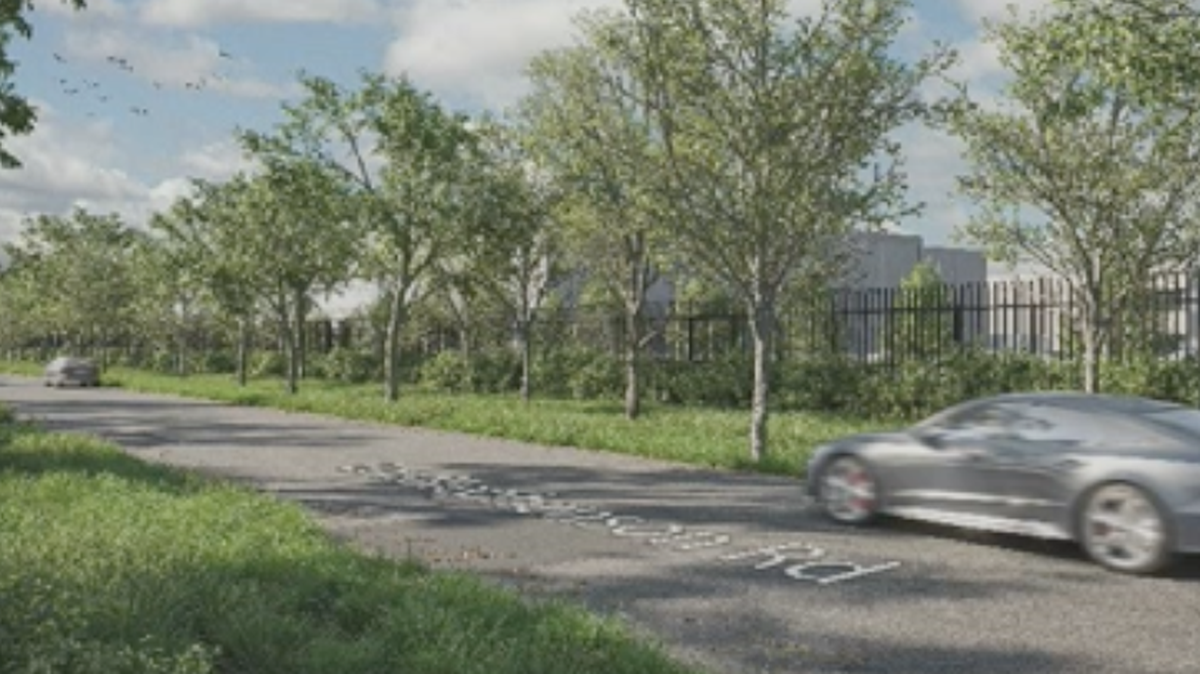
A plot of ranch land on Fort Worth’s outskirts is once again the collision site of corporate interests, public fears, and government balancing acts.
Black Mountain, a Fort Worth-based partnership of fossil fuel and mining companies, wants to convert roughly 142 acres of greenery along the southern edge Lon Stephenson Road into a data center park. Company executives and their consultants present the project as an economic boon for the city bearing few negative consequences for the area in its immediate vicinity.
Wary nearby homeowners and local officials said the group hasn’t done enough to allay concerns about traffic, noise and potential pivots to other uses.
Rhett Bennett, Black Mountain’s CEO, addressed the concerns during a data-heavy presentation before Fort Worth’s zoning commission Jan. 8.
The data center would, of course, generate some traffic, Bennett conceded, but far less than the land uses allowed under the property’s current zoning (single-family homes, general commercial, and low-density apartments among them), according to the company’s analyses.
The building also wouldn’t generate much noise, Bennett said. Bitcoin mines, data centers’ uproarious cousins, were other structures entirely.
Bennett acknowledged that the center would eat up lots of power (the Department of Energy expects data centers to consume between 6.7% and 12% of the country’s electricity by 2028). Some experts warn the energy appetites of data storage operations could test the limits of state and municipal grids if not properly managed and upscaled.
Bennett told commissioners and skeptical audience members that his company had chosen to build in this area because of the grid’s potential. He also stressed that the data center wouldn’t receive preferential treatment from local electricity providers at the expense of nearby homeowners.
Black Mountain sprinkled extra concessions on top of these reassurances: it pledged to distance any structures at least 80 feet from Lon Stephenson, maintain and spruce up the property’s landscaping, and route most of its traffic off Forest Hill Drive.
Bennett said his company’s pitch had earned the support of 43 nearby homeowners and the superintendent of the Everman school district, who wants the tax revenue the project would provide. Fort Worth planning staff deemed the project an appropriate use of the property.
A handful of doubters still not sold on Black Mountain’s plans took to the dais next.
“There are beautiful, large plantation-style homes on the north side of Lon Stephenson that will be facing whatever industrial park they want to build,” said Jessica Mang, a member of the Forest Hill Planning and Zoning Commission, the municipality just across the street from the site.
Mang noted the area suffered from not-infrequent power outages, raising the possibility that the data center could make the blackouts more common and costly. Lon Stephenson, she added, was ill-equipped to handle any new traffic at all.
Mang also suspected, without citing evidence, that many of the letters of support collected by Black Mountain had been signed “under duress.”
“The people who signed them were showed two pictures: do you want a data center — with a beautiful data center — or a trailer park — with a horrible looking trailer park,” she told commissioners Wednesday. “That’s not signing a letter of consent; that’s signing a letter of ugghh.”
After Bennett and a hired infrastructure consultant attempted to mount a rebuttal, the ranch’s owner descended from the audience to speak.
“I don’t want to change the area or do anything different — I want to take care of my neighbors. I really honestly believe this is the best way to do it,” said William Hornick, a retired Dallas firefighter who tended to the land since 1991. “The stuff being brought up by Forest Hill I understand, but they’re the ones putting in the massive amount of new homes coming in. Their area is going to be massively affecting the roads, way more than anything this ever will do.”
The debate over the future of Hornick’s land comes on the heels of a protracted and heated dispute over another data center proposal, about 16 miles west along Chisholm Trail Parkway. The positions for and against the project were nearly identical to the arguments raised by Bennett and Mang. Council member Jared Williams, whose district encompassed the site, ultimately pushed for the center’s approval, stressing its fiscal benefits and the negligent negative impact he thought it would have on surrounding subdivisions.
The zoning commission Wednesday decided to endorse Black Mountain’s efforts to repurpose Hornick’s land for a data center in a 6-4 vote. There’s wasn’t much back and forth among commissioners before the decision.
“When you’re meeting with the community, you should have these questions answered,” said commissioner Kelicia Stevenson, who opposed the project in its current state. “It will benefit the school district; I do understand that. I know that they need the revenue, but, however, I think that a lot of these questions should be answered.”
City Council will decide the case’s fate on Jan. 14.
This story was originally published January 10, 2025 at 1:39 PM.