10 years ago, she experienced homelessness. Now she owns a home. Here’s how it happened.
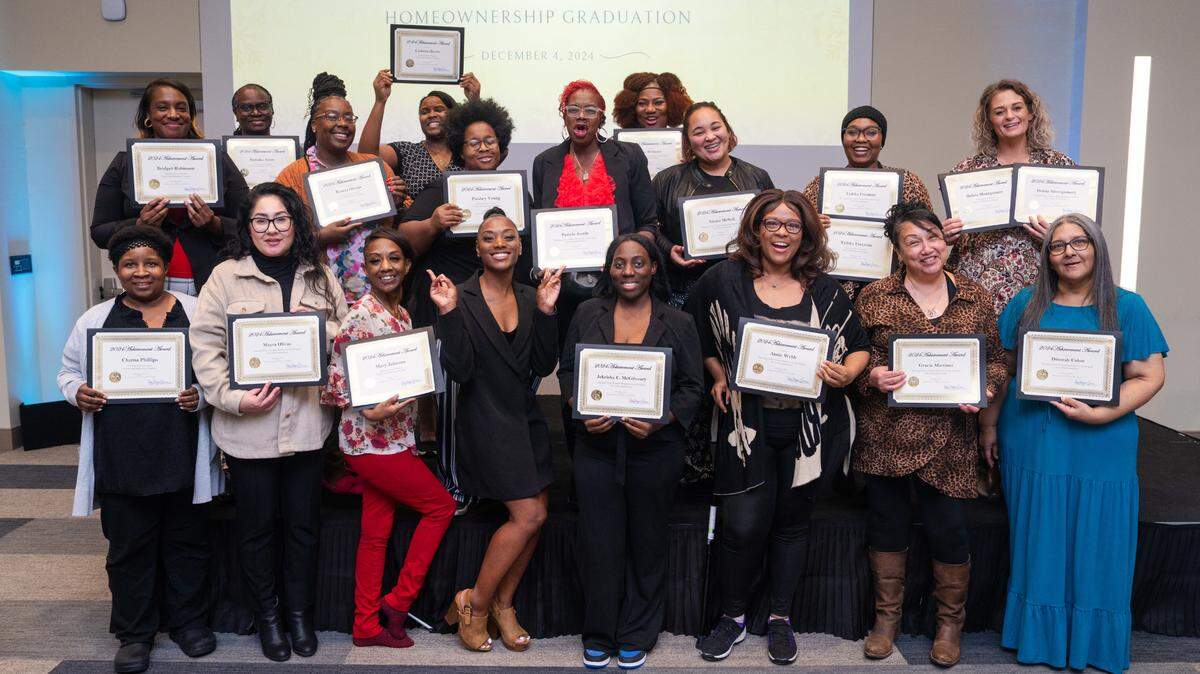
Bridget Robinson held back tears as she celebrated being a new homeowner.
Ten years ago, she had just moved to Fort Worth from Birmingham, Alabama, and was told she had to reapply for her housing assistance voucher. This meant she had nowhere she could afford to live and had to stay in a car with her son, her ex-boyfriend and his son.
They lived in a car for a few weeks, then moved from shelter to shelter. After a few months, they found housing with the assistance of advocacy organizations in the area.
In 2019, she learned about the Family Self-Sufficiency Program, which helps people become financially independent, and the Home Ownership Program, which provides individualized counseling. Both are administered by Fort Worth Housing Solutions.
Five years later, she has improved her credit score, obtained a limited liability company to protect her assets for her hair styling business and established a fashion boutique selling clothing.
And she has bought a home.
“I am proud to say that I own my home and I give all the glory to God through it all,” Robinson said.
She spoke at a Fort Worth Housing Solutions celebration in the Amon Carter Event Center at Lena Pope in front of a cheering crowd of about 50 people on Wednesday, Dec. 4. The audience included family members, counselors and other program participants
Robinson is one of 37 graduates of the Family Self-Sufficiency Program, and one of 16 new homeowners.
The program provides families with a five-year career and financial plan to improve their education and job skills. The goal is to guide families to better employment, higher incomes and less dependency on financial assistance.
If participants graduate, they receive an escrow payment of $10,000 or more to be used for anything they want.
The Home Ownership Program allows individuals and families to use rental assistance vouchers to buy a home and help cover monthly expenses. Participants also are provided home ownership training, personal credit repair, budgeting help, home financing and other services.
To be eligible for either program, an individual or family must be qualified for Housing Choice Vouchers, a federal program that subsidizes rent for low-income people.
Fort Worth Housing Solutions provides housing for over 34,000 individuals and families across all of its programs. Of those who use Fort Worth Housing Solution’s Housing Choice Vouchers, 79% are Black people and 9% are Hispanic people.
Average rents in Fort Worth have increased 22.8% since March 2020, according to a report on the city’s affordable housing crisis.
This places a burden on federal housing assistance programs such as Housing Choice Vouchers to protect low- and middle-income households. Rising rents mean fewer vouchers to go around.
A household earning the median income in Fort Worth can’t afford to buy a median-priced home in the city. A disproportionate number of families at risk of displacement are in communities of color. In neighborhoods where housing costs are already displacing families, 81% of residents are Hispanic, Black or other non-white races. Citywide, those demographics represent 62% of Fort Worth residents.
In Fort Worth, 17% of residents do not have a high school diploma compared to 15% across Texas. People with GED certificates have lower monthly earnings, an average of $3,100, compared to those with a traditional diploma who earn an average of $4,700. Those statistics are regardless of sex, race, ethnicity or age, according to the Census Bureau.
According to the Census, 14% of Fort Worth residents are below the poverty line, similar to Texas as a whole.
Mary-Margaret Lemons, president of Fort Worth Housing Solutions, said these programs help to break that cycle of poverty.
“The whole program is really educational, partnering and mentoring, giving them the budget and skills, the financial literacy, to be able to then not just be surviving anymore, but thriving,” Lemons said. ”So then to be able to pass down generational wealth, ownership and equity to your families, and really break the cycle of poverty.”
In 2024, the Home Ownership Program paid $268,086 to escrow accounts, and more than $1.7 million has been paid out in the last decade. Fort Worth Housing Solutions helped 127 clients receive credit counseling in 2024, and Housing Choice Voucher clients received $209,000 from the city for closing costs and down payment assistance.
There are over 200 people currently participating in the Home Ownership Program and over 250 people are at different stages of the Family Self-Sufficiency Program.
Deana Broussard, director of client and customer service for Fort Worth Housing Solutions, says the toughest challenge for people to complete the program is to be in the right mindset. Participants have to embrace what the staff is teaching them and follow through with each step.
“With us being mentors, we have to step in and say, ‘Hey, you can do this. Hey, let me help you find this resource. Let me help you find whatever it is you need to do to continue your journey.’”
Tyikka Freeman participated in both the home ownership and self-sufficiency programs. She grew up in foster care with her brothers and lived in multiple homes from ages 4 to 18.
In 2018, she had her first son and was using a housing voucher when she participated in the Family Self-Sufficiency Program. She didn’t take it seriously at first, she said. She became more focused in 2021 when she had a second son, had a hair styling business and wanted a better life for her children.
Freeman now has three children and says she was able to defy comments from people who said she would never graduate high school or be self-sufficient. Now, she can call herself a homeowner.
“It still feels not real to me, because, like I said, I grew up in foster care, and I have been in about 20 different homes,” Freeman said. “And to have my own, I don’t know what word to use, there’s no words for that.”
This story was originally published December 6, 2024 at 11:23 AM.
CORRECTION: This story has been corrected. Bridget Robinson was identified incorrectly in an earlier version.