
These Star-Telegram reporters told the stories of Texans in WWII, watched Japan surrender
Monday, Sept. 2, marks the 79th anniversary of V-J Day, or Victory over Japan Day, when Japan surrendered to Allied forces with the signing of the official Japanese Instrument of Surrender to effectively end World War II.
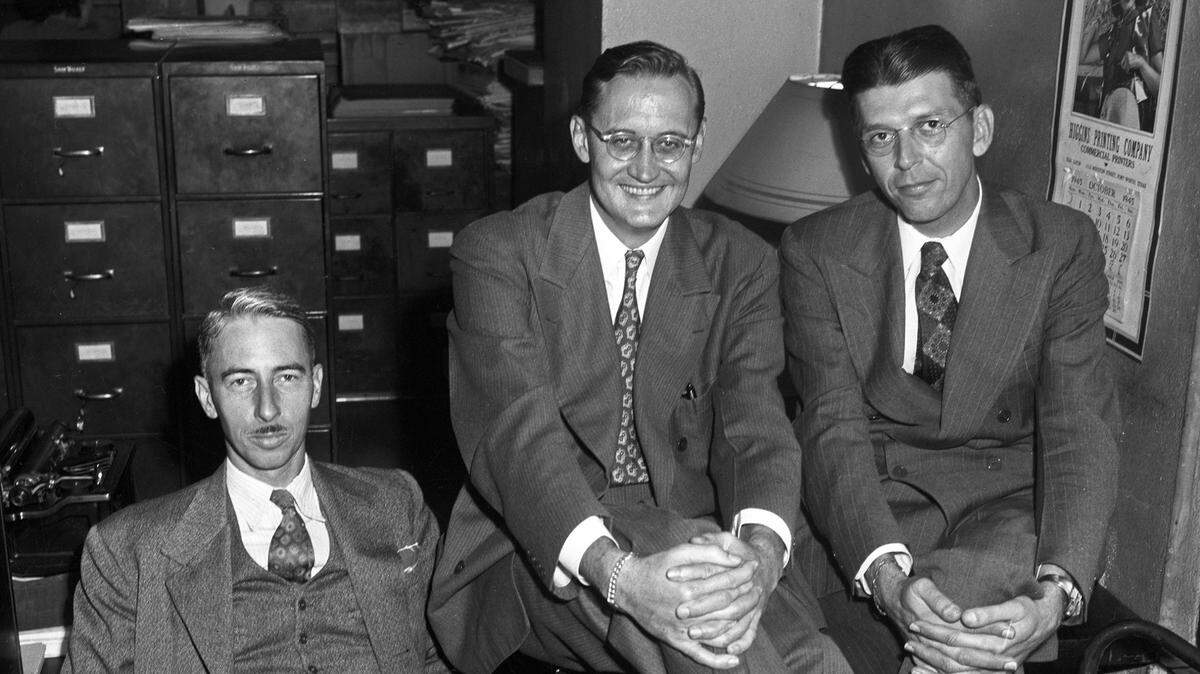
In commemoration of V-J Day, I am honoring three of the five Fort Worth Star-Telegram WWII war correspondents to share the stories behind their bylines. Reporters Flem Hall and Stanley Gunn — the subjects of a previous column — were the first two of five sent overseas to report on war efforts, and they were later followed by Robert Wear, Sam Kinch and Charles Boatner.
Robert Wear
Robert Wear reached London in late December 1944 as the V-1s of the “buzzbomb blitz” were followed by Hitler’s V-2 rocket. As their vessel approached the English shoreline, Wear reported that a lieutenant from Fort Worth sniffed the salty air and muttered, “Boy, this sure doesn’t smell like the Fort Worth stockyards to me!”
Wear described American soldiers, sailors and Air Force men dressed as Santa Claus attending parties for English war orphans. At a party in London on Christmas night, he observed as three Fort Worth natives, seemingly pulled together by some enigmatic force, belted out an impromptu rendition of “The Eyes of Texas,” a cappella, following an orchestral performance of “God Save the King.” Later, a story on 1st Lt. Carl Wallace Jr. of Fort Worth was relayed to Star-Telegram readers. Wear had encountered Wallace in the ruins of Luxembourg eating ice cream — enjoying the spoils of victory after capturing an ice cream factory.
Wear played a part in the effort to search for the son of Star-Telegram Publisher Amon G. Carter, Lt. Amon Carter Jr., who was held captive as a prisoner of war from 1943-1945. During his time overseas, Wear interviewed Gen. Dwight Eisenhower, Gen. Jonathan Wainwright and President Harry Truman. He said he worked alongside fellow Texas correspondent Walter Cronkite while in Europe. Wear also received a citation of commendation from Maj. Gen. Bruce Clarke, commanding the 4th Armored Division, with which he spent much time as it drove into central Germany in Spring 1945.
Wear encountered soldiers who trained at Camp Wolters in Mineral Wells who “gave good account of themselves at the front, especially in breaking through the German lines,” adding that he believed it was due to the “actual combat practice they received at Hell’s Bottom,” which was part of Camp Wolters.
Sam Kinch Sr.
Sam Kinch Sr., who began at the Star-Telegram in 1934, volunteered to fill in for Stanley Gunn, who was mortally wounded by a Japanese bomb that exploded next to his quarters on Oct. 28, 1944. Kinch covered news in England, France and Germany from December 1944 through March 1945, then landed in the Philippines to tell the stories of the countless Texans in combat with the Japanese.
Kinch was cited by Maj. Gen. J. M. Swing, commanding the 11th Airborne Division, for “displaying courage and disregard for danger” during the division’s parachute operations at Aparri, Luzon, and earlier when he was pinned under fire during the landing on Borneo.
Charles Boatner
Charles Boatner left for the Pacific in June 1945 and served as a correspondent with the Army, Navy and Merchant Marine during his service. He was made an honorary member of the 32nd (Red Arrow) Division after accompanying its men on patrols into enemy-held territory, doing work which Capt. William R. Fleischer called “something a little above and beyond the call of duty.”
Boatner relayed stories of Texans “braving submarines, mines, air strafing and kamikazes to deliver food, clothing, munitions and other supplies to the fighting Army, Navy and Air Forces.” He also described piloting a B-32 for 10 minutes, adding, “Note to the editor: Please rush me my silver wings.”
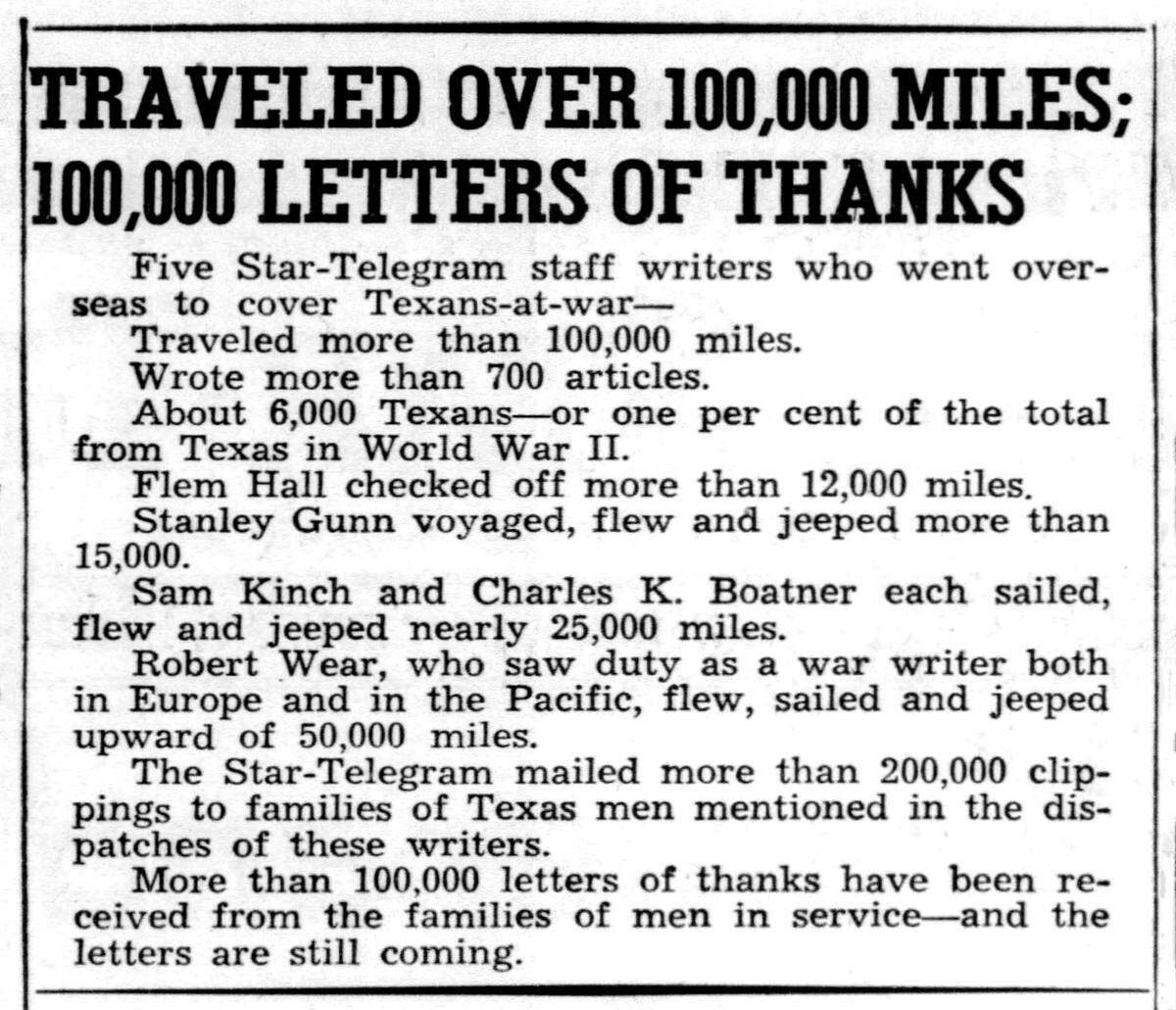
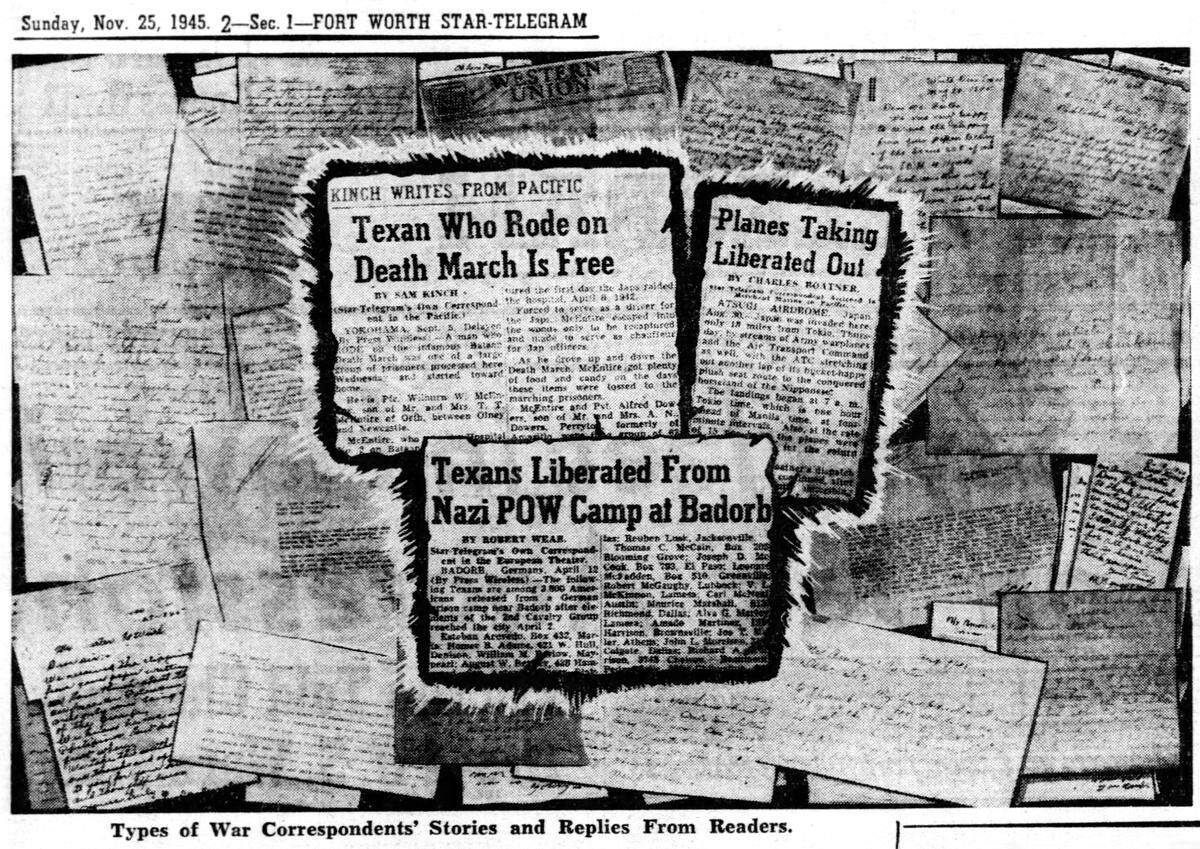
Though they each served for less than a year, these three valiant correspondents accomplished plenty: They were credited with expediting communications of the names and last known prison camp addresses of Tarrant County prisoners, shared news of the release of local servicemen and, fulfilling Star-Telegram publisher Amon G. Carter’s directive, they brought home cherished stories about Texas soldiers.
Wear, Kinch and Boatner all arrived in Japan in early August 1945 to report on the closing chapters of the war. On Aug. 10, 1945, news of a potential Japanese surrender spread. Boatner reported that the men, worn by four years of fighting, “stared mutely, blankly, frozen in their positions. The spell broke. They tumbled out of the tents and ran ... rifle fire and yells ripped the air ... the sunrise found a sleepy, happy bunch of homesick GIs.”
For Kinch, the sound of victory was deafening: “Everything that would shoot was being fired — land and sea pieces alike. The noise and the lights from tracer bullets and flares made it worse than any Fourth of July could be.” Four days later, Japan agreed to surrender.
Witnessing surrender aboard USS Missouri
The three Star-Telegram correspondents were in attendance during the final moments of the war aboard the USS Missouri, marked by the signing of the surrender terms by Japan on Sept. 2, 1945. Boatner watched from a press box, Kinch stood on a 16-inch gun turret, and Wear was perched on a 14-inch gun turret.
Kinch observed 235 writers and at least 200 photographers covering the ceremony. He set the scene of “probably the greatest assembly of brass and braid in history” with a description of the 16-inch guns of the USS Missouri symbolically pointing eastward toward the shore of Tokyo Bay, and sailors and guests “hanging over every rail for a sight of the ceremony, dazzled by the stars and other symbols of high rank.”
Robert Wear described the Japanese delegation as appearing “funereal in their antiquated-style formal finery” as they signed surrender documents. As the French prepared to sign, Kinch reported that the sun broke through the blue haze of clouds concealing Fujiyama, then 46 B-29s and hundreds of Navy fighters and dive bombers roared overhead to conclude the ceremony.
After returning home to Fort Worth, the three men were invited to speak at a Rotary Club luncheon held at the Hotel Texas on Nov. 2, 1945, the first of many speaking engagements for various clubs, to reflect on their experiences in the war. Their highest praises went to combat infantrymen and combat medics, those who “fought day in and day out under the war’s worst condition.”
They spoke about their three meals a day in Japan consisting exclusively of raw fish (including shredded octopus tentacles), raw onions and cold potatoes, which “[made] even K-rations taste good.” They reflected on the shock that never really wore off from “talking to a nice kid one day and hearing three days later that he had been killed.”
Boatner remarked on his relief to no longer be living in a “doll house” as his 6-foot-4 frame was no match for the 5-foot-10 Japanese beds and tiny bathtubs: “I got cramps in all my joints, and my cranium is rougher than Big Bend Park terrain.” They also hoped to forget the infestations of fleas they experienced in a Tokyo hospital and dredging through swarms of mosquitoes in the Philippines that “turned yellow from biting atabrine-stuffed soldiers.”
The three correspondents succinctly described the scene aboard the USS Missouri as historic, dramatic and thrilling. Kinch noted that, even prior to the explosion of two atomic bombs, the ruin and desolation of Japanese cities was visible and indicative of an impending surrender.
Sara Pezzoni works toward promoting greater access to Fort Worth Star-Telegram archival collection materials as a staff member of the Special Collections department at the University of Texas at Arlington Libraries.