
‘Nothing is more neighborly.’ In this Fort Worth suburb, the government visits the people
In most cities, citizens attend public meetings to converse with officials.
In Saginaw, the officials come to the residents.
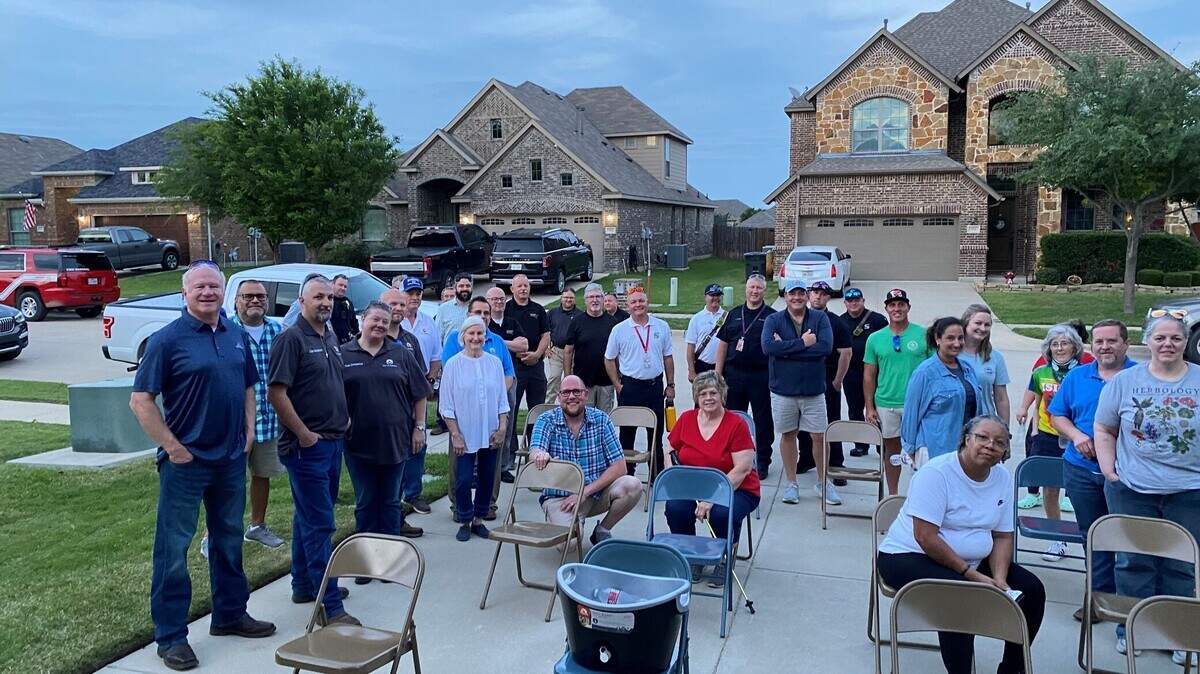
Known as Garage Gab, city leaders and department heads visit the homes of people around town to discuss projects, exchange ideas and generally work together to improve their beloved city.
The idea was the brainchild of City Manager Gabe Reaume. It came about during the COVID-19 pandemic in 2020 when being indoors among crowds was discouraged. He was visiting with a lady in her driveway at a safe distance and others stopped by to join in.
“Several of her neighbors came out to ask questions about city projects and to hear updates on what was going on around town. It was a really friendly and fun experience, a sort of impromptu block party,” Reaume said. “I decided that we should do something like it again.”
Saginaw brings ‘government to the people’
Saginaw Mayor Todd Flippo praised the creation of Garage Gab as a way to get people together to talk, while maintaining social distance.
“Folks feel more comfortable in their neighborhoods than in city hall,” he said. “We have brought Saginaw government to the people.”
Typically, a Garage Gab is requested by a person or neighborhood. The city officials show up with 10 to 15 employees, representing almost every department. This ensures that a city expert will be in attendance to answer almost any question that arises.
“Our citizens have really appreciated the face-to-face transparency and availability that the Garage Gab provides,” Flippo said. “We have shown that the city of Saginaw is governed by real people and we are ready to talk to our citizens.”
Among those citizens is Benjamin Guttery, a regular at the events.
“My husband and I are involved in the community, and with so much misinformation out there on Facebook, we thought it was important to have our neighbors be able to ask direct questions to not only elected officials but also city employees on neutral ground in our front yard,” Guttery said. “It’s been very beneficial to have code enforcement, permitting, environmental, animal control, police, and the fire department all in one place to speak to homeowners and to explain and answer their queries from various angles.”
Immediate response to concerns
Since that time, Reaume said the city has held dozens of Garage Gab, with attendance ranging between five and 50 residents.
“The average I would say is about a dozen residents. We usually have about a dozen staff from several departments on hand to speak and answer questions,” he said.
Reaume said an example of a problem solved is when, in a recent Garage Gab, some residents shared concerns about speeding on Basswood Boulevard. The following day, the police chief, who was in attendance, had officers out to conduct targeted traffic enforcement in the area.
“It was an immediate and visible response to the concerns raised, which I believe people genuinely appreciated,” he said, adding wryly. “Unless of course they got a ticket!”
Other complaints that have been resolved have included the replacement of missing street signs, patching of potholes, and repair of damaged playground equipment.
All-American City nomination
The city was recently nominated for the All-America City Award presented by the National Civic League. The award recognizes cities that leverage civic engagement, collaboration, inclusiveness and innovation to successfully address local issues.
Garage Gabs was one of the major reasons the city was nominated, noted Matt Leighninger, director of the Center for Democracy Innovation.
“The city of Saginaw’s Garage Gabs are a great way to bring together officials and citizens in a way that builds better relationships, facilitates information-sharing, and helps people understand each other,” he said. “It is an example of ‘going where the people are,’ which is a great principle for productive public engagement.”
Reaume summed up the program’s success simply, saying, “Nothing is more neighborly than old-fashioned face-to-face interaction.”