Toll lanes are expensive for a reason: they avoid traffic. Not at this Fort Worth spot
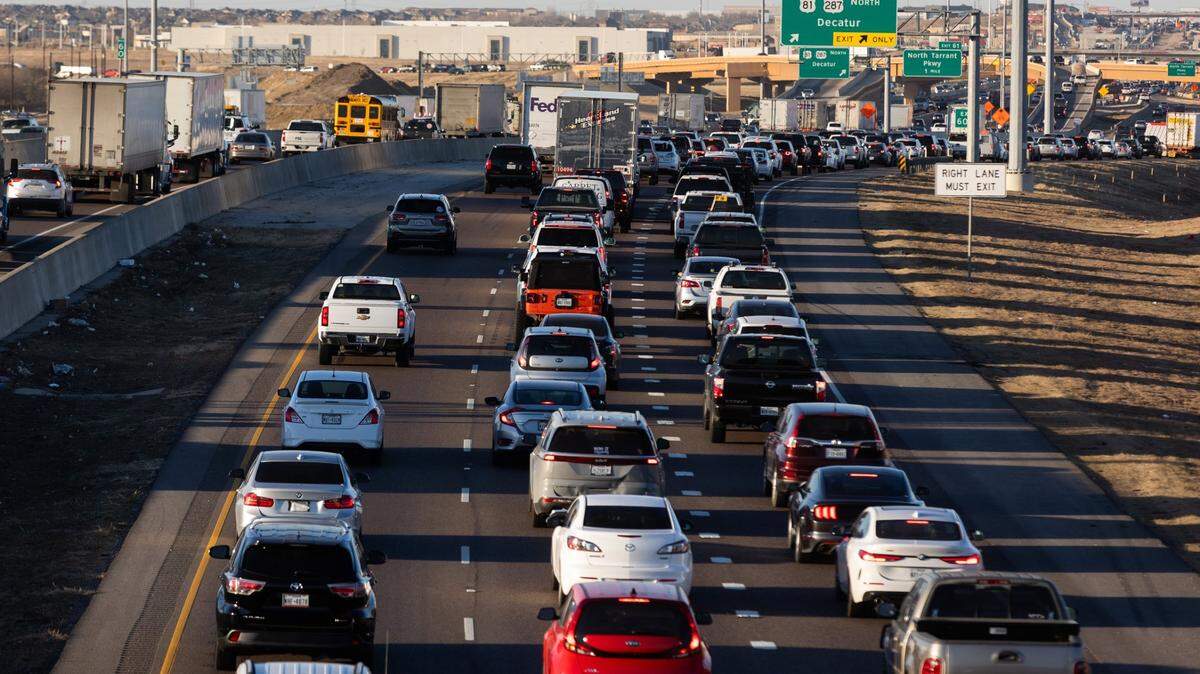
Picture this: You’re commuting from work on Interstate 35W. Maybe you live in Alliance or Roanoke.
You’re eager to get home so you take the TEXpress lane. It costs up to 90 cents per mile during rush hour, but sometimes it’s worth it to avoid sitting in traffic after a long work day.
The lanes’ variable pricing — which can mean spending up to $10 for a single one-way trip — is supposed to keep traffic moving at a minimum of 50 mph. But, it’s 4:30 p.m. and, in a span of a quarter mile, your speed decreases from 75 mph to 35 mph at Basswood Boulevard.
Here’s why.
Traveling north on I-35W, there are two TEXpress lanes and two regular lanes. However, U.S. 287 (the exit after Basswood Boulevard) has only two lanes in each direction. The off ramp from the regular I-35W lane to U.S. 287 is nearly a mile long. But the connector between the TEXpress lanes and U.S. 287 is only about three-tenths of a mile long.
As a result, traffic backs up on the on ramp, and the one mile between Basswood Boulevard and the U.S. 287 exit slows to a crawl.
Today, the congestion is an annoyance, but as development continues to boom in northwest Fort Worth, the traffic will without a doubt get much worse.
A fix is in the works, but it won’t be complete until 2030 — at the earliest.
Accommodating growth
U.S. 287 is the corridor to some of the fastest growing parts of Fort Worth, which is adding more people than any other city in the country. It is a main gateway to communities like Avondale and Rhome.
The Northwest school district, which includes Fort Worth, Rhome, Haslet, Roanoke and Justin, is forecast to enroll nearly 50,000 students by 2032. Only 20 years ago, the district enrolled just 6,000 students.
The projections are based on data about new housing developments, like Reunion, a 3,150-acre community from Dallas-based developer PMB Capital Investments that will feature 10,000 home sites near the intersection of Texas 114 and U.S. 287.
“As leaders, we need to prepare not only for the growth that’s here today, but the growth that’s coming in 50 years,” said Manny Ramirez, county commissioner for Precinct 4, which includes Northwest Tarrant County.
The rapid growth in this area has created what is called an “incomplete supporting thoroughfare network,” said Jeffrey Neal, senior project manager at the North Central Texas Council of Governments, an association of local governments created for regional planning.
When developers build housing communities, they often add capacity to roadways. But because this is done in a piecemeal fashion, the result is a roadway system with a lot of missing pieces.
“There’s so much growth that the street system has few opportunities for alternatives when there’s a traffic situation,” said Neal.
That’s what Ramirez has been trying to target at the county level:
“One way to provide relief is to make sure we’ve got adequate arterial roadways for our folks to travel,” Ramirez said.
TxDOT plans
The corridor was constructed with the expectation of future improvements, said Neal.
Multiple organizations are responsible for maintaining the corridor.
U.S. 287 is managed by the Texas Department of Transportation. The toll lanes and the ramps are managed by private transportation company North Tarrant Express Mobility Partners LLC.
But the ramps were designed and built by TxDOT.
TxDOT provided information about relevant projects affecting this corridor, but denied the Star-Telegram’s request for an interview.
TxDOT is about to embark on a $227 million project that could help the problem, but a solution to this issue is still years away.
The project will add one lane in each direction to the nearly seven-mile stretch of U.S. 287 between Interstate 35W and Avondale-Haslet Road. It will also add continuous one-way frontage roads.
The road widening is part of phase three of the project. The second phase is scheduled for bidding in 2026. TxDOT is still working on finding funding for the third phase, said an agency spokesperson.
If congestion gets really bad, NTE could provide refunds, Neal said.
Expediting the plans
The Council of Governments and Tarrant County are doing their best to abbreviate this timeline.
The Council of Governments applied for a grant that would enable TxDOT to widen U.S. 287 while it starts the project. If the council wins the grants, construction could start before the end of 2026, and the project could be completed by 2030.
Ramirez was faced with a similar question — how can I make this process faster? — in regards to Boat Club Road near Eagle Mountain Lake.
In that case, the county opted to conduct the redesign and engineering, so TxDOT could come in and complete the road. The county is doing something similar with Boat Club Road.
Ramirez said he intends to continue getting creative with infrastructure projects, like the U.S. 287 corridor.
“I don’t care who engineers it. I quite frankly don’t care who pays for it or who builds it. All I care is that in two to five years, our citizens are driving on it,” Ramirez said.