
Buffalo Bill brought his show to Fort Worth seven times, even after a sour first visit
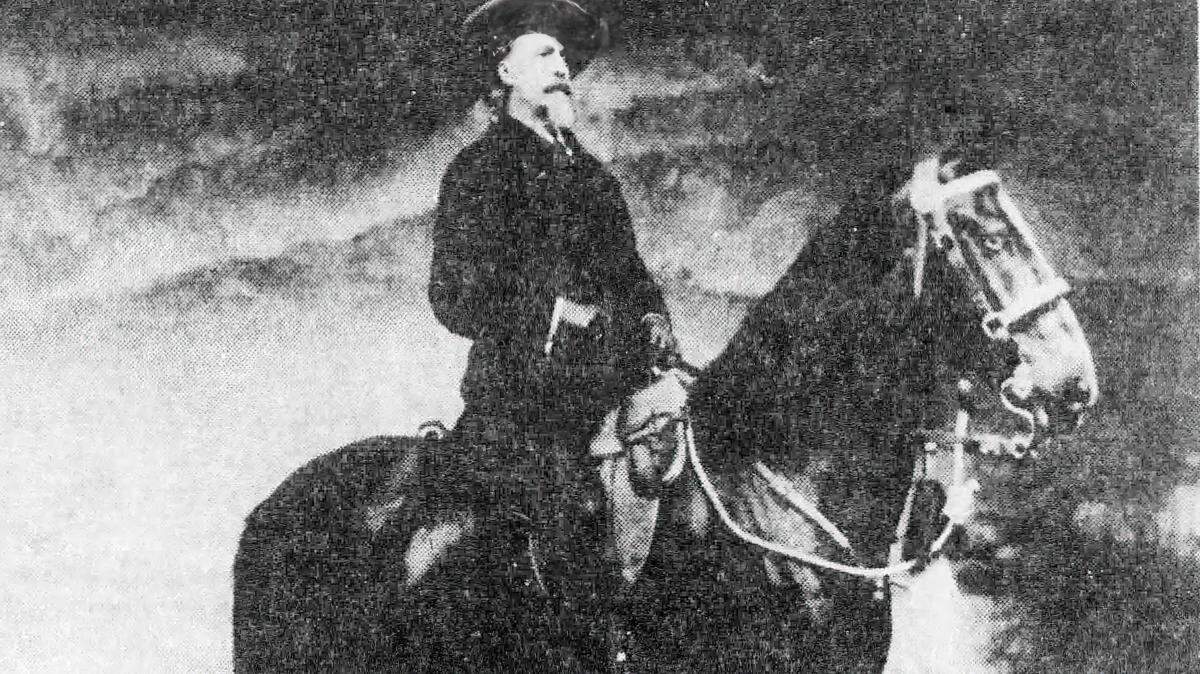
By the time Buffalo Bill came to Fort Worth for the first time in 1879 he was already a national celebrity. Elvis with a rifle. A Kardashian in buckskin.
Since he was a teenager, William Frederick Cody had made a living — and headlines — as an Army scout, buffalo hunter and fighter of Native Americans as Anglo settlers pushed westward.
The “wild West” had captured the imagination of people living on farms and in cities, especially back East.
Tall and lean with long hair, Van Dyke beard and sharpshooter eyes, Cody made a natural hero of dime novels and melodramas.
Exploiting that notoriety, in 1873 Buffalo Bill formed his own theatrical company, the Buffalo Bill Combination, and began to tour the country.
On Dec. 4, 1879, Cody’s combination steamed into Fort Worth. That night the “monster combination of 24 artists” presented a melodrama in which Cody rescued his sister from Mormons and Native Americans. The play was presented in Evans Hall, which was owned by merchant Burwell Christmas Evans.
After the performance, the Fort Worth Democrat reported that Evans Hall was “well filled,” the performance “first class.”
But Cody was not pleased.
The Democrat followed up: “Buffalo Bill himself told us, that during his seven years travel, he had never seen a stage in so bad a condition. No dressing rooms, no light, and, in fact, no nothing.”
Cody did not return to Fort Worth for 21 years.
In the years between, his show grew into a wild West circus. He hired Annie Oakley and Lakota chief Sitting Bull. In England his show performed before the Prince of Wales, Queen Victoria and the future King George V. At the Vatican, the show performed for Pope Leo.
By the time Cody returned to Fort Worth on Oct. 10, 1900, for a “grand street cavalcade” and two shows, his company had grown from 24 in 1879 to “over 1,200 men and horses.”
An ad in the Fort Worth Register called the show a “veritable kindergarten of history” with a “military brass band and orchestra.”
The 1900 show, coming less than two years after the Spanish-American War of 1898, featured 16 of Col. Teddy Roosevelt’s Rough Riders, who reenacted their 1898 “charge up San Juan Hill” in Cuba.
Buffalo Bill was back in Fort Worth in 1902. The ad for the show in the Telegram was a carnival barker-in-print: exclamation marks, superlatives, exuberant capitalization. “BIGGEST ANDcBEST!” and “SEE IT WHILE YOU MAY! ENJOY IT WHILE YOU CAN!”
There was even a simulated “buffalo hunt as it was in the far West” with “a herd of real buffalo, the last of their race.”
In 1908, Buffalo Bill’s show here featured a reenactment of Cody’s early days as an Army scout: the 1869 Battle of Summit Springs.
“The Battle of Summit Springs,” a newspaper ad read, “is depicted with realistic vividness. Showing one of the deciding conflicts ... in the long drawn out conquest of the western wilds.”
By 1910, the show had evolved again. Now it was double-Billed, named “Buffalo Bill’s Wild West and Pawnee Bill’s Great Far East Combined Exhibitions.” Gordon William (“Pawnee Bill”) Lillie was a showman and performer. Despite Pawnee Bill’s nickname, his part of the show was an “Oriental spectacle” showing the “richness and splendors of the romantic Far East.”
In 1912, Buffalo Bill was back in town, his hair and Van Dyke now as white as the horse he rode. Nonetheless, a Star-Telegram ad promised, “Buffalo Bill personally will appear at both performances Monday in which he will demonstrate with his rifle, mounted on a swiftly running horse, the fact that the grand old scout is still in the ring with eye undimmed and nerves as steady as ever.”
The Star-Telegram also went behind the scenes of the show, which arrived on 50 double-length railroad cars: “The show might well be termed a traveling city, for within its confines are a post office, a blacksmith and carpenter shop, a physician and veterinary’s office, a barber and tailor ship, restaurant, and a complete electric lighted carbonating plant on wheels for the bottling of Vin Fiz,” which was a grape drink made by Armour packing company.
When Cody came to Fort Worth in 1914, the show featured 40 clowns, a 60-member band, contortionists, tumblers, bareback riders, trapeze artists, “marvelously trained” horses and, of course, lions, tigers, monkeys and elephants trained to simulate popular dances such as the two-step and cakewalk.
In 1914, Cody was 68 years old. Nonetheless, he cut a dashing figure on a horse. Indeed, a highlight of the 1914 show for Cowtowners came when, the Star-Telegram wrote, “Buffalo Bill made his bow to the audience, ... riding around a couple of times on his easy-galloping snow-white mount. He drew up in the center ring and made one long bow as his mount backed a dozen steps, a trick of courtesy which Buffalo Bill himself taught him. Then Buffalo Bill spoke, bowing right to left: ‘Texas ...,’ he shouted, ‘Texas: what a thrill the name has. Butw hoever heard the name Texas without thinking of Fort Worth?’”
In 1915, 36 years after his first appearance in Fort Worth, Buffalo Bill returned for a last hurrah. He led a parade through downtown and rescued the passengers of a stagecoach after it was attacked.
William Frederick Cody died in 1917.
The Dallas Morning News editorial page reacted dryly: “Buffalo Bill probably was ready to go. He had outlived the buffaloes.”
Buffalo Bill Cody has been dead more than a century, but he remains an icon in popular culture and a subject of scholarship. A recent Google search of the term “Buffalo Bill” returned more than 6 million results.
Mike Nichols blogs about Fort Worth history at www.hometownbyhandlebar.com.
This story was originally published December 17, 2022 at 6:00 AM.