North Texas pastor defies IRS over politics, endorsements from the pulpit. ‘Big whoop’
A pastor in North Texas is doubling down on his church’s political involvement and on his own endorsement of candidates, directly challenging the IRS to revoke his church’s tax-exempt status and raising the specter of a legal challenge.
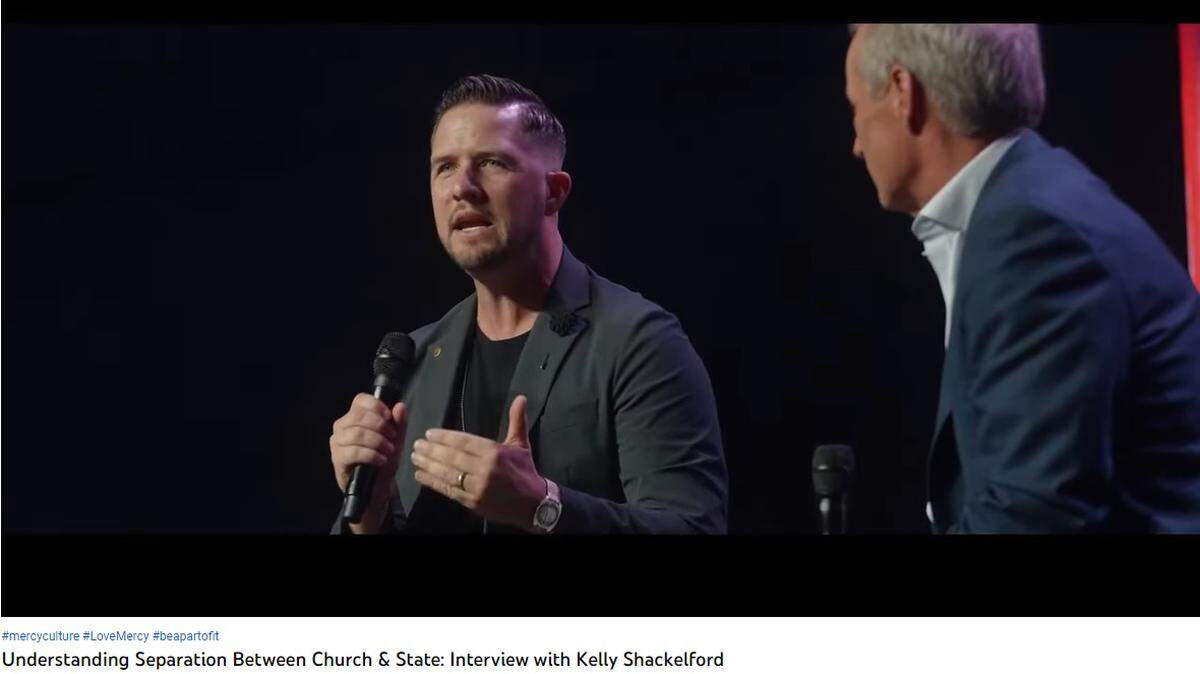
In his Sunday sermon, senior lead pastor Landon Schott of Mercy Culture Church in Fort Worth endorsed two Tarrant County candidates and encouraged other pastors to step into the political realm.
Mercy Culture has made headlines for over a year for its political involvement.
One of the church’s elders, Steve Penate, ran for Fort Worth mayor in 2021. The Star-Telegram reported specific politically linked events held by Mercy Culture, including when the church posted a banner one Sunday that said “Visit stevepenateformayor.com” behind the pulpit. Later that summer, the Washington Post wrote an extensive story about increasingly political churches, focusing on Mercy Culture.
And, most recently, the Texas Tribune included Mercy Culture in a story about 18 churches nationwide that appear to have broken federal Internal Revenue Service law that prohibits churches from certain types of political involvement. The IRS, under the Johnson Amendment, specifically prohibits churches and other nonprofit organizations from making campaign donations and from endorsing political candidates, on threat of losing their tax-exempt status.
But Schott doesn’t seem worried.
“There’s this, almost like, this scare tactic, this intimidation thing that comes to try to keep people afraid,” Schott told the congregation at Mercy Culture’s Sunday service, which was broadcast online. “And if there’s any pastors that are watching or watch the livestream, what you’re really talking about is the potential of losing your 501(c)(3). Big whoop.”
Schott referenced the gospels, in which Jesus is asked about paying taxes to Caesar. Schott then spoke again to any pastors listening.
“So at the end of day, what you’re basically saying is you’re not going to step out and help people because you’re afraid of paying taxes? They’re not even saying we legally can’t speak out, they’re threatening to take your 501(c)(3) away,” Schott said. “So take it. And we’re gonna preach the gospel.”
Mercy Culture’s Sunday service also featured guest speaker Kelly Shackelford, an attorney who focuses on religious freedom cases. Shackelford is the president and CEO of First Liberty Institute, which worked on two recent Supreme Court cases: the religious school choice case from Maine, and the football coach prayer case from Washington state.
Shackelford — who also works with Gateway Church, the megachurch that trained Schott and planted Mercy Culture — sat on stage Sunday and explained his legal take on the separation of church and state.
Shackelford said, among other things, that the Johnson Amendment does not stop individual pastors from doing whatever they’d like with regards to political involvement. Schott chimed in immediately, gesturing toward a handful of local candidates who were sitting in the church, including the Republican candidate for Tarrant County judge Tim O’Hare and the Republican candidate for Tarrant County district attorney, Phil Sorrells.
“You as a lawyer, one of the leading attorneys in the nation, are telling me that I can endorse candidates,” Schott said to Shackelford. “Then I endorse Tim O’Hare. Can I endorse Phil too? I endorse Phil. Can we keep going down the aisle?”
Despite Shackelford’s comments, the law isn’t quite so clear-cut.
IRS documents indicate that pastors do not actually have unlimited leeway. The IRS says that leaders of nonprofits, which includes pastors of churches, “cannot make partisan comments … at official functions of the organization” if they want to retain their tax-exempt status. Because Schott made his endorsements during a church service, they appear to be a violation of the IRS code, as the Texas Tribune reported for a similar statement that Schott made earlier this year.
But the Johnson Amendment is mostly a gray area, said Steven T. Collis, a professor focusing on religion and law at The University of Texas at Austin School of Law. The legal restrictions are difficult to interpret because the law has so rarely been enforced.
From the time that the political endorsement prohibition went into place in the 1950s, up until 2002, there are only two known cases of a church losing its tax-exempt status.
“Usually what happens is a law gets passed and then courts start applying it and, over time, you start to really get a firm understanding of how the law is going to be applied,” Collis said. “But when you have a law that just doesn’t really ever get enforced, and there’s not much case law, it leaves lots of questions open.”
On stage at Mercy Culture, Shackelford pointed to this lack of enforcement, too.
Schott and Shackelford also talked about the possibility that, if the IRS were to take away a church’s tax-exempt status, that would be an opportunity for the church to challenge the law itself and take the case to the U.S. Supreme Court.
That’s also the general idea behind an initiative called Pulpit Freedom Sunday, started by the conservative Christian group Alliance Defending Freedom, in which pastors across the country intentionally talk politics from the pulpit. While that initiative aims to trigger a court case that could overturn the Johnson Amendment, the IRS has so far not taken action against any of the participating churches.
“The IRS does not want that case, and as a result there’s been thousands of pastors who have given sermons, they have endorsed on behalf of their church, in the pulpit, they have sent a copy of their sermon to the IRS and the IRS has never wanted to bring that case,” Shackelford said. “Because they know the boogeyman would be over at that point under the First Amendment if they did.”
The tax law can only be challenged in a specific case, meaning that the law has to be enforced before it can be challenged.
Hiram Sasser, the executive general counsel at Shackelford’s First Liberty Institute, told the Star-Telegram that he’d like to see the IRS go after a church under the Johnson Amendment, because it would open the door to a legal challenge.
“We’ve been trying to get a case like that for 20 years,” Sasser said. “It would be great for them to give us a case by actually enforcing this thing.”
If he ever worked on such a case, Sasser said, he’d argue the law violated free speech and free exercise of religion provisions.
But Collis said he’d be surprised if the Johnson Amendment ever went before the courts.
“The biggest reason that will probably never happen is because I just don’t think it likely the IRS is going to come after them,” Collis said. “Historically, Black churches have been doing this forever, they just completely ignore the Johnson Amendment. … You’ve had a lot of other churches in recent years, especially among evangelical right-wing religious groups, going out of their way to endorse candidates.
“The IRS has been ignoring it for so long, I just don’t see any big change coming.”
But he also noted that, while the overtly political churches may make headlines, there are likely many churches that are staying clear of the Johnson Amendment by choice.
“I’m not sure the numbers rise to the level that the IRS is panicked about it,” Collis said. “There are a lot of religious groups who would voluntarily want to comply with the spirit of the Johnson Amendment, even if it wasn’t the law.”
Mercy Culture Church did not respond to requests for comment for this story.
This story was originally published November 4, 2022 at 11:39 AM.