
This trusted partner helped a Fort Worth boxer travel independently after he became blind
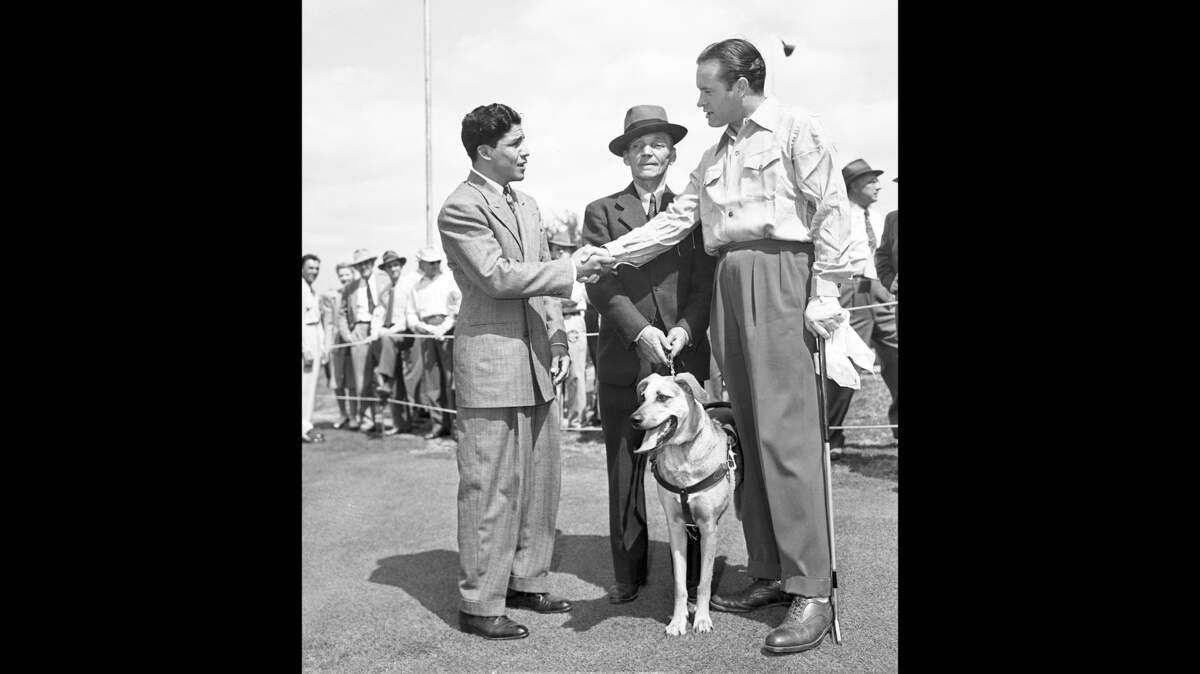
Before an opponent jabbed a rosin-covered thumb in his eye during a 1921 boxing practice match, Dick Griffin was a promising bantam-weight championship contender. Griffin continued to box despite a serious eye infection, and his friend and heavyweight champion Jack Dempsey paid to send him to eye specialists. Griffin had several operations to preserve his sight but, by 1934, he was completely blind. As his sight deteriorated, Griffin switched careers, becoming a boxing agent and promoter. It was not until 1942, however, that he gained a trusted partner in his guide dog, Gilda.
The first “seeing eye dog,” as they were initially called, arrived in the United States from Europe in 1928. By 1930 rules were established permitting the dogs on railroads and other public transportation. In June 1938 Lloyd Sparkman, a University of Texas Law School student, was the first person to walk down Fort Worth’s streets with a guide dog. It was a head-turning sight at the time because there were only six guide dogs in Texas. Sparkman was from Dallas, in town to give a talk about and demonstrate what the dog could do for him.
Howard Betis was the first Fort Worth resident to use a guide dog. He met Flash in October 1941, when the pair went through a month of training at the Seeing Eye Institute in Morristown, New Jersey. The Fort Worth Lions Club sponsored Betis’ trip. Betis, who became blind when he was 13, worked at American Manufacturing Company during World War II. He and Flash took the bus to work, where he checked the band grooves on shell casings being manufactured for Army and Navy munitions.
The former boxer, Dick Griffin, was not far behind. He and Gilda began working together in February 1942, a change that enabled him to navigate downtown Fort Worth independently.
Early in his career as boxing promoter, Griffin was instrumental in changing an 1895 Texas law that affected boxing. It banned any official designation for fight winners, making title fights essentially moot. Griffin went to Austin and lobbied the Legislature to enact a law which, in 1934, legalized professional boxing in Texas. That made his career viable.
One of Griffin’s biggest events was a 1943 world title match between Manuel Ortiz and contender Lupe Cardoza — held at Will Rogers Coliseum as a benefit for the Lighthouse for the Blind. After Ortiz knocked out Cardoza in the sixth round, Griffin and Gilda both “crawled through the ropes” to celebrate with Ortiz in the ring. It was probably the high point of Griffin’s career as a promoter, but he made no money from the charity match. Griffin died of a heart attack in 1950, which many said was actually a broken heart following a major match he organized that failed to draw an audience. Gilda was by his side.
Today, there are two main organizations in the United States training and providing guide dogs. The oldest, dating to 1929, is The Seeing Eye, Inc., in New Jersey, but the largest is Guide Dogs for the Blind, in California. Phil Green, a Fort Worth resident who works with his guide dog, Porter, sums up the difference that having a guide dog has made in his life: “I can travel independently. I never meet a stranger. I hear many dog stories. I was able to work for 10 more years because I have had guide dogs. They helped me get to work on public transportation and navigate my work campus. My dogs work for me, but they are in love with my wife, Subie.” It is an affirming story that has been replicated many times and in many places.
Carol Roark is an archivist, historian, and author with a special interest in architectural and photographic history who has written several books on Fort Worth history.
This story was originally published September 3, 2022 at 5:00 AM.