
Cliburn Piano Competition has always been intertwined with Soviet, Russian, US relations
Russia’s war on Ukraine has meant curtains for hundreds of performing artists with engagements in the West. But it did not alter the lineup at the 16th International Van Cliburn Piano Competition.
Fifteen Russian pianists were invited to screening auditions. Two advanced into the semi-finals. Official statements from the Cliburn say that music should be above politics.
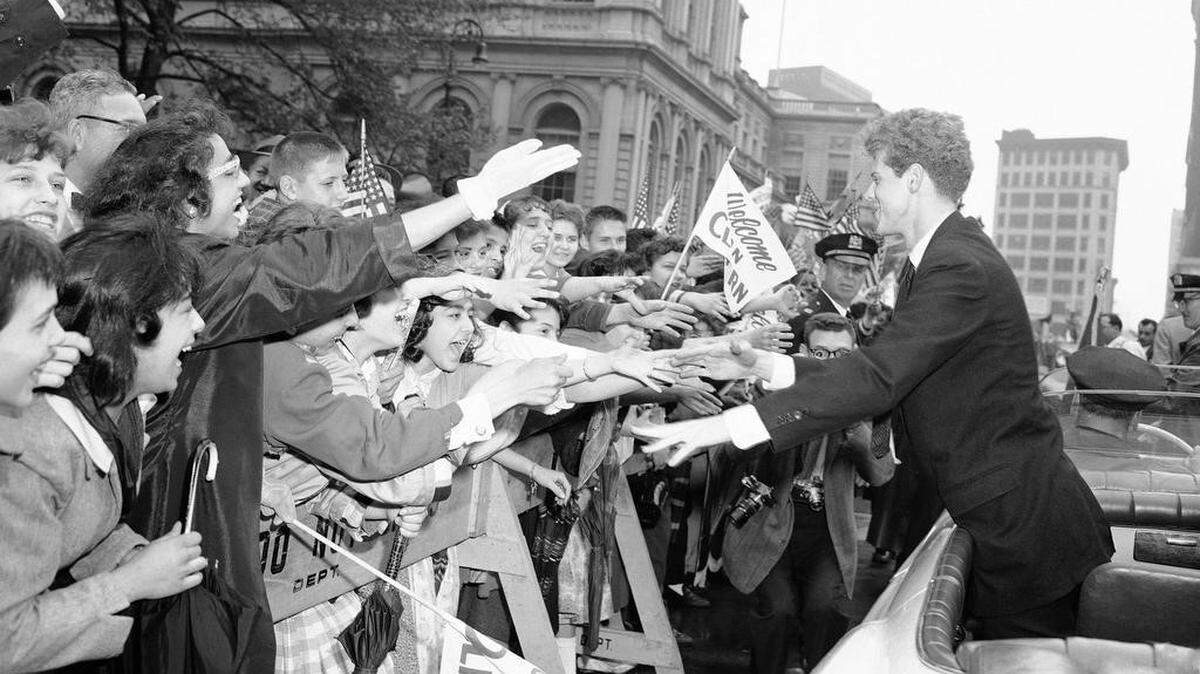
Yet politics is interwoven in the Cliburn Competition’s history. Contest namesake Van Cliburn rocketed to fame during the Cold War when he won first prize at the inaugural Tchaikovsky piano competition in October 1958 — six months after Russia shocked the world and punctured America’s prestige with the launch of Sputnik. As Cliburn played Rachmaninoff in Moscow, audiences swooned and threw rose petals on stage. New York welcomed Cliburn home with a ticker-tape parade. He later declared himself “a musical grandchild of Russia.”
The Texan’s fame temporarily thawed the chill in US-Soviet relations. It sparked the start of Fort Worth’s piano competition four years later. At the first piano festival, Russian-born Nikolai Petrov won the silver medal and Mikhail Voskresensky the bronze. At the second Cliburn competition, Radu Lupu, a Romanian who trained at the Moscow Conservatory, took the gold. Vladimir Viardo, the charismatic pianist staying at Martha and Elton Hyder’s Crestline Road mansion, won the grand prize.
Martha, a whirlwind who propelled the competition to great heights, escorted the 23-year-old on his U.S. concert tour. When a Cleveland snowstorm canceled their commercial flight to Cincinnati, she whipped out her American Express card. Telling Viardo this was a lesson in capitalism, she chartered a four-seat prop plane to reach his Cincinnati engagement. Such lessons in capitalism were interrupted within a year when the USSR revoked Viardo’s travel visa without explanation.
At the next Cliburn in 1977, South African Steven DeGroote won the gold, but all the buzz was about the Russians — always a force in classical music. Silver medalist Alexander “Lexo” Toradze had such an explosive, percussive style that he broke two keys on the Steinway grand at his host family’s home. The piano hammers split, leading to jokes that he held a black belt in piano.
While touring in Spain in 1983, Lexo, a Georgian native, evaded his Soviet handlers and requested asylum at the American embassy. In 1991 he became a professor at the University of Indiana and was the subject of “Kicking the Notes,” a public TV documentary. Last month, on May 11, Toradze, 69, died of heart failure.
The 1977 Cliburn shone the spotlight on another Russian, Youri Egorov, 19, who had defected to The Netherlands the year before. When Egorov did not advance to the finals in Fort Worth, outraged fans raised $10,000 to match the prize awarded the winner and arranged his New York debut at Lincoln Center’s Alice Tully Hall. At the time of Egorov’s 1988 death from AIDS, he had made 14 classical recordings.
The 1977 Cliburn Competition hosted five Soviet pianists. During the next decade, the Cold War hardened into a deep freeze. President Jimmy Carter imposed an American grain embargo against the Soviet Union. The U.S. boycotted the 1980 Moscow Olympics. The Soviets retaliated with an Eastern-bloc boycott of the Los Angeles games. In 1983, President Ronald Reagan vilified Moscow as the capital of the “evil empire.” Is it any wonder that no Soviet pianists participated in the Cliburn competitions of 1981 and 1985?
Change was in the air. Emerging Soviet politician Mikhail Gorbachev began pushing for Russian reform under the concept of “glasnost,” meaning openness and transparency. The travel visa of Vladimir Viardo, revoked in late 1973, was reissued in 1987. Very much in demand, Viardo performed outside the Iron Curtain and in 1989 accepted an endowed chair at the University of North Texas, where he remains on the faculty.
At the 1989 Cliburn competition, the winner was Alexei Sultanov, 19, an Uzbekistan native with so much talent and personality he made guest appearances on Johnny Carson and David Letterman’s late-night shows. Tragically, Soltanov suffered a stroke and died in 2005.
Glasnost led to “Soviet Space,” a ground-breaking exhibit in 1991 sponsored by the Fort Worth Museum of Science and History. Eighty tons of Russian space equipment went on display. More than 200 local volunteers served as translators and docents. A cosmonaut threw out the first pitch at a Texas Rangers ballgame. Soviets sat in box seats with George W. Bush, then a managing partner of the team.
Two days before the exhibit opened, the museum hosted a lavish gala. Van Cliburn had such a grand time chatting in Russian with 20 Soviet VIPs that he spontaneously invited everyone within earshot to an impromptu dinner party at his home the next night. He contacted the Fort Worth Club for catering. By the time guests reached Cliburn’s mansion in Old Westover on June 28, 1991, the dining room was set with silver trays piled high with pasta, seafood, caviar (flown in from five states) and shots of iced Russian vodka.
Happy to be hosting his new friends, Cliburn sat down at his Steinway grand and played Moscow Nights, a lively Russian tune, followed by the Soviet national anthem and The Star-Spangled Banner. That evening, there was harmony between music and science as the Cliburn again proved to be a vehicle reflecting the ups and downs in East-West relations.
(Hollace Ava Weiner, an author and historian, is director of the Fort Worth Jewish Archives.)