
How about this spectator sport: Purposely crashing two locomotives head on. Really.
America loves fads, and Joseph S. Connolly was a master promoter of one of America’s oddest fads: head-on collisions between two steam locomotives.
Under Connolly’s direction, on Sept. 11, 1896, at Des Moines, Iowa, two “40-ton ten-wheelers” faced each other from opposite ends of a temporary railroad track. Each locomotive’s engineer put his locomotive into motion, brought it up to nearly 40 mph and bailed out just before impact. When the two locomotives collided, both were demolished as iron shrapnel flew in all directions from a thundercloud of steam and smoke.
An estimated 80,000 people paid to witness the collision.
Why?
In 1896, locomotives were billowing, belching metaphors for America’s might as an industrialized nation. Locomotives were the fastest, most powerful things on Earth. They also were physically intimidating. There was something delightfully decadent, if not downright dangerous, about witnessing two such behemoths butt heads like rams on rails.
Connolly’s first collision had been a success. But four days later came an event that might have derailed the fad.
William Crush, a passenger agent of the Katy (Missouri-Kansas-Texas) railroad, talked his superiors into letting him stage a locomotive collision promoting the Katy. A temporary town, named for Crush, was erected outside Waco.
The spectacle was billed as the “Crash at Crush.”
An estimated 40,000 spectators watched as two 32-ton locomotives collided at 45 mph.
Two spectators were killed by flying shrapnel.
Tellingly, a tragedy that could have ended the fad instead ensured the fad’s longevity. Dozens of such collisions would be staged in the next 40 years.
And Joseph Connolly would be among the most prominent promoters.
By the time Connolly rolled into Cowtown in 1907, he had staged 26 collisions and had earned the nickname “Head-on Joe.”
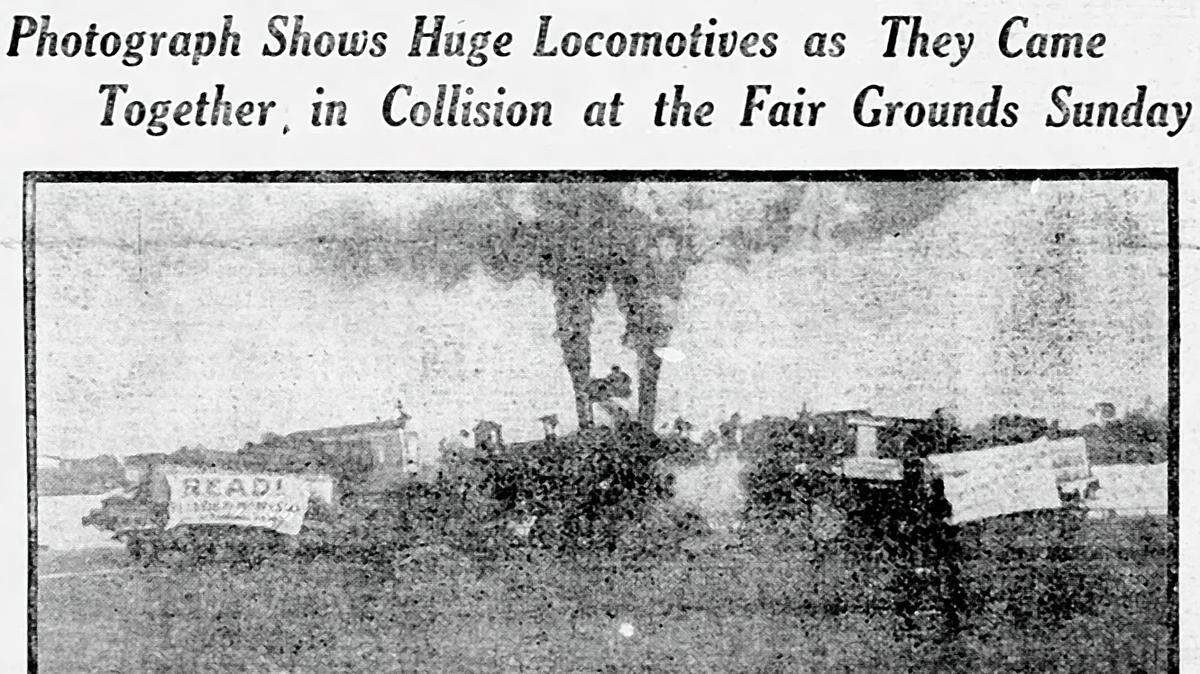
Connolly arranged to stage a collision at the Fort Worth fair, held in October at the Driving Park, located west of downtown where Montgomery Ward would one day stand.
Connolly had two locomotives brought in from Ohio. A temporary railroad track nearly a mile long was laid at the Driving Park, the Fort Worth Telegram reported.
On Oct. 13, the Dallas Morning News reported, an estimated 25,000 people “attended the Fair this afternoon to witness the head-on collision between two railway locomotives. The engines ... were started at either end of a ... straight track and came together with a crush in front of the grandstand. ...They were under full steam ... when they came together and there was enough of realism about the mimic railway catastrophe to excite the crowd. After the locomotives had locked together in a death grip an immense cloud of smoke and escaping steam rolled up from the site, obscuring the wreckage. Small pieces of iron flew for a short distance in several directions, but as the crowd was some 500 feet away no one was injured.”
In 1932, Connolly staged his final collision. By the 1930s the fad of staged locomotive collisions was losing its popularity. Amid the deprivations of the Great Depression, demolishing perfectly good locomotives seemed wasteful.
The last locomotive collision in America was staged in 1935.
Joseph S. (“Head-on Joe”) Connolly died in 1948. From 1896 to 1932 Connolly had staged 73 collisions and destroyed 146 locomotives. He was proud that no one had ever been (seriously) injured at one of his spectacles.
Mike Nichols blogs about Fort Worth history at www.hometownbyhandlebar.com.