A flurry of unmarked graves could be the neighbors of this new Fort Worth apartment complex
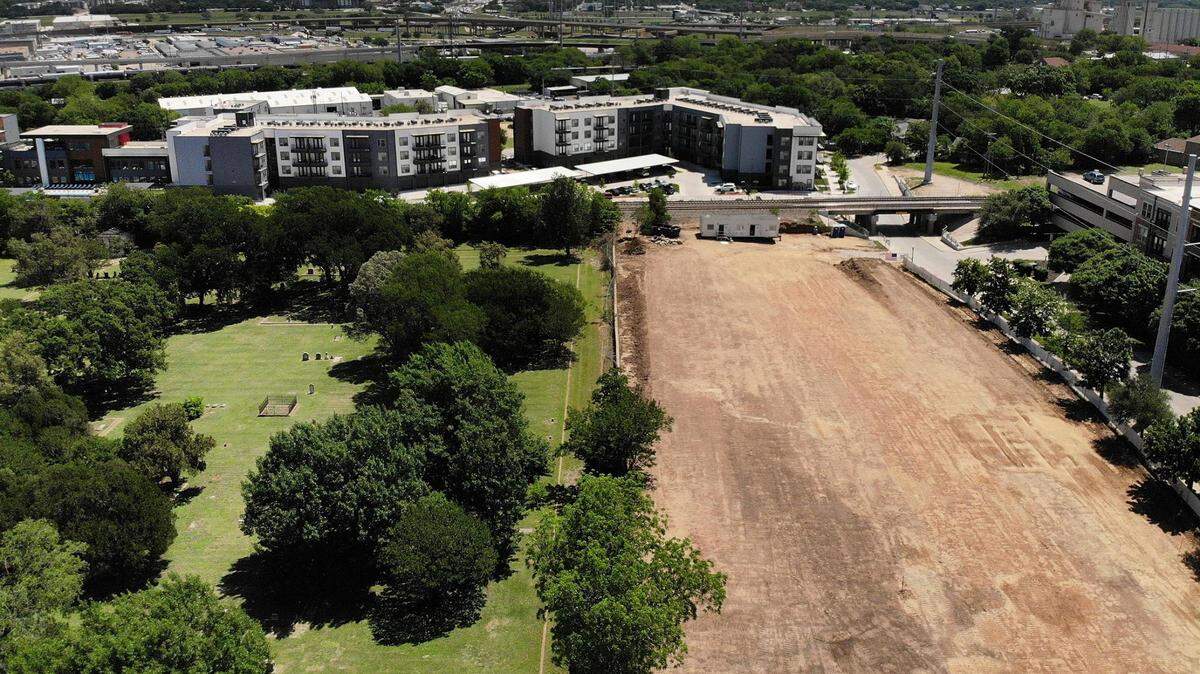
Just before noon on a cool Friday morning before blistering heat washed over a Fort Worth weekend, Pioneers Rest Cemetery off Samuels Avenue was a picture of peace.
The cemetery’s old trees stretched their branches over row upon row of worn headstones. It was nearly empty, and any silence was broken by the sounds of nearby traffic, a train screeching by or birds chirping somewhere off in the distance.
It’s a site that’s both Fort Worth’s oldest cemetery and on the National Register of Historic Places. Laid to rest here are some of the city’s earliest residents, like Edward Tarrant, as well as members of the Daggett family, who pioneered the early development of the city.
Like many areas in Fort Worth, Samuels Avenue has seen massive growth as apartments pop up every which way up and down the block. To any developer, it’s a cash cow, and it’s only natural that someone would want to build — and live — here.
But one new development is an unwelcome neighbor for the Pioneers Rest Cemetery Association.
In a plot that edges right up to the cemetery will sit Trinity Highline, a 172-unit apartment complex by Houston-based developer Urban Genesis that was approved by the Downtown Design Review Board in December.
Melanie Smith, the association’s secretary, said the city and developer didn’t bring the association to the table for the project. She also said she wasn’t notified about the project, which at one point sat dormant, until April.
The project for her comes with concerns about disturbances to the site, among those being the impact on vegetation with the tall building blocking sunlight, drainage from the apartments that will sit higher than the cemetery and more trash in an area that’s seen unpermitted use as a dog park by nearby apartment residents despite a big sign on the black wrought iron fence outlawing pets.
But the biggest concern of all: the cemetery’s unmarked graves, and it’s unclear how many there are and which ones lay within or outside of the property line. Smith and association president Ervin Hauk believe the developers’ assessment for possible remains wasn’t enough, and said they would’ve partnered with the developer to figure it out had they been asked.
History shows that before Pioneers Rest became the cemetery it is today, it was a plot of land with no clear ownership where those who died were buried haphazardly. There’s a high probability those in the unmarked graves were members of the city’s disenfranchised Black, Hispanic and Native American communities, Smith said.
Hauk’s concern with the incoming apartment’s proximity: “You’re covering up people,” he said. “You’re losing history.”
Smith, who’s also a Daggett family descendant, said most of the unmarked graves are in the cemetery’s southeast corner, which backs up to the concrete wall separating the cemetery and property where the apartments will be. The only way to tell which side of the fence those remains could be is to start digging.
A planning manager with the city said the developer covered all its bases with the project to make there wasn’t a disturbance of remains.
Sevanne Steiner, a planning manager for the Downtown Urban Design District and manager of the review board, said the developer had someone examine the soil during the project’s grading process. She said no remains were found, and that the developer told her the processes were agreeable to the Texas Historical Commission.
Messages from Urban-Genesis were not returned.
Smith and Hauk said the process should’ve been more than just looking at the soil. Hauk said the area should’ve been scanned with a magnetometer or ground penetrating radar. If either of those picked anything up, then they’d need to dig down six feet to check in a process called ground truthing.
“That’ll tell you the truth,” Hauk said.
An archaeologist should have been involved, Hauk said.
Steiner said her office isn’t required to notify neighbors about incoming projects but It does send courtesy notices to those who are registered neighborhood organizations or alliances.
Both Smith and Historic Fort Worth Inc.’s executive director Jerre Tracy argue the cemetery association should’ve had proper notification. The site was placed on Historic Fort Worth Inc.’s endangered places list in 2007.
Steiner also said the issues brought forth by Smith weren’t under the purview of the review board, but that she knew there had been a drainage study done and storm water prevention protection plan approved before the site’s grading.
There are laws in place that protect cemeteries and remains, but the blurred line comes with the notion of an unmarked grave. Burial laws for unmarked graves don’t take effect until remains are found, a representative with the Texas Historic Commission said.
Steiner said that if remains are found at all during construction, it has to stop immediately and the authorities need to be notified to determine if the remains are historical or the result of a crime.
Tracy said that across all of Fort Worth there has been never-before-seen concentration and density in the form of chunky apartments. The consequences of that growth and its impacts to historic areas are making themselves clear in the situation at Pioneers Rest Cemetery, she said.
And Hauk agrees — development has its consequences.
As he walked the cemetery on Friday, he came across two crunched up water bottles at the back of one headstone. Hauk sighed heavily, his hands resting on the hips of his Wranglers.
”There needs to be something done.”
This story was originally published May 6, 2022 at 4:48 PM.