
Riverside revival: How Fort Worth’s Race Street came back from the dead
Resurrecting is a good way to describe the revival of Race Street because it is anchored on one end by the beautiful Birch Easterwood-designed Riverside Baptist Church building, itself reborn recently as The Cielo Place at Riverside apartments. Race Street is coming back from the dead, or at least the stretch from Sylvania Avenue to Six Points.
Race Street is the commercial heart of Riverside. Nobody knows how it got its name. It was laid out as part of the Riverside neighborhood in the 1920s after that area was annexed by Fort Worth. Early on, it was a combination of commercial and residential properties that ran down to the Trinity River on the west and merged with Belknap Street and Riverside Drive to form “Six Points” on the east. Commercial development dominated the section going east from Sylvania.
In 1930 when state highways Texas 10 and Texas 121 were building into Fort Worth from the east, property owners on Race and Belknap streets battled to get the route. Belknap Street won, and in 1934 the Belknap Street Bridge over the Trinity opened, connecting Riverside to downtown. Thereafter Race became strictly a neighborhood thoroughfare. At the time it was not paved. That did not happen until 1932.
Two of the earliest businesses on Race Street were Riverside Lumber Yard (2601 Race St.) and Hilliard Furniture (3200 Race St.), which were successful because of the area’s rapid growth. Neither business suffered from being on an unpaved street. They made money from the booming construction in the area.
Race Street really came into its own after World War II. Real estate promoters proclaimed it “the coming street for business” because it was conveniently situated just two miles from downtown. Promised development for this “rapidly growing industrial and residential district” included a new bank, Post Office, and bowling alley. Churches and retail were certain to follow.
It became a thriving thoroughfare that fulfilled that promise. Landmarks that went up in the late 1940s and ‘50s included Riverside State Bank, a U.S. Post Office, Riverside Baptist Church, Scott Drug Store, and the Tower Theater. The western end was anchored at the intersection of Race Street and Sylvania Avenue by Lucas Funeral Home and Riverside Ice Co. The funeral home was a family business that came to Riverside in 1929. In the years following they buried everyone who was anybody in Riverside, including J.J. “Mickey” Hurley, longtime president of the Riverside Civic League; and Doyle Willis Sr., the longest serving state legislator in Tarrant County history.
Riversiders got their first neighborhood movie theater in 1929, but the Texan (first show: “The Greene Murder Case” with William Powell) was nothing compared to the Tower Theater, which opened in 1942 (first show: “Birth of the Blues” with Bing Crosby and Mary Martin), the most luxurious neighborhood theater in Fort Worth at the time.
The Post Office (2900 Race St.) and Riverside State Bank (3000 Race St.) arrived in 1946. The Post Office provided Riverside residents with window service for the first time. The bank offered patrons the luxury of “ample free parking.”
Things were definitely looking up by 1951 when the Melody Shop opened at 3100 Race St., selling the latest music in the form of LPs, 78s, and soon, 45s. That same year, Riverside Baptists built a magnificent building at 3101 Race St., which boasted air conditioning for a sanctuary that seated 800.
In 1948 Race Bowl opened at 2800 Race St. It was hands-down the most modern bowling alley in Fort Worth at the time with 16 lanes, “semi-automatic” pin-setting machines, air conditioning, and a television in the lobby. In 1965 it became Riverside Lanes, aiming to improve its image by advertising itself as a “family bowling center.” In 1973 it became Fort Worth Bowl but lasted only five years. When it burned down in 1978 it was the oldest continuously operating bowling lanes in Fort Worth, and that was the last Riversiders saw of a bowling alley on Race Street. Leisure entertainment tastes had changed and so had the neighborhood.
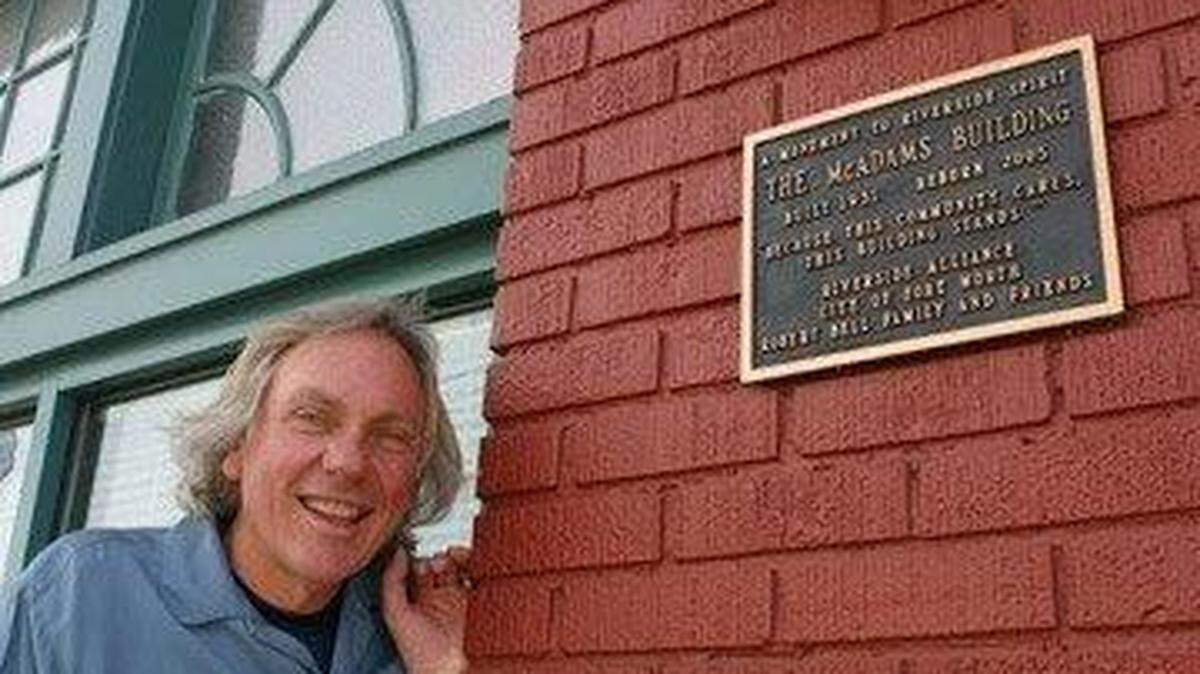
Anchoring Race Street at Riverside Drive on the south side of the street (3100 block) was the red-brick McAdams building, built by J.A. McAdams in 1931 for $14,000. Over the years to follow its principal tenant was Scott’s Drugstore, but slowly it sank into disrepair until the last tenant moved out and it became an eyesore seemingly destined for the wrecking ball.
The fate of Race Street was always tied to the surrounding neighborhood. As that changed in the 1960s so did Race Street. Riverside had once been an all-white neighborhood. The first Black families moved into the area in 1956, and white residents fought the change bitterly. But the racial makeup of the neighborhood changed along with its socioeconomic status. In 1965 the Playmate Club opened at 2816 Race St. Its Black customers came to hear Ray Sharpe and his band among other acts until the place closed in 1970.
Real diversity in the neighborhood meant not just Black people, but Latinos and eventually Vietnamese. Middle-class whites moved to the other side of town, and one by one the old businesses moved out or closed for good. The Tower Theater shut its doors in 1966, after 25 and more than a thousand bookings. It was torn down and replaced by a 7-Eleven. Riverside State Bank had already moved to East Belknap Street in 1956.
By 1999 the Riverside Baptist congregation was described as “a declining church,” attendance having dwindled to fewer than 100 on Sunday mornings. Attempts to merge with a nearby Hispanic congregation failed, and on Dec. 23, 2018, they held their last service in the building. They sold their beautiful structure to a developer who had big plans for it.
But the resurrection of Race Street had already begun when the McAdams Building was saved from demolition by Robert Bell, who bought it in 2004 and made it the first major redevelopment on the street. New tenants included Mama Mia’s Italian restaurant.
Unfortunately, saving one landmark alone did not reverse the decline of the street. Perhaps nothing represented that decline more than the closing of the Melody Shop in 2002. For nearly 50 years it had been a mecca for the record-buying public from all over the city, but its stock of popular albums and 45s was no longer in demand. Lena Mae Ball, who had started the business with her husband, finally retired, and no new investor came forward to keep the doors open.
Race Street’s fortunes turned after the city designated Six Points as an “urban village,” ripe for private investment. But developers were slow to come. It finally roared back to life in 2018 with the Star-Telegram dubbing it “the next hot neighborhood.” Now the street’s “bohemian” culture gave it new appeal. The catalyst was the creative re-use of the Riverside Baptist Church. It was Fort Worth’s first historic church building “adaptively used” as residential space.
In 2019 the old Post Office building was reborn as The Post at River East, a restaurant, bar, and performance venue that turned the shell of the building into an open-air patio. Other recycled spaces were 2920 Race St. (Born Late Records & Tatoos) and 2929 Race St. (a craft brewery). The developer, wanting to avoid the neighborhood’s old negative connotations, christened it “River East,” which made no sense historically or geographically but sounded tres chic.
Today the street’s future looks bright, but for old-timers, nothing will ever replace memories of the Golden Age of Race Street in the ‘50s when you could parallel-park your car while you mailed a letter, bought a few records, had an ice cream soda at Scott’s Drugstore, and took in the latest movie at the Tower theater.
Author-historian Richard Selcer is a Fort Worth native and proud graduate of Paschal High and TCU.