Med school split: TCU-UNTHSC separation agreement gives details of institutional divorce
Leaders of TCU and the University of North Texas Health Science Center are putting positive spin on the recently announced split over Fort Worth’s allopathic medical school. But the separation agreement between the schools highlights the reality of an institutional divorce.
A 14-page separation agreement between TCU and UNTHSC, obtained by the Star-Telegram on Thursday, breaks down the logistics of splitting a medical school in two. The agreement, which went into effect on Jan. 1, addresses everything from student ID cards and library access to insurance coverage and custodial services.
The document also hints at the deeper question of why the institutions are parting ways.
The two universities issued a joint announcement of the separation on Wednesday but did not provide any details about what led to the split. Press releases and official comments instead heralded the separation as “the next evolution in the advancement” of the school.
But the separation agreement says that HSC and TCU couldn’t agree on how to work toward joint accreditation for the medical school, which is an M.D. program.
“Although the Parties have explored various paths towards a joint medical degree program, the Parties have not been able to agree on pursuit of a specific path toward a joint medical degree program,” the agreement reads.
HSC spokesperson Laken Rapier said in an email that there “was no one reason that led to the decision to transition” the medical school to TCU. Both TCU and HSC representatives told the Star-Telegram that the decision to part ways had been in the works for several months before its official announcement this week.
State Rep. Charlie Geren, who sits on TCU’s board of trustees and who spearheaded state legislation that paved the way for the joint medical school, said Thursday that he knew about the possibility of a split before the official announcement but “didn’t realize it was going to be announced this quickly.”
The TCU-HSC partnership launched in 2015, and the joint medical program welcomed its first class of students in 2019. The school’s launch meant that Fort Worth no longer appeared on the list of large cities without an allopathic medical school, which indicates a school that offers an M.D. program. But HSC has long had another medical school, offering a D.O. program, in the Texas College of Osteopathic Medicine.
While TCU has been the degree-granting institution for the M.D. program, the joint medical school has used HSC facilities. As such, a portion of the separation agreement is essentially a lease agreement.
During the transition of the medical school to TCU — the medical school will eventually move to leased space, according to a TCU spokesperson — the school will continue to use space in the HSC Interdisciplinary Research and Education Building.
According to the agreement, TCU will lease 60,000 square feet of space from HSC at a price of $180,250 per month in rent, an additional monthly $32,629 in maintenance and operations fees, and $11,441 in security fees — for a total of nearly $225,000 per month.
HSC will provide standard utilities to the TCU medical school in that space, the agreement says, but TCU will be responsible for reimbursing HSC for phone and internet use. That lease runs from Jan. 1 through the end of August, the agreement says, with an option to renew until the end of December.
TCU will also be able to use other HSC space as needed, the agreement says.
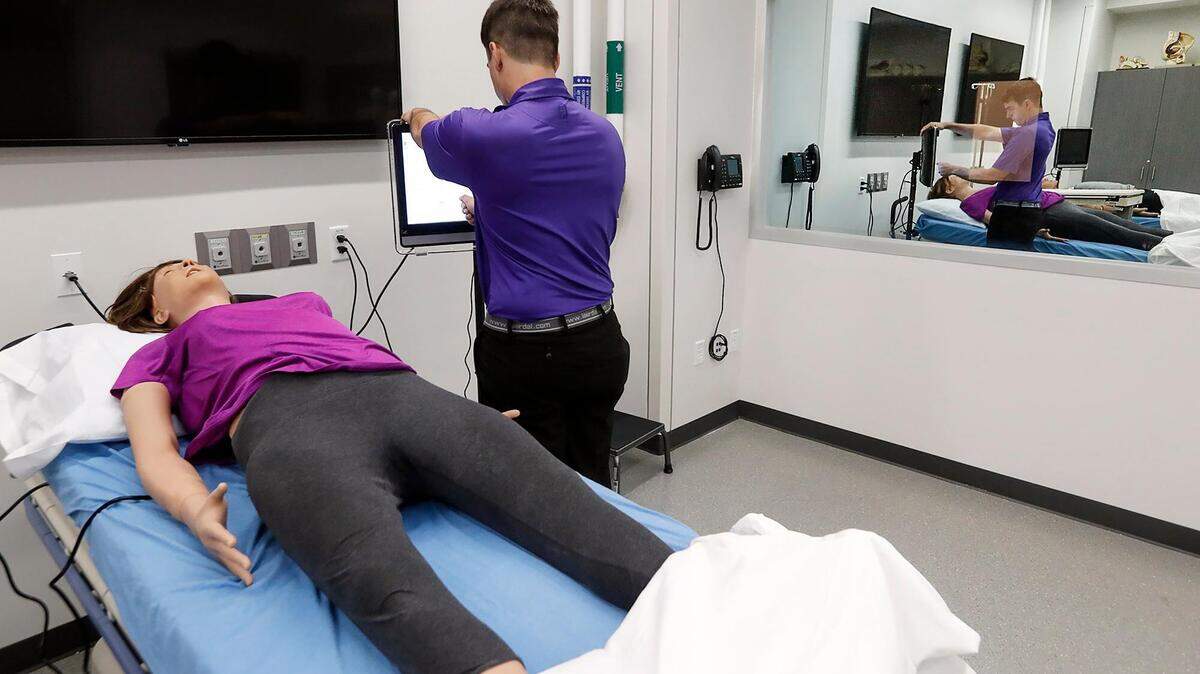
The agreement delves into the specifics of use for a number of additional spaces, including the library and the labs. Under the agreement, TCU will pay to use all of these facilities: more than $1 million for a library subscription fee, plus $165 per student per semester for access to the library. TCU will pay several hundred dollars per student per semester in a cadaver anatomy fee, and $1,000 per day for use of the anatomy lab room. Meanwhile, the fee for the simulation lab and clinical skills lab is included in the other fees that TCU is paying to use the HSC facilities.
The details included in the separation agreement underscore the complexity of an institutional split.
Fort Worth City Councilor Elizabeth Beck, whose district includes a large portion of TCU, said she saw a similar split firsthand when she was a law school student at Texas Wesleyan as Texas A&M took over the program.
With that perspective, Beck said she isn’t concerned about the medical school split having a negative impact on the community, although she did reference potential logistic challenges during the transition.
At the law school, “the hiccups were in things like processes changed, merging systems and those type of more mechanical, administrative type of issues,” Beck said. “That’s probably indicative of any time companies merge or split or switch to new systems.”
TCU, for its part, said that students’ academics will not be interrupted as their program becomes the new TCU School of Medicine, and that students will see “little difference in their day-to-day education.” Similarly, most of the medical school faculty are already TCU faculty; an HSC spokesperson said the few exceptions — a total of six employees, according to the separation agreement — will be offered TCU positions during the transition.
Tarrant County Judge Glen Whitley, who formerly sat on UNT’s board of regents, said the transition may bring some bumps. But he also doesn’t foresee any long-term effect on the community — particularly because the allopathic medical school will still be in the city.
“I think it’s something that they need very much, I think it will bring a lot of prestige to TCU,” Whitley said. “And so I believe that, yes, this may slow the process a little bit, but I think it’s not going to really too negatively impact the whole process.”
This story was originally published January 13, 2022 at 5:15 PM.