TCU has become ‘full-fledged’ leader in protecting endangered African rhinos. How?
An African safari trip was always in the cards for Katie Lawton. From the minute she stepped foot on TCU’s campus, she was on a mission to study abroad in South Africa, where the university has taken groups of students since 2015.
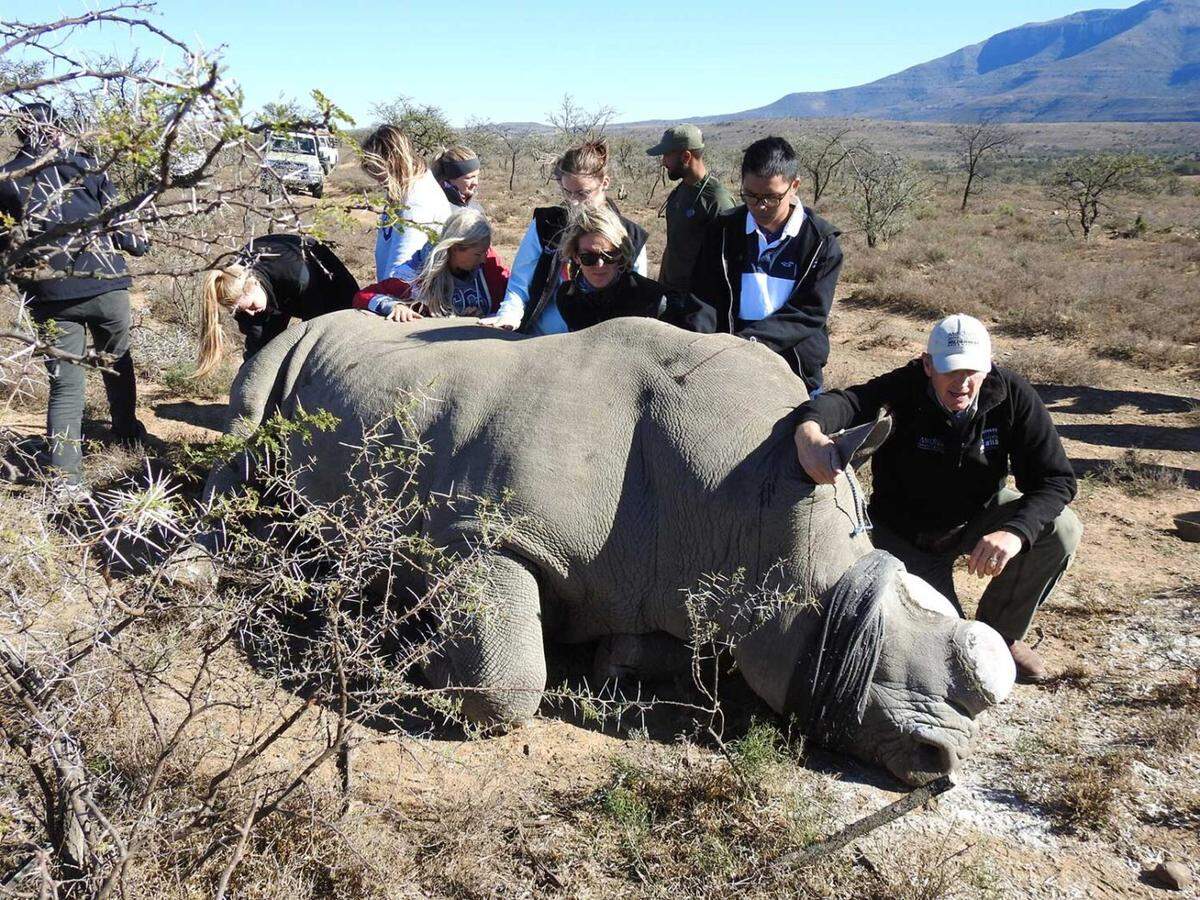
What she didn’t expect was for that three-week journey, led by the TCU Rhino Initiative, to change the course of her collegiate and professional career. Learning about the rhino poaching crisis and doing hands-on procedures with animals gave Lawton an “unexplainable” feeling pushing her to take action.
“It was honestly life-changing,” said Lawton, who graduated with an environmental science degree in June. “Because they immerse you so well into the actual rhino issues, you come out feeling really changed, like you’ve experienced the whole culture and that you really want to do something about it.”
The world’s rhino population has dropped precipitously since the beginning of the 20th century, driven by poaching and demand for horns in countries where they are believed to have medical benefits or religious power, according to Save the Rhino. Around 27,000 rhinos remain in the wild, compared to 500,000 in the early 1900s, according to the World Wildlife Fund.
Those alarming statistics inspired Michael Slattery, the director of TCU’s Institute for Environmental Studies, and South African wildlife veterinarian William Fowlds to form the Rhino Initiative in April 2014.
Originally imagined as a study-abroad program to give students direct experiences with wildlife, TCU’s initiative has grown to become the “full-fledged” academic partner for rhino conservation in the Eastern Cape of South Africa, Slattery said.
“We are very singularly focused on raising awareness and funds here in the United States so that we can relieve the burden of these reserves in South Africa that can help with rhino protection and management programs,” Slattery said. “That burden is especially acute as a result of COVID, because at the end of the day, wildlife conservation is a very expensive proposition.”
The pandemic cut deeply into South Africa’s safari tourism economy, which doubles as a massive funding source for wildlife conservation in the region. COVID-19 also forced the cancellation of TCU’s annual Rhino Run in March 2020, taking away one of the program’s most important fundraisers and “galvanizing” community events, Slattery said.
Coinciding with World Rhino Day on Sept. 22, the run is back on for Sunday, Sept. 19 at 2850 Stadium Drive on TCU’s campus. Registration is open for the adult 5K and children’s 1K races, both of which will kick off at Parking Lot 3 shortly after 8 a.m.
In the past, the thousands of dollars raised by the run have gone toward building the anti-poaching communication center at the Amakhala Game Reserve, where Fowlds is based. This year, funds will go solely toward rhino procedures, including the process of collaring rhinos to track their movements and help with anti-poaching efforts.
“COVID has put such a dent in the finances of these game reserves that they are a year to 18 months behind in their upkeep and maintenance, including batteries for these collars,” Slattery said.
For the first time, the event will be supported by a student group that has grown to more than 100 members, said Camilla Price, the president of TCU Rhino Initiative Club. Founded by Lawton and her study-abroad classmates in fall 2019, student leaders raised around $5,000 before campus life shut down in the early months of the pandemic, Lawton said.
The club has been deeply affected by COVID-19, forcing student leaders to hold outdoor events, host virtual guest speakers and find new ways to recruit members, according to Price. Luckily, the group has been able to gain traction due to people’s natural interest in helping animals, she said.
“I think people really enjoy the opportunity to make a difference for wildlife because it’s not something that we often talk about in our classes, or in other activities,” said Price, who came to TCU in part because of the initiative. “It definitely helps that rhinos are cute. We have a lot of signs that get people’s attention, and we can tell them about how rhinos are facing extinction and how they can participate with us.”
Why has this effort taken off at TCU and not a larger university with more international programs? Slattery’s personal connection to South Africa, where he was born and raised, is certainly part of the equation.
But there is something about TCU’s more “manageable” student body in comparison to larger Texas universities, as well as its commitment to being part of a “global community,” that has allowed the Rhino Initiative to thrive, Slattery said.
“I think it resonates because of the mission statement at TCU, and because of the connection that Texans have to the environment and to conservation,” Slattery said. “We have a wonderful zoo down the road from us. There’s an ethic of conserving and preserving landscapes that speaks to people.”
That ethic has spoken to Lawton, who returned to South Africa in July to work as a conservation intern based at the Amakhala Game Reserve. She is working on a project that would create more wildlife habitat for rhinos, elephants, giraffes and other wildlife species. None of it would have been possible without the Rhino Initiative, she said.
“I couldn’t have imagined that just two months after graduating that I would be here doing something that’s my dream job,” Lawton said. “I did not believe I’d be traveling halfway across the world. It all worked out perfectly, and I’m very grateful.”