
Fort Worth’s first community fridge program helps serve vulnerable neighborhoods
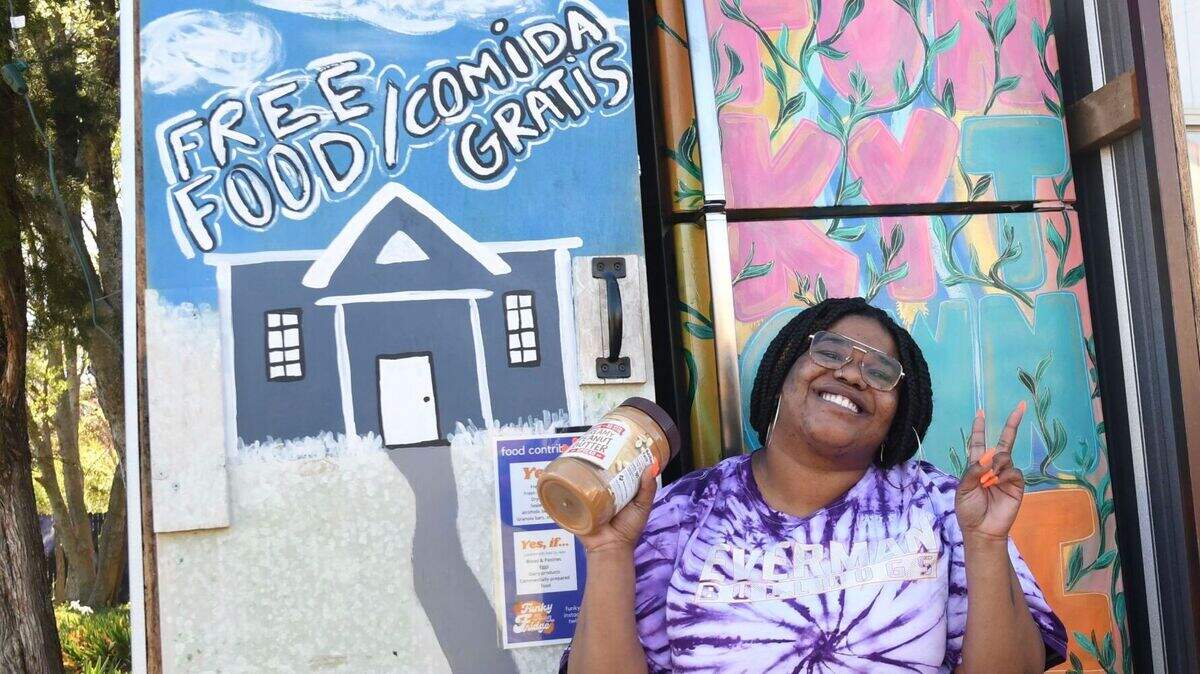
The pandemic and its subsequent economic upheaval prompted one Fort Worth native to adopt a creative approach to nourish people living in some of Tarrant County’s hungriest ZIP codes.
Kendra Richardson started Fort Worth’s first community fridge program, Funky Town Fridge, to give people access to food from refrigerators stocked by the community.
“I think the fridges are great mechanisms in our community to help feed those who may not ask for help or food in other ways,” said Lauren Selking, a Fort Worth citizen who donates to the fridge at least once a month.
Richardson opened three fridges, each in Fort Worth ZIP codes with limited access to grocery stores.
Fort Worth locals donated all three fridges to Richardson. The fridges look like they could be found in a kitchen, except they have all been decked out by local artists.
The fridge is housed inside of a wooden shed to protect it from weather. There’s also space for non-perishable food items and non-food items like hand sanitizer, toilet paper, pet supplies, baby formula and hygiene products.
In early July, Richardson saw stories about fridges in Houston and New Orleans. She started to search for her own fridges and reach out to possible host buildings to start her own community fridge project. By Sept. 26, 2020, Fort Worth’s fridges were open.
“I knew that this was something that Fort Worth needed,” Richardson said. “I wanted to show what action looked like. I created an Instagram to try to start get the word out.”
She placed the first fridge at 3144 Bryan Ave. in the Southside neighborhood. The others are in Poly and Como.
“There are no grocery stores anywhere in these neighborhoods where I now have fridges,” Richardson said.
Getting Started
It took some time for people to understand how the fridges worked.
“The concept is hard for people to grasp. You’re not used to seeing a refrigerator outside with a shed,” Richardson said. “I understand, I get it, but now more and more people are understanding.”
Once people started to understand the concept, her vision came to life. People started donating fridges, offering their building to be used as a host and donating food.
“It kind of took legs of its own and grew,” said Richardson. “I think now people see how dire the need is, and I think now the community is more committed to keeping them filled. We’re learning as we go.”
While community fridge programs have been around since 2015, more community fridge programs have popped up across the United States since the beginning of the pandemic, according to the Freedge database.
Freedge is an international network that was established in 2014 to promote and support community fridges. Freedge keeps track of community fridge programs around the world. The database shows 325 community fridges worldwide, with 169 located in the United States alone. Of the 325 fridges logged, 96 of them show the fridge installation date, with 42 installed between 2020 and 2021.
“We’re not just giving people anything that we just don’t want,” Richardson said. “They’re getting good quality food from Whole Foods, Sprouts, Central Market and everywhere else.”
People can bring fresh produce, bottled water, butter, yogurt, milk, shelf-stable meat and eggs. But community members should avoid putting items in the fridge like raw meat, homemade meals, soda and any non-nutritious food.
“My sister Mallory and I have donated to the fridge six times now,” said Fort Worth resident Melany Krazer. “We try to drop off once a week to once every two weeks. It depends on if we get enough goodies together or not that week.”
Krazer said she learned about the fridge from her sister, who saw it on Instagram.
To keep the fridges full, Richardson posts on Instagram to let the community know they need donations.
“Kendra does a great job shouting out to the community when the fridges are in need, and it seems the community always comes through in one form or another,” said Krazer. “It does seem that the community does a great job helping to keep them all full. I have seen nonprofits in the area, restaurants and small businesses step up and contribute too.”
The community is the grassroots of the project; anyone can stock the fridge at any time and anyone can take food whenever they need it. While Richardson and her team of volunteers check in on the fridges to make sure it is being filled with healthy food, it is up to the community to keep it full.
“I can’t come and fill the fridge every 30 minutes. But even if I did that wouldn’t be sustainable. I am trying to sustain this thing,” Richardson said.
The Krazer sisters have donated produce, almond milk, breads, canned goods, shelf-stable items like mac and cheese, tuna and spaghetti, fridge items, frozen goods, drinks, cereals, shampoos and conditioners, hygiene items and books.
“We always help and donate when we can,” Krazer said. “Mutual aid is a very neat concept because it isn’t necessarily donating, it’s giving what you can and taking what you need. You don’t have to jump through hoops to receive any items - it’s just there when you need it. I love that.”
The fridges make food easily accessible. Since the fridges are located in the neighborhoods where people need food, they do not have to worry about transportation to get to the food or about arriving at a certain time to pick it up.
“I believe they [the fridges] are serving so many members in our community who may not know where else to go,” Selking said. “We actually saw a gentleman when we were dropping food off and he was so kind and thankful. It feels good to know you are helping provide nutritional food for those that may not have access to it.”
Anyone can open a community fridge if they find a local business to agree to let the fridge be placed outside their building. The host building provides the electricity to keep the fridge running.
Some community fridge programs are a part of larger networks like Los Angeles Community Fridges (LACF) and A New World In Our Hearts NYC, but others are fully run by individuals and their team of volunteers.
The story behind the fridge
Richardson, who teaches high school world geography, grew up in the Stop 6 neighborhood where she constantly saw people around her in need.
“The more that people learn about the fridges, it brings awareness to how these communities have been suffering in Fort Worth,” Richardson said. “I started the fridge because there were already black communities in Fort Worth that were suffering from racism and then the pandemic hit, so I wanted to make sure that I did something to help ease the burden or make it a little bit better.”
Richardson said it’s not just about providing the community with food, it is about making a lasting difference in these neighborhoods and addressing the systems that allow hunger to persist.
“There was always a need,” Richardson said. “People still don’t have jobs; people are still living in poverty. All this was way before the pandemic. The pandemic just made it worse or it either highlighted what people are going through.”
Now that there is an accessible resource in these communities, Richardson said the food is gone all the time.
This story was originally published May 3, 2021 at 5:30 AM.