
A house was built with logs from the Fort Worth military post. It likely still stands.
The Army decided to close Fort Worth. By 1853, the old military post wasn’t needed anymore. Native American tribes that once frequented the area were peaceful or had moved farther west, mostly leaving this part of North Texas to Anglo settlers. The soldiers were sent off to other posts, some to a second line of forts farther west or toward the Rio Grande to guard against Santa Anna’s threatened actions.
What, then, to do with the old fort buildings? The bluff overlooking the Trinity River was a good site for a town. Families who had previously lived farther from the fort grounds picked up stake and moved to the bluff area. Some old fort buildings were reused, while others were dismantled and the timbers used in new buildings or stacked for the taking.
One of the new buildings constructed using logs from the fort was a two-room house built on the western edge of the old military grounds in the mid- to late 1850s. In 1869 the Gambrell family bought the small house, made additions, and operated a grocery from their home. Early city directories show that the house was located at 218 W. Belknap. J. C. Gambrell died in 1874, but his widow, Catherine, raised her two daughters in the house.
She finally sold the land to make way for the Tarrant County Criminal Courts Building constructed in 1917-1918. Mrs. Gambrell’s daughter recalled that her mother did not want to see the tiny house destroyed by progress. That was something that was happening all too often as Fort Worth boomed during the early years of the 20th century.
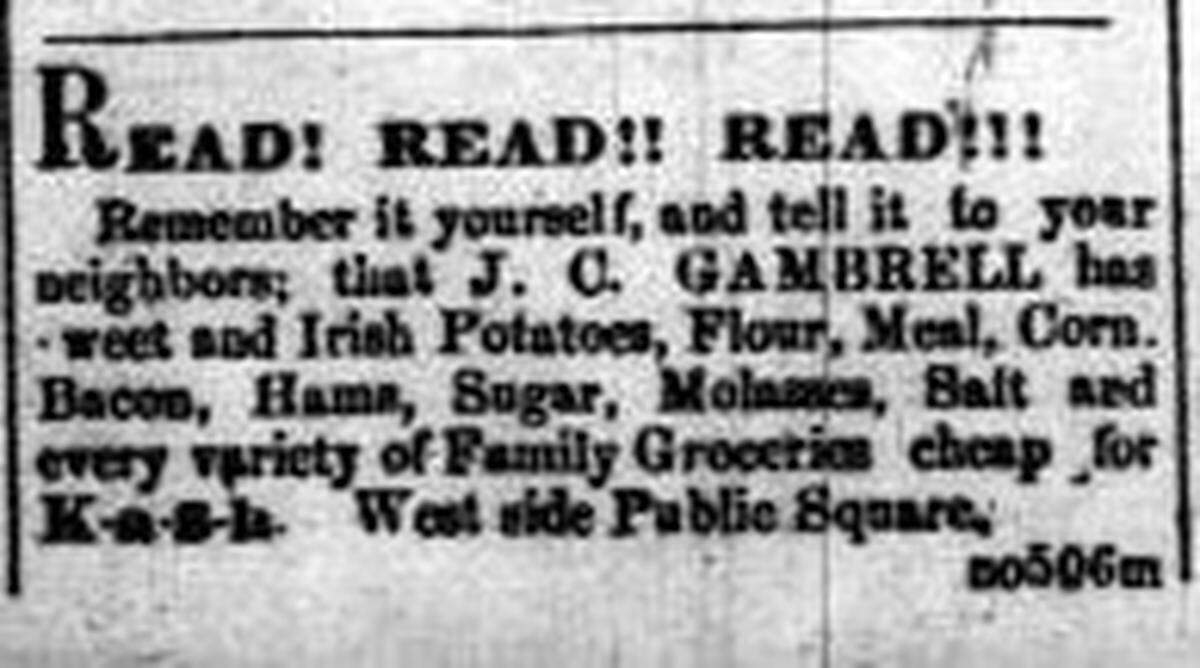
Instead, Catherine Gambrell had the house moved. By 1920 it was serving as a rental property in an old neighborhood just off Samuels Avenue near Pioneer’s Rest Cemetery. There it stood for decades. At least one fort timber was removed, now owned by Log Cabin Village and on display in the 1895 Room of the Tarrant County Courthouse. A gavel, now lost, was also crafted from a piece of an old fort log from the house.
After Mrs. Gambrell’s daughter died in 1947, the house slipped into obscurity. It was sold in 1965. Most historians, if they thought of the house at all, believed that it had been demolished. Today, using digitized historical documents, we now know that it is very likely that the house still stands.
Are the fort-era timbers still there? Probably. Taking out large structural timbers would be like moving a railroad track. You only do it if you absolutely have to. Tests are underway to determine how much historical fabric (a word preservationists use to mean the timber, nails, etc.) remains.
The family that now owns the house has limited economic resources, but has taken care of the house for 65 years. Apartment buildings are going up all around the house, so it may not be long for this world. It would be a shame to see what may well be the oldest house (although not on its original site – that honor belongs to the Van Zandt Cottage) in Fort Worth fall to the wrecking ball.
Carol Roark is an archivist, historian, and author with a special interest in architectural and photographic history who has written several books on Fort Worth history.
This story was originally published November 28, 2020 at 6:00 AM.