
Meet the forgotten hero of the Texas Spring Palace fire of 1890 in Fort Worth
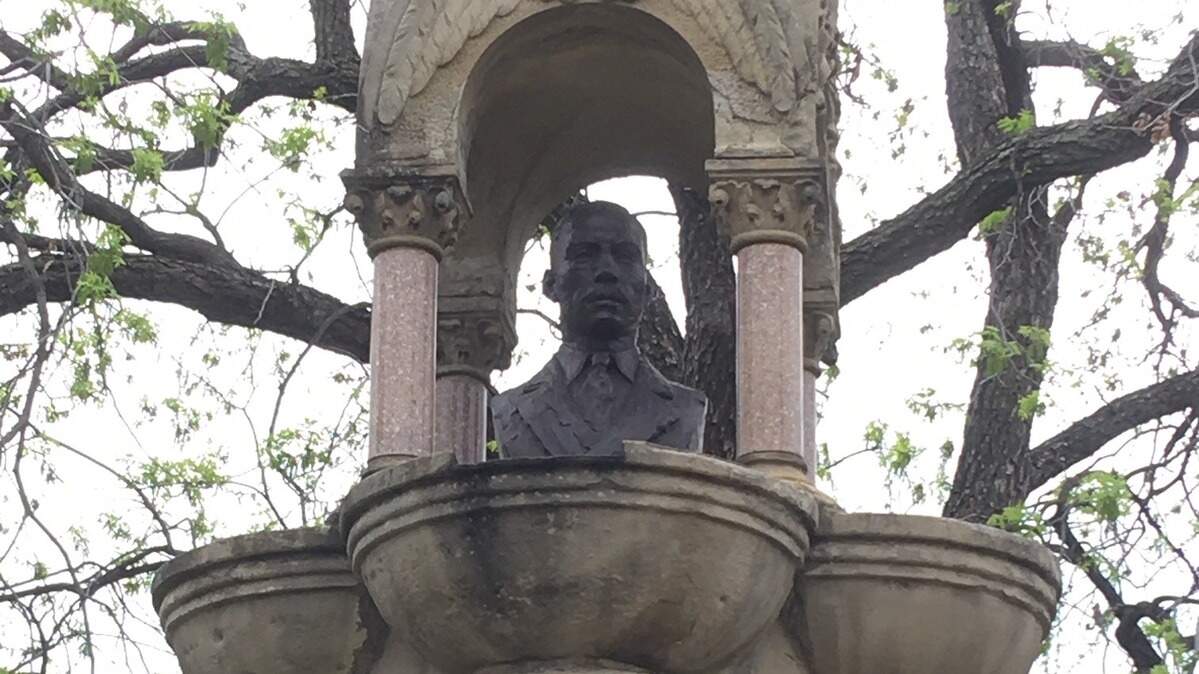
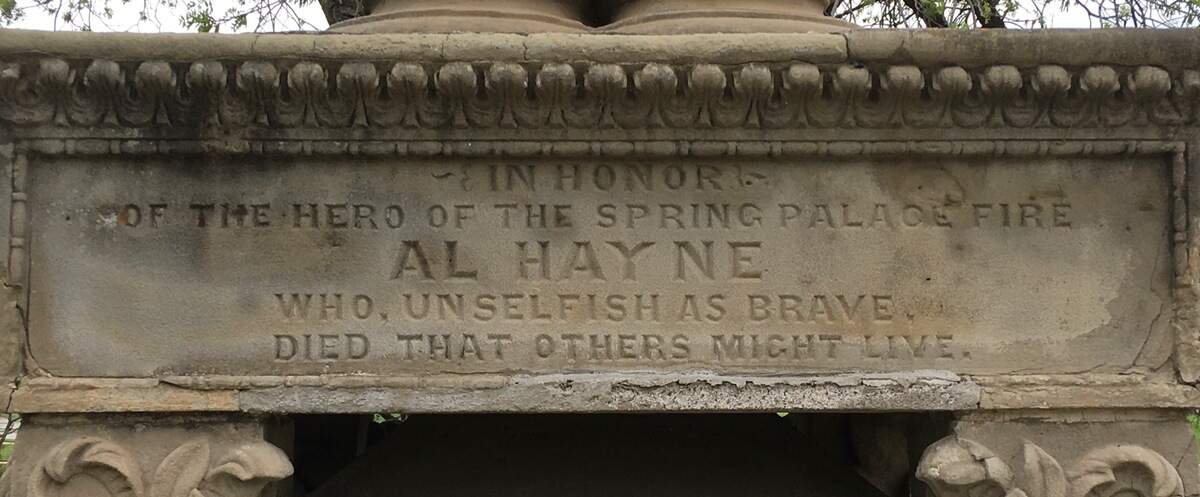
If you grew up in Fort Worth or have lived in our fair city for more than five minutes, you must have heard of Al Hayne, the hero of the 1890 Texas Spring Palace fire.
If not, you can drive down Lancaster and see his memorial standing near the intersection of Lancaster and Commerce. Al is a little weather-beaten but still recognizable.
He will forever be remembered for his self-sacrificing actions on the night of May 30, 1890. It was the last night of the Texas Spring Palace’s second season when the exhibition building erupted in flames. The thousands of people inside at the time raced in a panic for the exits.
Hayne, an English-born civil engineer who had called Fort Worth home for 10 years, was one of those inside, perhaps planning to attend the grand ball that night. He sprang into action, finding a rope somewhere and racing upstairs to the second level. There he began lowering those who had been overcome by smoke and flames to the ground from the west tower.
Then he managed to reunite some families who had been separated when the fire broke out and lead them and others down a staircase and outside. With the building collapsing upon itself, he raced back into the inferno one last time to see if anyone was left. Instead the rescuer became another victim. Those outside saw him appear at a window, his clothes on fire and his face and hands already badly burned. He was too weak to save himself.
Enter a second hero of that night, Jesse Williams, a stableman who had been standing on the grounds watching the comings and goings at the exhibition. He could watch from a distance, but he could not join the festivities because Williams was African American. That did not stop him from joining the rescue effort, however. He helped catch a lady lowered by rope from the second level, then with others he caught sight of Hayne through a window, “leaning up against a wall,” grievously injured.
Williams rushed into the building, picked up Hayne and carried him out to safety. He carefully laid him on the ground where others could minister to him. Only then did he notice his own coat was on fire. He put it out with some help then disappeared into the crowd. No one noticed. They were focused on getting the badly burned Hayne to the city’s only hospital, St. Joseph’s Infirmary, where he died the next day.
The conflagration from the first cries of “fire” to the collapse of the building lasted no more than 15 minutes. Six days later the Fort Worth Gazette recounted the story of the “Hero of the Spring Palace Fire,” eulogizing, “No truer hero ever died on American soil or for the American people.”
Below that eulogy it reported the story of the “brave colored man” who “did his best to save poor Al Hayne’s life.” Hayne was “a hero;” Williams “performed a heroic act.” It was an important distinction. The only other African American connected to the Spring Palace was the unknown “negro boy” whose energetic dancing reportedly ignited the fire when his shoe struck a phosphorus match, a story akin to the legend of Mrs. O’Leary’s cow starting the great Chicago Fire.
Subsequently, Williams might have dropped off the face of the earth. The only notice Fort Worth paid to him was a series of ads he placed in the “Help Wanted” section of the newspaper seeking “general utility” work for a “young colored man with good recommendations.” While looking for work, he resided at Bill Love’s saloon on 12th Street. There is no way to know if Williams found a job as a utility man, though surely someone would have hired the man who risked his life trying to save Al Hayne.
Three years later, the Woman’s Humane Society erected the combination monument-horse fountain in front of the T&P passenger station. Al was the first thing people saw in Fort Worth when they emerged from the station. And in local legend he was transformed into a full-fledged fireman and adopted by the Fort Worth Fire Department as part of its history.
As for Jesse Williams, he fell from the pages of history, a forgotten black man who had literally 15 minutes of fame on May 30, 1890. There are no pictures of Williams, no mention of him in Fort Worth history books.
Author-historian Richard Selcer is a Fort Worth native and proud graduate of Paschal High and TCU.