8-year-old Fort Worth girl got the ‘gift of life’ after her heart started failing
Lisa Robinson had to decide if, in the event her daughter’s failing heart gave out, she wanted to donate her good organs to children whose lives could depend on them.
It was a “hard conversation” for the mother to have, forcing her to consider the possibility her then-7-year-old daughter, Riley Robinson, wouldn’t make it. At the same time Lisa, 38, knew somewhere out there, another family could be having the same discussion that could save Riley’s life.
Riley, the second-oldest of four girls, caught a cold in November 2018 that persisted for weeks, even as her sisters came down with the same virus and it quickly passed. Lisa brought Riley in to her personal physician one day and an X-ray revealed a surprising discovery — her heart was failing. In clinical terms, she had dilated cardiomyopathy, or an enlarged heart with less power to pump blood.
She spent about seven months living at Children’s Medical Center Dallas waiting for her turn for a transplant, with devices implanted inside of her doing the work her heart couldn’t. Lisa ultimately decided she had to list Riley as an organ donor for all the girls and boys who knew exactly what she was going through.
Since Riley, 8, had her transplant operation in May, Lisa has felt a deep appreciation for — and a connection to — the family of the 11-year-old girl whose heart beats inside of her daughter’s chest.
“You’re loving somebody else more than yourself at that moment,” Lisa said. “It’s what love is, right?”
David Sutcliffe, who was part of Riley’s team of pediatric cardiologists at Children’s Medical Center, said the operation went well and Riley’s body accepted the new organ. “She is very strong, and that was very evident,” he said.
After missing most of last school year, Riley was able to return in the fall to Calvary Christian Academy, where her favorite subjects are math and science. The second-grader usually has enough energy when she’s done with school to play basketball with her sisters or have NERF gun fights.
“I’m glad that I have it,” Riley said of her new heart. “But at the same time, I’m sorry they lost whoever they had.”
Almost 10 months after receiving her life-saving transplant operation, Riley and her family shared their story at the end of American Heart Month to let people know the challenges faced by children who have heart failure, and that it’s not as uncommon as some might think.
Sutcliffe, who also serves as a pediatric cardiologist UT Southwestern Medical Center, said each year across the country there are around 14,000 admissions for heart failure in children. Though the defect is far more common in adults whose lifestyle factors can play a contributing role, he said, children with heart failure make up a large patient population that is “quite complex.”
Inside of Riley, Sutcliffe said, there was an error in her genetic code she had likely been living with her whole life that was triggered when she got her viral infection.
He was on the team of cardiologists at Children’s Medical Center Dallas who took on Riley’s case when she was admitted with what they call “end-stage heart failure.”
He and other doctors watched her, week after week and month after month, put up with the invasive devices and a cocktail of daily medications. They watched her maintain her goofy sense of humor, spraying silly string at medical staff and on one occasion even tee-peeing the nurse practitioner’s office with toilet paper and shaving cream.
They watched her smile her way through a time where the future was uncertain.
“Her strength and will and drive and just pushing through this entire course — which was by no means easy — is just a testament to what a wonderful child she is,” Sutcliffe said.
‘We’re just waiting for this heart’
Riley came close to dying her third night at Children’s Medical Center Dallas.
Measurements important to heart health — such as heart rate and blood pressure — were looking poor in Riley, and her body seemed ready to give up. Doctors gave her a series of different medications through “PICC lines” leading directly to her heart, Lisa said. Based on how her various counts responded, they would give her more of this medicine or that medicine.
They did this process of trial and error through the night, trying to keep Riley alive.
And Lisa believed she met an angel in scrubs.
A nurse named Reggie could overhear her talking with her sister about God in Spanish, which she learned as a child of missionaries growing up in Mexico. When Lisa lay on the bed to hold Riley, tears streaming down her face, he closed his eyes and led her in a prayer.
“He was just saying, ‘You know where she’ll be,’” Lisa said. “‘You know if she doesn’t make it tonight, you know that you’ll get to see her one day again.’”
Riley made it through the night.
But her long journey to a heart was only beginning.
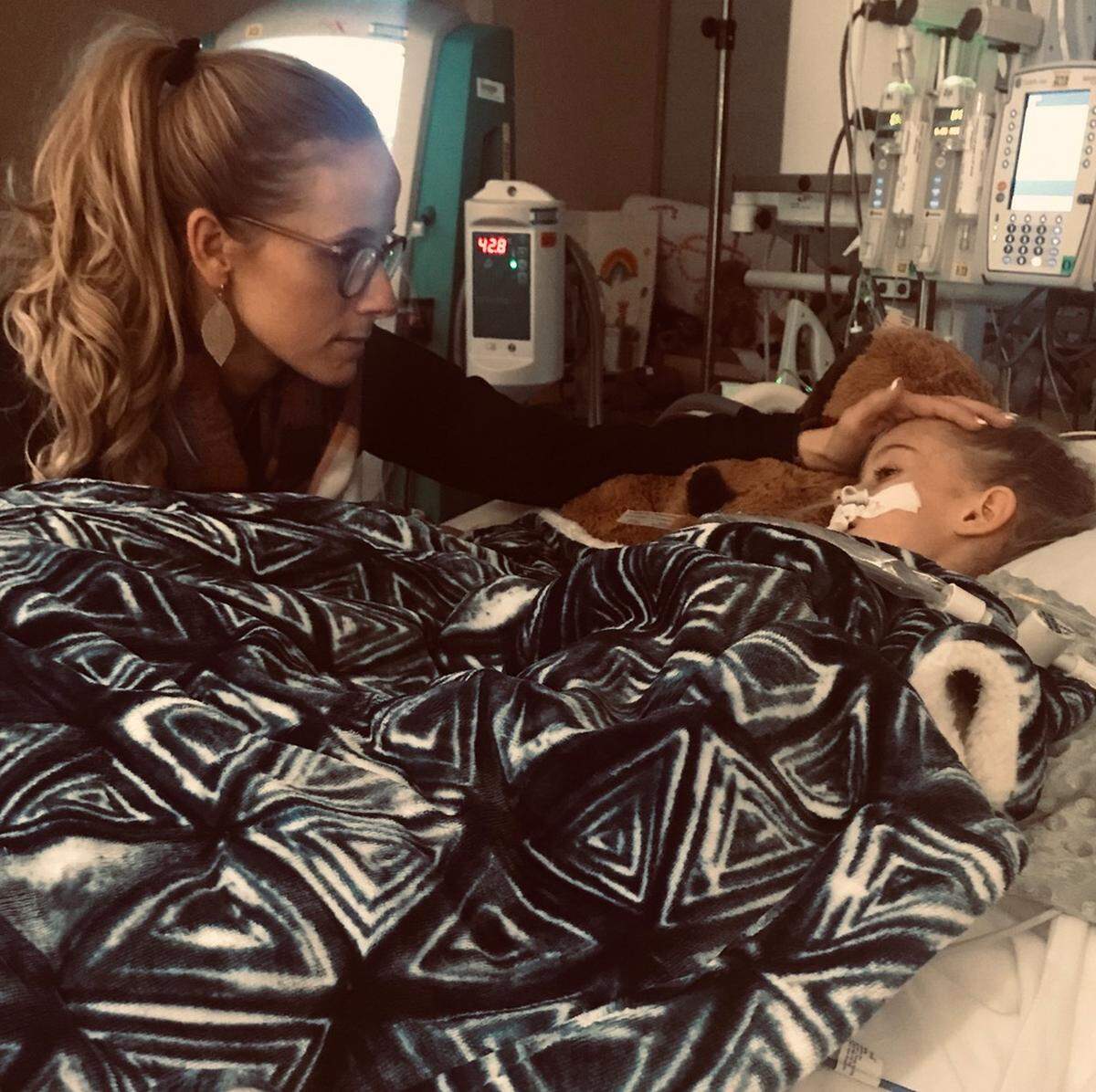
The medications stopped helping Riley, so she had to be evaluated for ventricular assist devices, or VADs, Sutcliffe said. The heart has two main pumping chambers — one on the right and one on the left — known as ventricles, and VADs mimic them. For many people with heart failure, an L-VAD or an R-VAD can be sufficient, but Riley needed both of them.
Photos taken at the hospital show Riley, frail and weak, with two tubes jutting out of her stomach into a large electrical machine. She remembers that one of the VADs took her blood out, causing it to circle through the tubes, “and then it would go out the other tube into me.”
The L-VAD and R-VAD allowed her to stabilize and to get back to being herself. She named the twin devices after her two favorite superheroes: Green Lantern and “Spidey,” or Spider-Man.
“Then Riley started to have a lot of fun,” Lisa said.
As she waited for her name to rise to the top of the transplant list, she turned Children’s Medical Center Dallas into her own personal playground. One video taken by Lisa shows her tearing through the hallways on a trike, her VADs still connected to the large machine being pushed by a nurse. Another shows her having a water-gun fight with staff outside of the hospital, the machine covered in plastic.
One day, she had a lightsaber duel with a nurse as the triumphant “Rocky” theme blared in the background.
“We’re just waiting for this heart. Everybody keeps telling you that it’s gonna come around the corner, and then it’s not,” Lisa said. “I just was motivated to try to help her have fun and try to do things that other people hadn’t.”
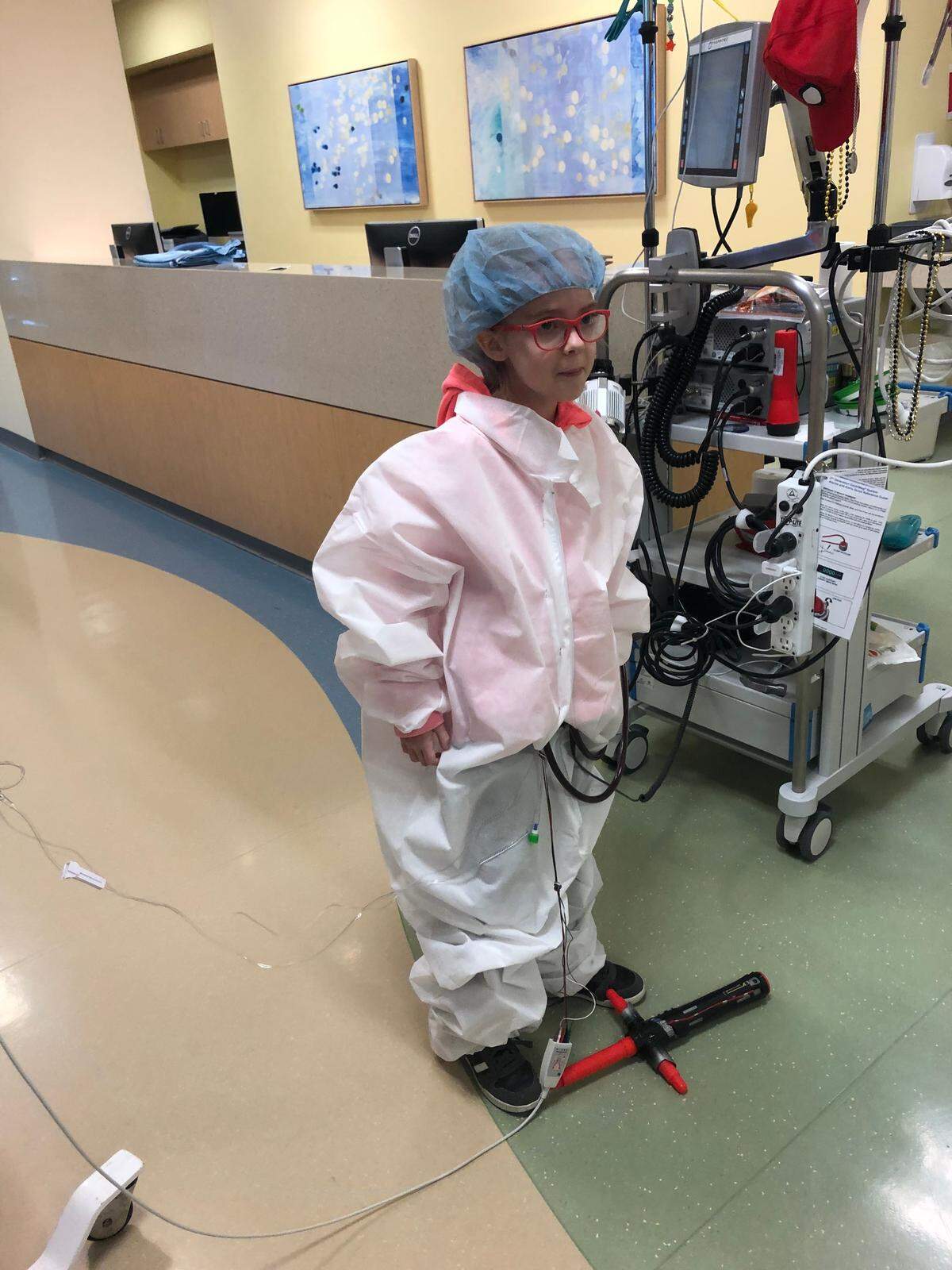
Riley’s older sister, Jada Robinson, 10, said she was proud of her for how she handled everything.
“At the same time, though, it was scary in some points where she was getting worse,” Jada said. “During the flu season, it was also hard to know that we couldn’t see her because of that, and we wanted to be there for her.”
When it would be time for Riley’s transplant operation — meaning she met the criteria of being the highest risk and having the right organ come along — Lisa didn’t want the doctors to ask her any questions, only to tell her. She gave them a codeword to use: Pineapple.
Riley’s VAD coordinator was Facetiming with Lisa, Riley and two of her sisters when she held up something to the camera.
“They had a cup of pineapple,” Riley said with a big smile on her face.
‘The gift of life’
Riley was excited she was ready to get a new heart but also nervous about the surgery, unsure when she would wake up or how she would feel, she said.
The medical staff tried to help ease her mind.
She remembers as she was heading into her surgery, her mother played Christian worship music and doctors and nurses danced by her side all the way into the operation room. Most kids, her mother reminds her, don’t get to walk into their own surgery. But doctors let her.
The operation lasted about eight hours, Sutcliffe said, and it involved putting Riley onto a heart bypass machine to keep her blood flowing, stopping her heart entirely and sewing in a new heart in place of the old one.
Her mother remembers seeing her wake up in the ICU, her chest visibly open and covered in plastic so doctors could monitor her new heart, which was slightly too large.
“She’s talking to you while you have this chest open, so that part was intense — to see that and to encourage her not to move,” Lisa said. “At the same time being excited she has this new heart and there’s this hope she can come home.”
But she wasn’t in the clear — the sudden replacement of VADs with a working heart raised her blood pressure, and she ended up having a stroke and a seizure. The sicker a heart transplant candidate is going into surgery, Sutcliffe said, the sicker they will be coming out.
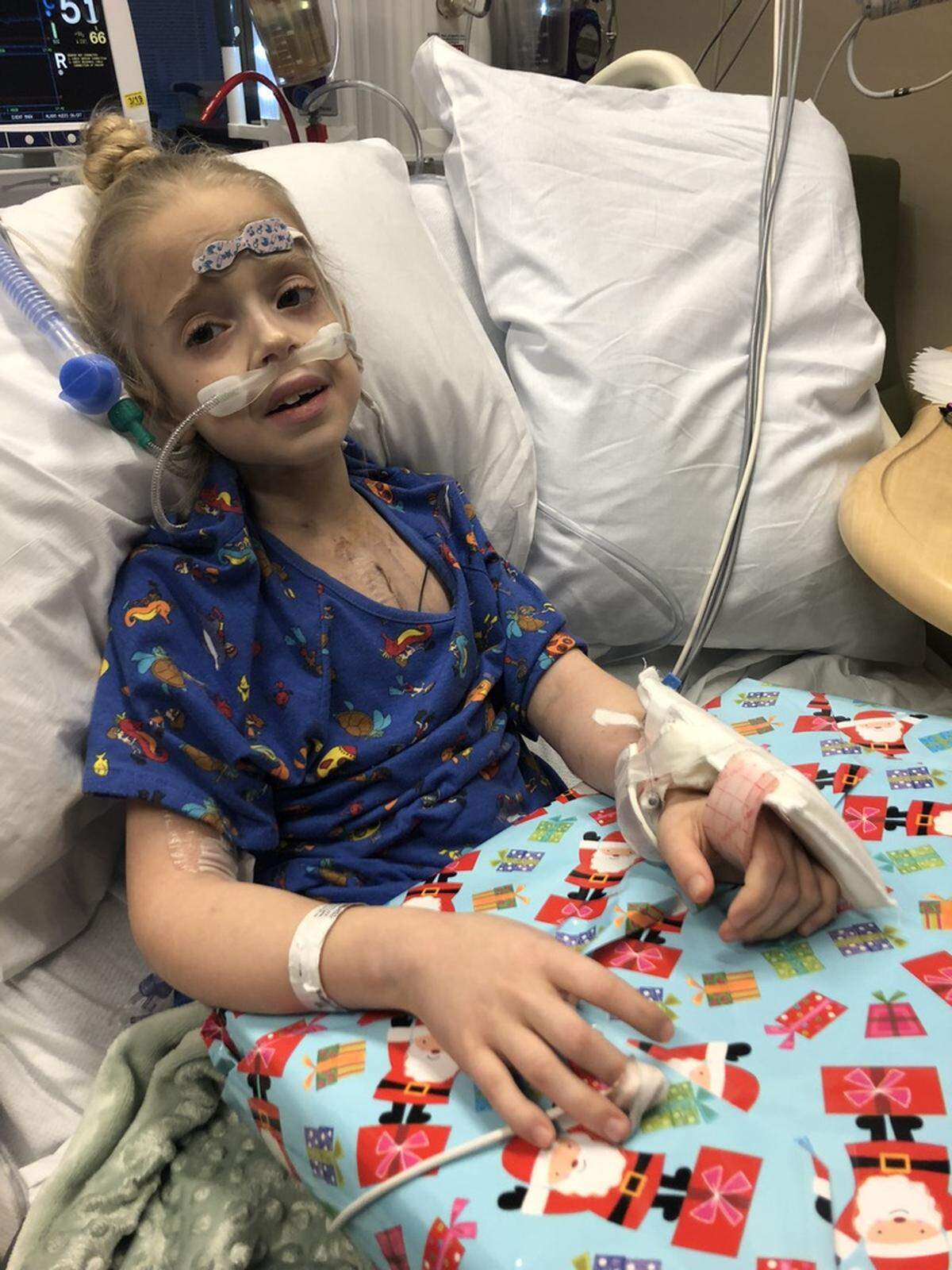
Riley was unable to move the right side of her body for around 30 minutes, and her mother prayed for movement as she was being moved to get a CT scan.
When she got to the doors of the room, she raised her right hand and ripped the breathing tubes out of her nose.
“We all just started praising God in that moment,” Lisa said.
For the first three months after her operation, Riley’s immune system was weak and she had to spend time in isolation in the hopes of avoiding catching a virus. Every two weeks she would see her respiratory therapist, who drew blood and performed an EKG to check up on her heart.
Over time, however, she has gone down to one meeting a month. And she has returned to a normal life.
Her heart, Sutcliffe said, should last her for roughly 15 to 18 years, which is typical for children who receive transplants. She said she takes medications every day to keep her heart strong, blood thin and blood pressure low.
As she spoke to the Star-Telegram before the end of American Heart Month, she said if she had to give advice to other kids with heart failure, it would be “even when you’re hurting, you should get up instead of laying in bed.”
“Because when you get up,” she said, “you get stronger.”
Each of Riley’s sisters wrote letters to the family that donated the heart and, within the next several months, they received a letter back expressing excitement the heart was a match.
They hope they can meet with the family one day so they can say thank you in person.
Lisa just isn’t sure how she will say it.
“They gave us the gift of life,” she said. “How do you thank someone for that?”
This story was originally published February 29, 2020 at 6:00 AM.