
‘Our kids are dying.’ How these Fort Worth area schools are trying to prevent suicide.
Michael Chaney shared a story that he almost wasn’t alive to tell.
“When I was 16 I made three attempts at suicide. My family didn’t learn about it until I was an adult, but yes, I almost killed myself three times,” Chaney said.
The thing that kept him from going through with it, he said, were the words of someone else who attempted suicide by jumping off the Golden Gate Bridge in San Francisco and survived. Kevin Hines is the subject of the documentary “Suicide: the Ripple Effect.”
“He said the second his hand left the rail he realized he wanted to live, and that he immediately regretted his decision,” Chaney said. “I kept thinking of those words and that’s what stopped me. My brain was able to tell me in the right moments Kevin’s words.”
Chaney’s family, though they didn’t know of his attempts until many years later, still saw that he needed emotional and psychological help. He’d lost his father when he was 10 years old, as well as a close friend later.
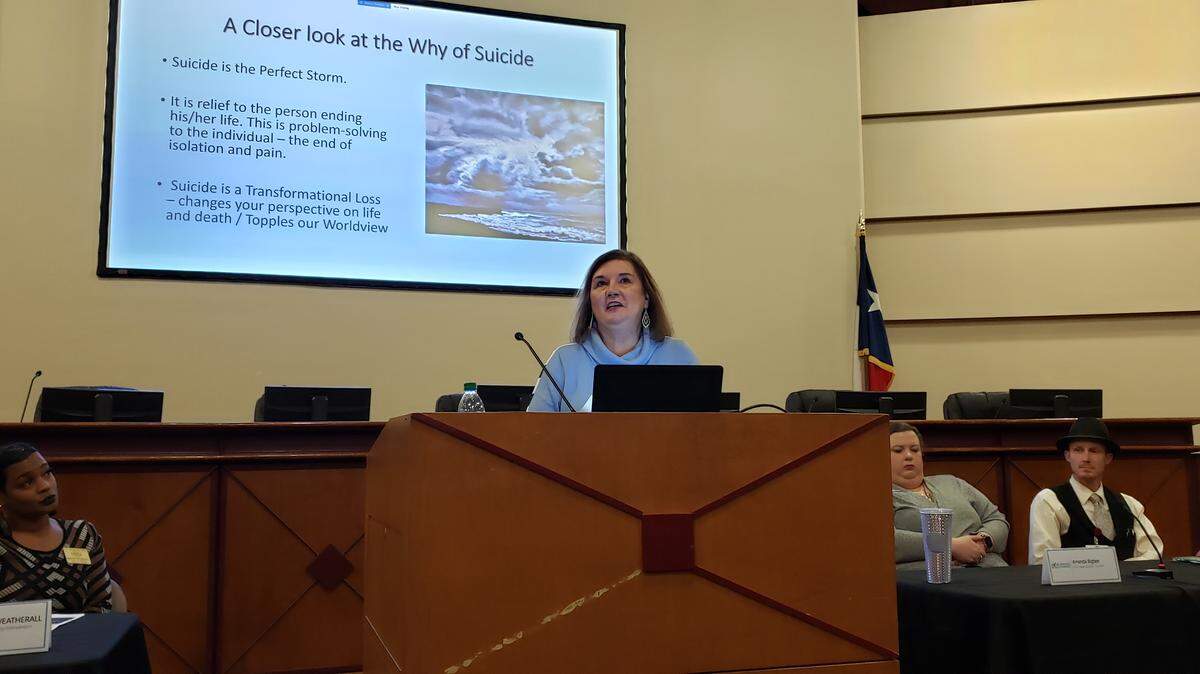
Now, at age 36 and a community support specialist for the company Mind Above Matter, Chaney was one of several members of a panel Jan. 30 for the Keller ISD Parent Suicide Awareness Night and Community Forum. The evening featured a presentation from Keller ISD Intervention Counselor Francine LaLonde, along with interaction between the panel and community guests. Marcene Weatherall, Keller ISD Director of Intervention Services, was the moderator.
“We’ve got a lot of suicidal outcries in our district, and unfortunately some completions,” Weatherall said. “It’s now the second-leading cause of death for 10- to 24-year-olds.”
LaLonde displayed statistics that showed that another life is lost to suicide in the United States every 13.7 minutes, and that every day about 105 Americans take their own life. A map she displayed showed that the suicide rate in every state rose from 1999-2016, with the exception of a 1% decrease in Nevada.
Weatherall said the district has educated employees about possible signs of suicide, along with making students aware of the dangers.
“We’re really working hard in our district to get our leaders and peers to respond to the signs. A lot of our kids are coming forward and helping,” Weatherall said, noting that a student may report something they saw on social media or in a text.
The district has identified grades 6, 7, 9 and 11 as screener groups, asking them to watch a video and answer a few questions. Weatherall said that is because those grades/age groups are in crucial transition years.
“We picked those grades because per data it shows an increase in outcries,” she said.
The Keller ISD has approximately 35,000 students across 42 campuses.
LaLonde said that while statistics tell a story, it’s not always the complete story.
“Many people want to push it under the rug. They don’t want to admit it happened in their family,” she said.
Potential signs
LaLonde said prominent signs to look for include changes in personality, sleeping too little or too much, loss of joy and withdrawal or isolation.
For example, Weatherall said a person may go from depressed and gloomy to suddenly outgoing, writing letters, making phone calls, or giving things away, all potential signs of an upcoming suicide attempt.
“Once a person decides to commit suicide, they have this peaceful feeling, a burden has been lifted,” she said.
LaLonde said that Marsha Linehan, creator of Dialectical Behavior Therapy, likened suicide to an exit door from a burning room in the mind of the person contemplating such an act.
LaLonde added that it makes her think of people who jumped from the World Trade Center during the 9/11 terrorist attacks.
“They were just taking the only way out they could see,” she said.
LaLonde also said signs can be found in dialogue. She suggested listening for such phrases as:
▪ ”I don’t want to be a burden to my family.”
▪ ”Things are just not worth it anymore.”
▪ ”Nothing seems to matter.”
▪ ”I just can’t go on like this.”
▪ ”Life just isn’t worth living.”
She also advised straight talk with someone who could be thinking about suicide.
“We have to be direct with them, listen to their story, how they got to that room. Don’t shame them. Don’t blame them,” LaLonde said. “For them, it’s a relief to hear that, to know that someone gets it.”
School counselor Danny Ross added: “A lot of these kids, they want to be heard. Let them know, ‘Please, come to me. I’m here to help.’”
And social media is playing a part in the increase, Weatherall said.
“I’m sitting with my phone waiting for 50 likes like the popular girl, and I don’t get them. I start to think I’m not worthy, and to some that can push them over the edge,” she said.
Audience members asked for more awareness programs in schools, along with support and education for siblings of children with mental illness.
Kierra Woods, a drug prevention specialist in Keller with four children in the district, said such meetings are critical.
“Our kids have so much access to everything now. We’ve seen so much suicide at alarming rates,” she said. “With this, at least we can be ahead and act instead of always reacting.”
Removing the stigma
Amanda Bigsby, attorney for the district, was also on the panel and is a survivor of suicide. She also works with the American Foundation for Suicide Prevention. Her mother took her own life 21 years ago, she said.
“There’s a stigma associated with mental health and suicide. The more we have open communications, the more likely people are to get help,” she said. “My sister and I were both in college at the time, and that was before people were talking about suicide. In the moment there’s a level of shock and shame. We need to make people move beyond that and understand more.
“Putting some action behind the grief has helped me a lot, helped things make sense, and understand there is a purpose.”
Chaney added, “We need to change how we look at mental health. Mental health is something every single person has.”
The school district has an anonymous hotline, which includes reporting someone suspected of a possible suicide attempt. But LaLonde urged anyone who suspects a potential attempt to never hesitate to come forward, even students who might sometimes feel they could lose a friend in the process.
Weatherall said there can never be enough awareness and welcomes more discussion on the subject.
“We need to invite everybody to the table,” she said. “Our kids are dying.”