Pastor who shot at Fort Worth mob during racial siege returns to give sermon of peace
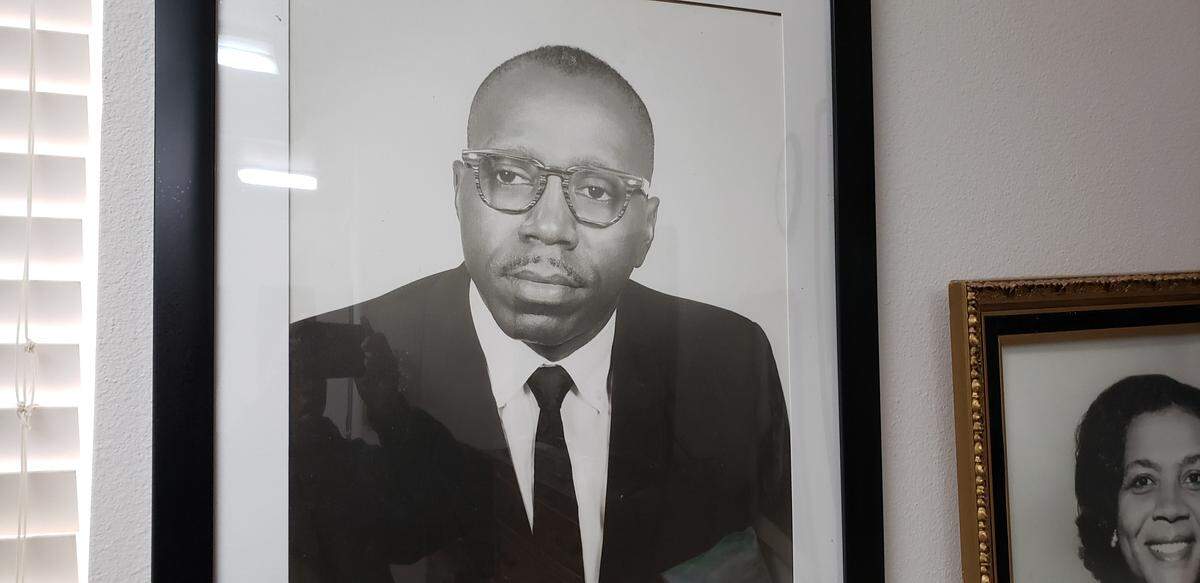
On his 96th birthday on Sunday, Lloyd Austin will be preaching at St. John Missionary Baptist Church, the place where he spent more than 40 years behind the pulpit.
Austin retired from active ministry, but still maintains an active Bible study class at the nursing home where he lives and he also travels for guest appearances.
“I’m retired. I didn’t die,” Austin said the day before Thanksgiving. “You got to keep it movin’.”
That’s a bit of a contradiction. While always being on the move, Austin has developed a reputation for steadfastness and a firm and unwavering spirit that has been a community’s anchor. Austin is also a lead character in a story about how the world tried to get him to move and he successfully withstood the pressure that was brought against him.
Austin worked, got married, had a child, bought a house, and while he was doing all that, somehow, always found a place and time to preach to people about God’s love and being thankful for His grace and mercy, he said.
Austin said he plans to talk about how the Lord brought him through and ask people to come to Jesus on Sunday. Austin said he rarely talks about the troubles the Lord overcame on his behalf.
“I‘ll be preaching on Sunday morning telling folks that they need to be saved,” Austin said. “That they need to get right with God. I’ll be telling people that they need to find them a good church. Not one where there’s a lot of hoopin’ and hollerin’.”
Mosier Valley roots
Austin was born in Hugo, Oklahoma, and moved to Fort Worth when he was 9 years old in 1932. Austin served as the pastor of St. John Missionary Baptist Church in Mosier Valley from 1963 to 2005. He was married to Macie Farrow Austin, a Mosier Valley native, for 68 years.
Austin’s history and the history of Mosier Valley are inextricably bound together. Settled in the 1870s by freed slaves just south of the sites of Hurst, Euless, and Bedford in Tarrant County, Mosier Valley is the oldest African-American community in Tarrant County.
Mosier Valley reached a peak population of about 300 in the 1930s, but the needs of that population were routinely ignored by the governments that took their tax money, Austin said. Slowly the population dwindled.
Austin said he doubts that the few black people who live in or frequent Mosier Valley know much about its history or its founding. Austin remembers because he lived and became a part of that history and the struggles he endured.
Austin talks as though he never had any intention of being involved in the Civil Rights Movement, in Mosier Valley or anywhere, but it just kind of found him. He said he doesn’t talk about it often because he does not want to sound like he’s bragging.
Although one of the confrontations that is a part of his history occurred more than 63 years ago, in some ways, it’s still fresh.
“I do say something about it sometimes,” Austin said. “But if you rub a sore, you make it bleed.”
‘We didn’t worry about the color situation’
During work trips Austin made between his home in Fort Worth and East Texas to deliver large bags of seed, he would sometimes see the man who owned the house on Judkins Street that Austin later purchased for his family. Austin noticed when a “For Sale” sign went up in the yard.
Austin visited the house and asked the owner if he would sell it to him, and he replied that he would. The owner needed to move from his home in the 200 block of Judkins Street because of his job, Austin said.
“We didn’t worry about the color situation,” Austin said. “He said he would sell it to anyone who would buy it.”
Austin, his young wife and 1-year-old daughter moved into the house on Sept. 1, 1956, becoming the first black people to own a home on the previously all-white block.
Austin should have worried, but he did not. Another black couple, Lawrence and Ava Peters, purchased a house in the 100 block of North Judkins Street in 1953. On Nov. 2, 1953, the Peterses reported their car had been blown up after someone detonated several sticks of dynamite planted beneath the car’s hood. Austin said he and Peters were friends.
The day the Austin family moved in with the help of one of Austin’s brothers there were only hints of what was to happen. One woman, who Austin described as an alcoholic, stood in front of the newly purchased house, shouting that the white people in the neighborhood should do something about this attempt at integration.
“One [n-word] man and all you white men scared of him,” Austin said he heard the woman scream.
The next morning a newspaper reporter knocked on the door and asked Austin if he knew that his neighbors were planning to burn down his house. Things got worse after that, Austin said.
“The whole area was just packed with white folks and as the hours passed, more of them came,” Austin said. “They called me a bunch of ugly names and had signs painted. They hung a dummy from a tree limb in my front yard with a knife in its chest and a red stain that ran down from the knife.”
Austin said he called the police, who ignored his pleas for help. The police asked if there had been any violence and Austin replied that none had occurred yet, but said he felt it was only a matter of time.
The crowd threw rocks at the house, Austin said.
Two front window panes were smashed, and a screen on one of the windows was torn and broken, according to newspaper reports.
“I said to the Lord I’ve had enough of this, I can’t handle no more of it,” Austin said. “So I went to the window and raised it, didn’t aim at nothing, just shot out the window with a .22 rifle and it hit a young man’s car that was out there.”
The police arrived within minutes, Austin said. He said he listened as the crowd was ordered by Fort Worth Police Chief Cato S. Hightower to disperse within five minutes. Once the block was cleared, police patrolled the area, but Austin said he is not sure how long that lasted. The mob never reformed in front of his house.
The next month, in October, Austin said he was invited to a meeting with some of Fort Worth’s “rich people” where he was encouraged him to keep down confusion and move out of the previously all-white neighborhood.
Austin refused and lived there another four years.
“I told them I wasn’t going to move,” Austin said. “I wasn’t going to be made to move from something that I had worked hard for. I wasn’t stealing. I ain’t done nothin’ to nobody.”
‘The kids, they don’t care about color’
The Austin family was forced to move in 1960, the minister said. A major thoroughfare sliced through the area and the state purchased the land in order to build it, Austin said.
But before that happened, the neighbors all retreated to their respective corners, and began to act civilly toward each other, Austin said. The man whose car was shot was contacted by Tim Madigan, a former Star-Telegram reporter, and expressed regret for taking part in the 1956 confrontation, Austin said.
Madigan wrote in his blog that Stephen Shoemaker, who was around 19 at the time of the disturbance, had his attitudes regarding minorities change during the time he spent in the U.S. Army.
Shoemaker apologized to Lloyd and his wife, Macie Austin, for being there that night.
“I accepted his apology,” Austin said. “I have nothing against him. I barely remember his name. I wasn’t a hero that night. I had a wife and a baby. I don’t even think about it too much now.”
The feelings of his neighbors also grew softer toward his family, Austin said. The neighborhood became peaceful, he said. There was an unmarried white woman with two children about his daughter’s age, who would come by and play with his daughter, Austin said. He would cut her yard for her when he cut his yard.
“The kids, they don’t care about color,” Austin said.
And as for the woman he described as an alcoholic who first approached the family the day they moved in, she made it her responsibility to watch Austin’s house when the family was away. Whenever someone would come by and knock on the door and the family was gone, she would be sure to tell Austin about the visit, he said.
“She stopped drinking and became a friend,” Austin said.
This story includes material from Star-Telegram archives.