
Early Greek residents of Fort Worth were thankful Americans, but still tied to Greece
In 1908, the Fort Worth Telegram (not yet the Star-Telegram) reported that workers at the Armour and Swift meatpacking plants spoke 30 different languages.
Although many hailed from Eastern European countries, workers also came from Holland, France, Mexico, Sweden, Japan, Greece, and other nations. It was a hard job, but one for which English language skills were not necessary.
Many Fort Worth Greeks came not from Greece itself, but from Turkey. Internal strife and civil war took a heavy toll on people of Greek descent who had lived along the western coast of Turkey for many years.
About two-thirds of the Greeks listed in the 1910 census worked either in the packing plants or the food service industry, while the others were largely peddlers, bookkeepers, or shoe shiners. Nonetheless, despite their relatively small numbers, they had a significant impact on the social and civic fabric of Fort Worth.
In 1910, several early 20th century arrivals, including candy store owner Basil G. Booth (shortened from Boothounis), grocer James Metaras, and confectioner Nick Gavril (originally Gavrelos), were among those involved in the establishment of the Eastern Greek Orthodox Church of Saint Demetrios.
It was the first Greek Orthodox Church in Texas and the Southwest, preceded only by Saint John the Baptist Greek Orthodox Church in Omaha, Nebraska, the first west of the Mississippi, established in 1908. Coincidentally, Omaha was another city known for its meatpacking plants.
Saint Demetrios parishioners first met above a store at 104-1/2 Houston St. The congregation was, however, closed for a time as many young men - and most of the Greeks in Fort Worth at this time were men - went to Greece in 1912 to fight for their country in the first Balkan War.
The number of Greeks in Fort Worth waxed and waned with the fortunes of their mother country but, by early 1917, enough lived here that the church was re-established, and architect L. B. Weinman drew plans for a permanent structure on the North Side. That building still stands today at 2022 Ross Ave.
By the early 1940s, many Greek immigrants had saved their wages from the packing plants and turned to farming, particularly vegetable truck farming in the Trinity River bottom lands.
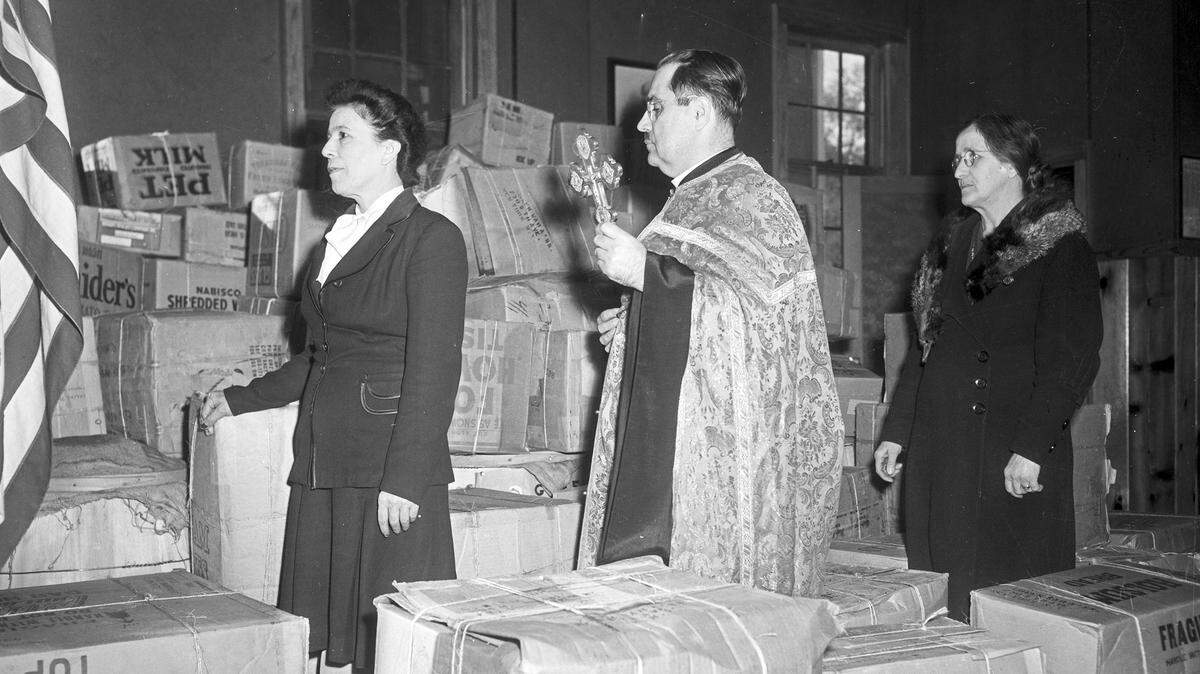
There were still a number of Greek restaurant owners (represented today by Mike Smith of the Paris Coffee Shop and Ann Diakis Shaw of Shaw’s) and a growing middle class who took up other occupations and became involved in civic affairs – including Homer Dear, an educator and state representative, who was the son of Rosa Dear, who is shown in the picture that accompanies this column.
The Depression-era Federal Writers Project noted that the some 1,400 people of Greek descent in Fort Worth were “so Americanized that it is difficult to distinguish them from [other] inhabitants.” However, when Nazis commandeered crops for their own use during World War II, starving the people living in Greece, Saint Demetrios members sent food and clothing relief packages.
They were thankful to be Americans, but did not forget the land of their forebears.
Carol Roark is an archivist, historian, and author with a special interest in architectural and photographic history who has written several books on Fort Worth history.