
Fort Worth mayor says feds won’t control police during special initiative
Suspicion of the federal government is a reflex for some Texans (see the recent reaction to the U.S. military’s plan to stage a training exercise in the state).
Other Texans welcome federal programs, especially from the Justice Department, that give a nudge to state and local governments.
Both sides were evident Tuesday during two public discussions of a new grant that Fort Worth has received from the Justice Department. Called the National Initiative for Building Community Trust and Justice, the grant, given to only six U.S. cities, is intended to reduce crime and nurture trust between civilians and local law enforcement.
In the morning, Tracie Keesee, project director for the initiative, was at City Hall to give a briefing to the City Council.
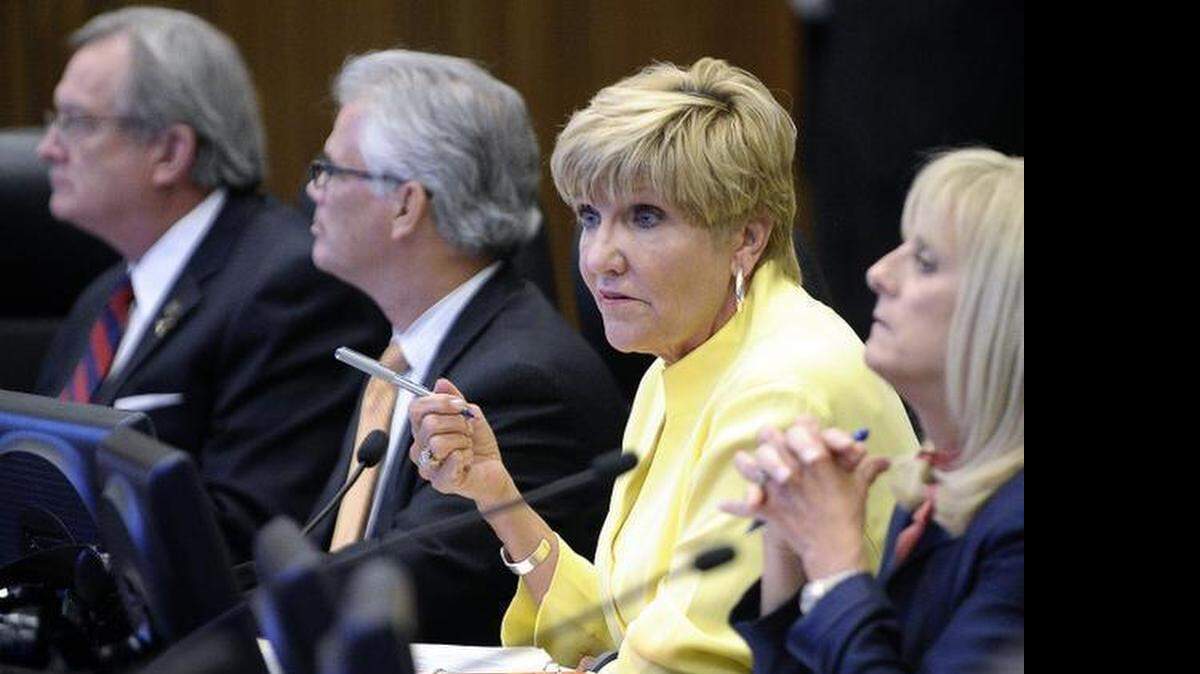
During Keesee’s presentation, Mayor Betsy Price said: “One of the concerns that has come up has been this is a federalization of our Police Department. It is not. Fort Worth was picked because we have a lot of model community policing efforts going on.”
Price stressed that any policy changes that come out of the program will be decided by the Fort Worth Police Department.
“We want to make sure that people understand this is a partnership, and we are not giving up control,” Price said.
Keesee agreed. “This is a complete community collaboration and Police Department collaboration for forward-thinking people who know that if we don’t stay ahead of the game, we could end up like fill in the blank” — meaning like Ferguson, Mo.; Baltimore; or New York.
On Tuesday evening, Keesee and four other people working on the initative were at The Potter’s House in Fort Worth, where they were peppered with questions from more than 50 people, mostly about how the project would work. The questions included how information would be gathered and reported; what was the scope of the project; and how would data be used after it was analyzed.
Bryan Muhammad, leader of Fort Worth’s Millions More Movement, said his organization has tried to work with Fort Worth police administrators but can make no headway.
“We have a serious problem,” Muhammad said. “They are locking up and beating up our children. People in the community basically feel … it’s them against us. We are trying to keep our city from going up in smoke.”
Others lamented that the meeting was poorly advertised and not enough advance notice was given.
Keesee said it is not unusual for early meetings to be small and grow over time. Other staff members will visit for later meetings, she said.
Jocelyn Fontaine, a senior research associate with the Urban Institute, said that in coming months, members of her organization will begin “knocking on doors and asking people to complete surveys.” Residents will be paid for their time, Fontaine said.
The answers will be analyzed, and the results used for research focusing on three areas:
▪ Racial reconciliation leading to frank conversations between minority communities and law enforcement to address historic tensions.
▪ Procedural justice focusing on how law enforcement interactions with the public shape residents’ opinions of police.
▪ Implicit bias considering how subconscious psychological processes shape authorities’ actions and possibly result in racially disparate outcomes.
“We are looking at the dynamics between police and communities of color,” Keesee said. “We’re here to address just a small portion of what’s going on. I hope we will leave something behind in Fort Worth that’s tangible.”
Fort Worth was one of six pilot cities chosen for the $4.75 million partnership. The others are Stockton, Calif., Pittsburgh; Minneapolis; Gary, Ind.; and Birmingham, Ala.
The initiative will be guided by a board of advisers that will include national leaders from law enforcement, academia and faith-based groups, along with community leaders and civil-rights advocates.
This report includes material from the Star-Telegram archives.
Caty Hirst, 817-390-7984
This story was originally published May 5, 2015 at 11:06 PM with the headline "Fort Worth mayor says feds won’t control police during special initiative."