
Schieffer tells TCU crowd he’ll retire this summer
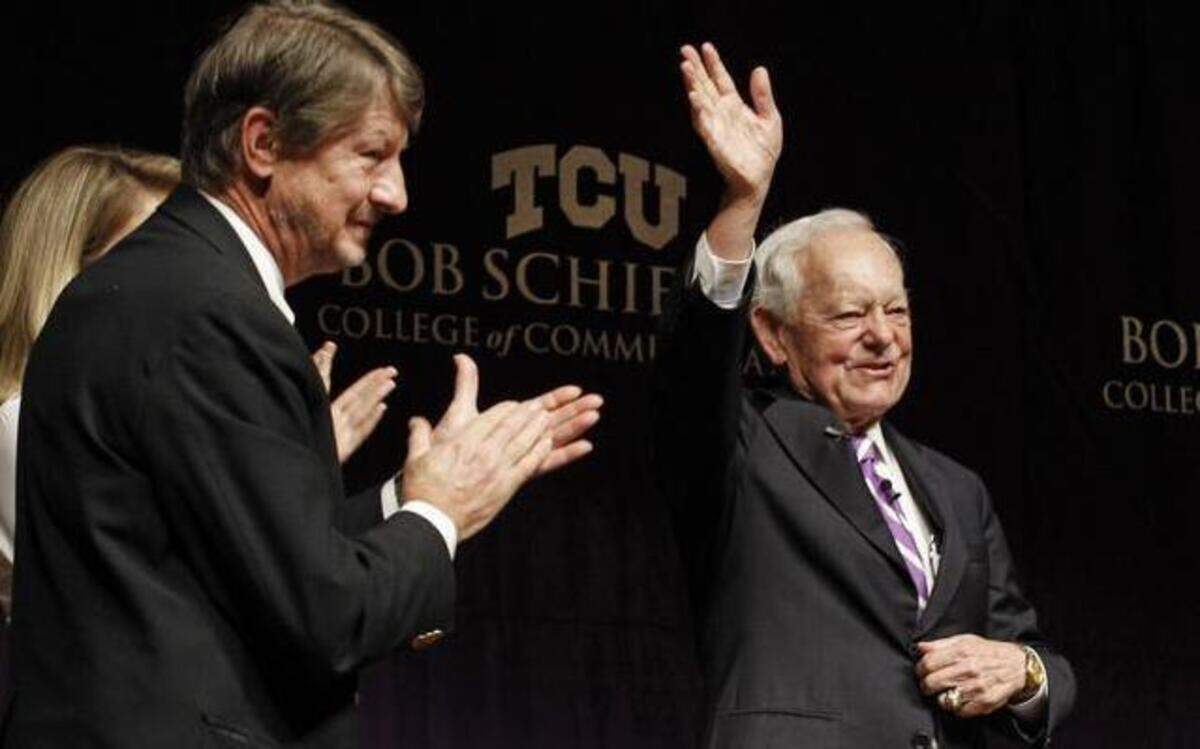
Bob Schieffer, the longtime CBS newsman and host of Face the Nation, announced his retirement Wednesday in the city where he began his storied career 58 years ago.
“I wanted to quit while I can still do my job. I covered the Senate long enough to see people carried out on a gurney, and I didn’t want to be one of those people in my profession,” Schieffer, 78, told the Star-Telegram, where he worked in the 1960s.
“Maybe I have taken a little off my fastball, but I’ve still got a pretty good fastball.”
Speaking to about 1,200 students, alumni and media figures gathered for the 11th annual Schieffer Symposium on the News, Schieffer said he will retire effective this summer, then take a few months off before deciding what to do.
Mary Hager, executive producer of Face the Nation, who has worked closely with Schieffer for 25 years, said she was saddened by his decision.
“In many ways, he is my best friend,” she said. “He’s my first call in the morning and my last call at night.”
Throughout his career, Schieffer has served as an inspiration and mentor to countless colleagues, said David Rhodes, CBS News president and Schieffer’s boss.
“There is nobody like Bob, and that is the way a lot of his colleagues feel,” Rhodes said. “He has a gravitas within our organization and the industry that is hard to duplicate.”
Known for his folksy Texas charm and conversational style, Schieffer has spent the past 46 years at CBS, as a reporter and weekend news anchor and later as moderator of Face the Nation, a Sunday morning news show that he has hosted for 24 years. In March 2005, Schieffer replaced Dan Rather as anchor of the weekday CBS Evening News on an interim basis, a period that saw a substantial increase in ratings.
Symposium to continue
In retirement, Schieffer and his wife will remain in Washington, D.C., he said. But they will maintain ties to Fort Worth and TCU.
In 2005, TCU named its journalism school in his honor. In 2013, it named the college where the journalism school is housed the Bob Schieffer College of Communication.
He returns every year to host the news symposium, where journalists selected by him gather at TCU to discuss current events and world news.
Panelists this year were Dan Balz, political correspondent for The Washington Post; Gayle King, co-anchor of CBS This Morning and editor-at-large for O, The Oprah Magazine; P.J. O’Rourke, political satirist and journalist; and Holly Williams, a CBS News foreign correspondent.
Symposium topics veered from the rise of the Islamic State and negotiations with Iran on its nuclear program to the state of journalism and the 2016 presidential election. Panelists also discussed partisanship in the Capital and vitriol spewed on social media.
“If you cover politics these days, you are making someone mad every day,” Balz said. “Politics is so divisive.”
As a public figure herself, King said, she has learned to better handle social media and online attacks.
“I used to find myself engaging with these people on Twitter,” she said.
“It is someone sitting in their basement with no underwear and no accountability,” King said, to laughter from the crowd. “You can’t take it personally.”
Of the 2016 campaign, O’Rourke said, “The idea of another Bush-Clinton race, one figures voter turnout would be in the low one figures.”
Williams, who covers the Middle East, said she is often asked what it’s like to work in war zones as a woman. She responds that it’s the same as it is for a man and that she takes numerous precautions.
“We do not take unnecessary risks,” she said. “My daughter is 4 years old, and I plan on being there while she grows up.”
A life in news
Schieffer has interviewed every sitting president since Richard Nixon and most of the presidential candidates, serving as moderator of presidential debates in 2004, 2008 and 2012. On his watch, Face the Nation became the highest-rated Sunday talk show of the past three years.
The newsman, who has won numerous awards for his coverage of the Pentagon, White House and Congress, has long been known for his dogged reporting. In 2012, when he repeatedly pressed Mitt Romney for his opinion on immigration reform, the Republican presidential candidate’s evasive answers went viral.
“His nonanswers became the answer,” Schieffer said.
Schieffer’s first job in journalism came in 1957, when as a TCU sophomore, he started working for local radio station KXOL, for $1 an hour.
“I thought it was the best job in the whole world,” Schieffer said.
After graduation, he served three years in the Air Force before accepting a job at the Star-Telegram as a night police reporter. There, Schieffer got his first big break.
On Nov. 22, 1963, the young reporter was working in the newsroom when he answered a phone call from a woman asking for a ride to Dallas. Schieffer recalled that he almost hung up.
“Lady,” Schieffer said, “this is not a taxi, and besides, the president has been shot.”
“Yes, I heard it on the radio,” the woman told him. “I think my son is the one they’ve arrested.”
It was Lee Harvey Oswald’s mother. Schieffer picked up Marguerite Oswald at her Fort Worth home and drove her to Dallas, where he filed reports from a phone at the police station.
Schieffer called the assassination of President John F. Kennedy one of the defining stories of his career.
“At the time, we didn’t know what this meant. We didn’t know if these were the first shots fired of World War III,” he said. “This was unlike anything any of us had covered. We were literally terrified.”
The Star-Telegram years
While he was working one afternoon, his phone rang. It was George Ann Carter, the wife of Amon Carter Jr., publisher of the Star-Telegram.
Carter asked Schieffer whether he was married because she wanted to set him up on a date with her neighbor, Patricia Penrose.
“I was so nervous because it was the publisher’s wife that I actually stood up at my desk,” he said. “I was afraid it wouldn’t be proper being seated while talking to her.”
The two did go on a date, and three weeks later, they decided to get married. They now have two children and three grandchildren.
“I owe the Star-Telegram so much,” Schieffer said, laughing.
In 1965, the Star-Telegram sent Schieffer to cover the Vietnam War — the first Texas journalist to report from Vietnam.
After returning, Schieffer would later join WBAP-TV (now Channel 5) in Fort Worth.
A different time
Schieffer moved to Washington in 1969 and soon joined CBS. He recalls the numerous parties and dinners that he and his wife hosted at their home, where politicians of both parties mingled.
Now, with the polarization of Washington politics, such evenings are a relic of the past, he said.
“Elected officials don’t even know each other anymore. They don’t want to be seen with each other because they think the people back home will think they are consorting with the enemy,” Schieffer said. “Washington is completely and totally broke, and I don’t know what will happen.”
Partisanship has made the job of the journalist more difficult, Schieffer added. When he arrived in D.C., most members of Congress did not even employ press secretaries.
“Now,” he said, “the lowliest subcommittee chair has a media coach and consultants and gurus telling them what to say.”
He said journalism, a field that will forever be his passion, faces a daunting future.
“The great question and challenge of journalism is not whether people read the print newspaper or iPad,” Schieffer said. “It’s content. Is it accurate? You cannot have a democracy as we know it unless people have access to independent, accurate information they can compare to government’s version of events. That’s what we do and what we’re all about. That is as important to democracy as our right to vote.”
This report includes material from the Star-Telegram archives.
Sarah Bahari, 817-390-7056
Twitter: @sarahbfw
Bob Schieffer timeline
1937: Born in Austin, but his family moves to Fort Worth, where he will later graduate from North Side High School.
1950s: Goes to work at radio station KXOL, where he went by Bob Shafer for two years because the station manager couldn’t pronounce Schieffer. Graduates from TCU in 1959.
Early 1960s: Begins work as a night police reporter at the Star-Telegram. Is introduced to his future wife, Patricia Penrose, by George Ann Carter, wife of Star-Telegram Publisher Amon Carter Jr.
1963: Reports on the assassination of President John F. Kennedy, including an exclusive interview with the mother of Lee Harvey Oswald.
1965: Becomes the first reporter for a Texas metropolitan newspaper to report from Vietnam. When he returns after about four months, he moves to television. Channel 5 in Fort Worth offers him $155 a week, $20 more than his weekly salary at the Star-Telegram.
1969: Moves to Washington, D.C., to work for a new network, Metromedia. Soon joins CBS News, thanks to a glowing recommendation from Jim Byron, news director at Channel 5. His first government beat is the Pentagon. He will later cover the White House, Congress and the State Department.
1973: Named anchor of the Sunday evening news at CBS.
1977: Named anchor of the Saturday edition of the CBS Evening News, a position he held until 1996. He was the interim anchor for the weekday CBS Evening News in 2005-06 after Dan Rather left.
1991: Becomes host of the Sunday morning public affairs program Face the Nation.
2005: The first Schieffer symposium is held at TCU, featuring Bob Woodward, Tom Brokaw, Tom Friedman and Jim Lehrer. The event is held in conjunction with TCU naming its journalism school after Schieffer.
2008: Named a living legend by the Library of Congress.
2012: Moderates debate between Republican nominee Mitt Romney and President Barack Obama. Also moderated presidential debates in 2004 and 2008.
2013: TCU’s College of Communication is renamed the Bob Schieffer College of Communication.
2015: At the 11th annual Schieffer Symposium on the News, Schieffer announces he will retire this summer.
Source: Star-Telegram archives
This story was originally published April 8, 2015 at 7:47 PM with the headline "Schieffer tells TCU crowd he’ll retire this summer."