
TCU program puts aspiring principals on the front lines
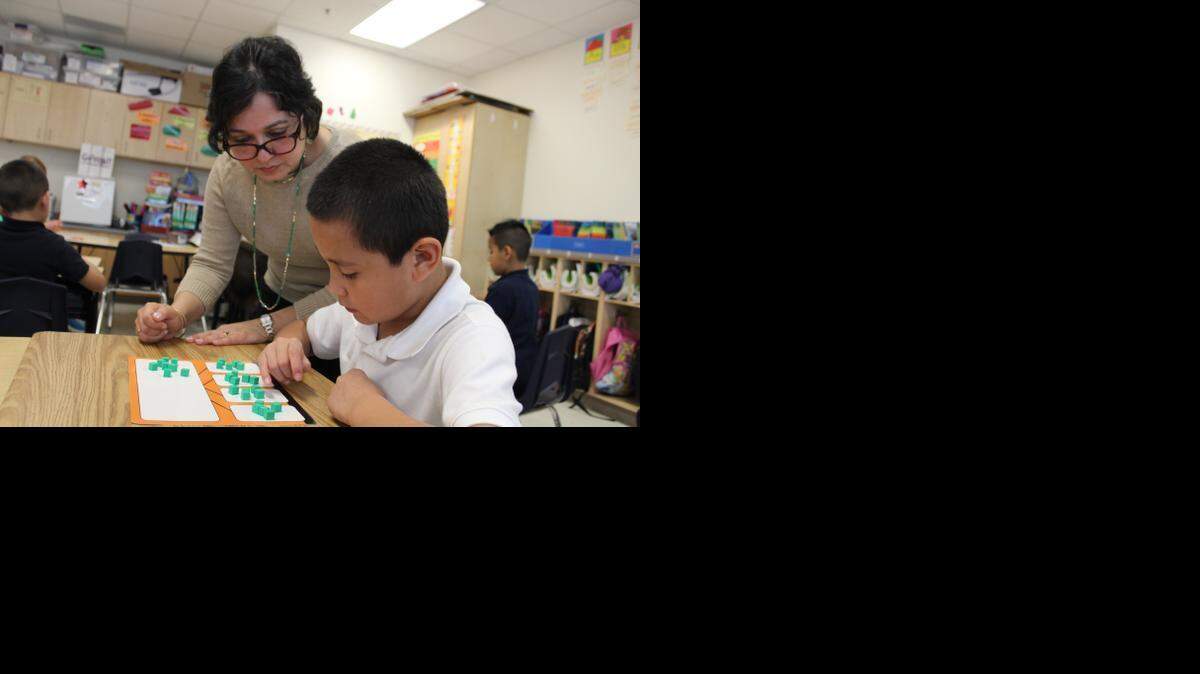
On a typical Tuesday morning, Katy Kirby, a principal intern at Daggett Middle School, has a desk parked in the hallway so she can have “data meetings” with students.
After three hours, the spunky educator has chatted with more than 150 seventh-graders. The talks usually entail a review of a student’s test scores and maybe a brief discussion about other matters, such as lunchroom behavior the day before.
Kirby’s style is not that of a disciplinarian; she’s more of trustworthy guide, addressing students with words like “Angel” and “Sweetheart.” She says her immediate goal is to point out a student’s strengths and discuss upcoming test dates. If a student needs additional support to boost test scores, such as after-school tutoring, she helps make the arrangements.
“This reading benchmark, you are beautifully set to pass that,” Kirby told a student during a recent chat. “Now this test on the 31st is coming up quick. … What are you going to do to get ready for it?”
Kirby, a former teacher at McLean 6th Grade Center in Fort Worth, is among 10 educators enrolled in a new principal leadership program at TCU. Unlike most statewide programs, which require aspiring principals to juggle full-time teaching jobs while completing 160 hours of hands-on principals’ training, the TCU program cuts candidates loose to spend an entire year at a school as an assistant principal.
The first class, which includes educators from the Keller and Fort Worth school districts, graduates in May.
“It really gives aspiring principals a ‘boots on the ground experience’ to see if this is what they really want to do,” said Michael Sorum, chief of academics for Fort Worth schools. “And it lets us see how they perform, before they are officially assigned to do something.”
“It’s a great program,” said Penny Benz, assistant superintendent of human resources for the Keller school district. “We’re very excited.”
Marla W. McGhee, associate professor of the educational leadership program at the TCU College of Education, said the program exposes candidates to a hands-on component that is often missing from many school leadership training programs.
“By getting to do that full-time practicum, you get to see the arc of the school year from beginning to end,” McGhee said. “You get to develop a relationship with a campus mentor, the principal, which is really extraordinary.”
Good for school districts
University research shows that many principal training programs lack “real-life” leadership challenges. Those that do offer internships often have shallow experiences, Stanford University researchers have discovered. The interns “commonly settle for fleeting experiences and passive exercises, such as shadowing a principal,” according to Stanford researchers.
TCU’s program also is unique because it partners with local school districts to support candidates. Decades ago, school districts would provide paid internships to candidates seeking a principal’s certification, but those internships were mostly done away with in the 1980s because of budget constraints and for other reasons, McGhee said.
The Fort Worth school district is paying Kirby’s salary while she interns at Daggett Middle. In turn, Kirby promises to stay in the district for at least four more years.
“That’s the investment the district is making,” McGhee said. “The district is allowing the individual to have a full-time experience.”
Four years ago, TCU education professors noticed a problem with the way future principal were being taught. The master’s degree candidates — aspiring to become the instructional leaders of K-12 campuses all over North Texas — were being thrown into situations they were “ill-prepared for,” said Melody Johnson, scholar in residence overseeing the educational leadership program at TCU.
“It wasn’t for their lack of will,” said Johnson, a former superintendent with the Fort Worth school district. “It was because of the impracticality of the program they were in. They were being set up for failure.”
The focus of TCU’s program: “You will be leadership-ready when you leave this program,” Johnson said.
Financial support helps
To allow candidates to pay tuition at TCU, local businesses were sought to provide financial support. So under the two-year program, one-third of the cost of the program is picked up by the master’s candidate, another one-third by TCU and one-third by businesses and local foundations. Beginning in the fall, a 36-hour master’s degree program will cost approximately $50,940, records show. But under the special program, the per-student cost is more in the range of of $16,978.
The Sid Richardson Foundation, one of a handful of financial sponsors, signed off on the program several years ago when career educator Val Wilke was executive director. Wilke, who led the foundation for 38 years, died in December.
“The foundation did some work years ago about the importance of effective principals,” said Pete Geren, current president and CEO of the foundation. “It’s been a longtime emphasis.”
So when TCU officials came calling, it was natural to support their efforts, Geren said.
Ritu Balial, a principal intern at Rosemont Elementary School, said the financial support helped seal her decision to apply. Balial has worked 14 years in the Fort Worth school district.
“It would have been a huge sum of money that I would have had to spend from my pocket,” Balial said. “So this funding support has really helped me.”
Balial, who was a teacher in New Delhi, India, before moving to the U.S., has an unpredictable schedule at Rosemont, and she often is hit with unusual tasks. For example, she’s already made a number of home visit to parents of students who are chronically absent from school.
Just last week, she secured a trip home for a kindergartener who missed her ride home from school. Early in the school day, she sometimes roams the hallways to ensure that students have been fed breakfast.
In most cases, parents are supportive and want the best for students, she said.
“It’s about communicating and developing relationships in a very congenial communicative way,” said Balial, who has specialized in working with English as a second language learners and immigrant children at more than 30 campuses in the Fort Worth school district.
Connecting with kids
After one of her recent “data meetings,” Kirby was asked by McGhee to explain why she engages students in such conversations.
“Tell me how this came to be?” McGhee said.
Kirby said it was something she often did with students when she was a teacher. It helps her build relationships with students so she can be a motivating voice.
“Sometimes, I just feel like kids aren’t brought to the table,” Kirby said. “We talk about them all the time. We talk at them and around them … so sometimes, they feel like, ‘I’m not noticed.”
The “data meetings gives kids an opportunity to be noticed and to be noticed by somebody beyond their teacher,” Kirby said. “For an administrator to notice a kid, it comes at a different tone.”
McGhee says Kirby’s practice of parking herself in the hallway — being constantly visible to students — is nothing new.
“So often as a principal,” McGhee said, “I used to do the same thing. There’s nothing magical about being in the office. It’s actually a pretty bad place to be.”
Yamil Berard, 817-390-7705
Twitter: @yberard
Helping future principals
These businesses and organizations are providing financial support to the TCU principal leadership program:
Sid Richardson Foundation, Rainwater Charitable Foundation, Morris Foundation, Gregory A. and Laura E. Bird Foundation, Lockheed Martin, JPMorgan Chase Bank, and Betsy and Steve Palko.
Source: TCU College of Education
This story was originally published March 20, 2015 at 6:46 PM with the headline "TCU program puts aspiring principals on the front lines."