
Hurst veteran a ‘very fortunate survivor’ of close calls in B-36s
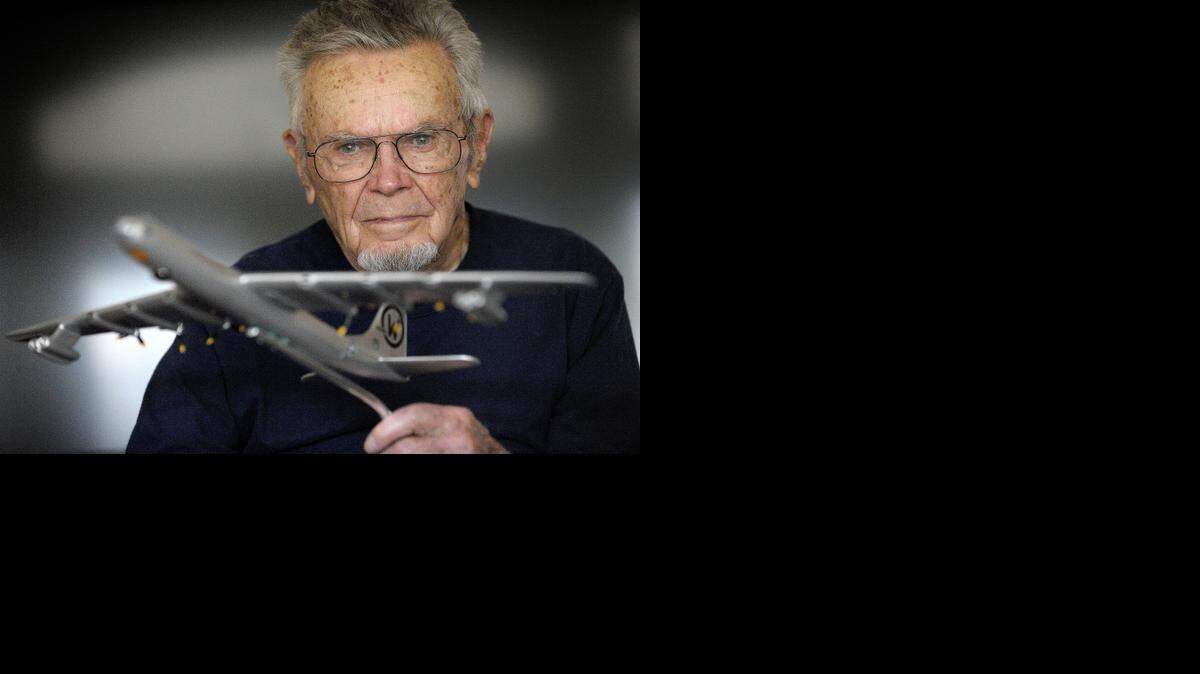
At 93, Dick Thrasher considers himself lucky.
Not only lucky to be alive, he said, but also lucky enough to have survived three harrowing events in the sky.
Sixty-five years ago, he was a gunner on the crew of an Air Force mission that was supposed to simulate a nuclear attack.
The B-36 Peacemaker would take off on Feb. 13, 1950, from Eielson Air Force Base in Fairbanks, Alaska, fly south off the Canadian coast, on a simulated bombing run over San Francisco before flying home to Carswell Air Force Base in Fort Worth.
It never made it.
Several hours into the flight, the plane began icing, three engines caught fire and it started losing altitude.
Before the crew could bail out, they had to fly out to sea and get rid of the plane’s lethal payload — a 10,000-pound Mk-4 nuclear bomb.
It would become the United States’ first “broken arrow” — code for a mishap involving a nuclear weapon.
Thrasher and 11 others survived by parachuting out of the plane. Five crewmen — Air Force Staff Sgt. Elbert W. Pollard, Capt. Theodore F. Schreier, Capt. William Phillips, Lt. Holiel Ascol and Staff Sgt. Neil A. Straley, did not survive.
While many details of the crash remained secret for decades, there have been news articles and books written and documentaries made recounting the events of that night as the bomber flew on autopilot for another 200 miles before crashing atop Mount Kologet in a remote section of British Columbia. The crash site wouldn’t be found until 1953, and the secrecy that surrounded the mission left a lot of questions.
At the time of the crash, the Canadians and the public weren’t told what the plane had onboard. Thrasher would see the flash of an explosion beneath the clouds from the back of the bomber.
“We were carrying an atomic bomb,” Thrasher said. “It didn’t have the plutonium to make it work. It exploded in the air — a conventional explosion — not atomic. We turned around and went toward land.”
Thrasher, who retired as a senior master sergeant in 1971, and the other survivors parachuted onto Princess Royal Island, just off the coast of British Columbia.
They spent about 36 hours on the island before a Canadian fishing boat picked them up.
The mystery surrounding their mission would last for decades.
Thrasher would make a trip to the crash site in 1998 at the invitation of a writer to see it for himself.
And in 2012, some remains that were found inside a boot by a Canadian fishing boat in 1952 were identified, after multiple DNA tests, as belonging to one of his crewmen, Pollard. He was buried at San Francisco National Cemetery at the Presidio, near the Golden Gate Bridge.
Streets in an area of Westworth Village that was once part of Carswell are named after some of the missing men, including Pollard.
Thrasher has his own theory about why he survived and others perished.
“None of the rest of them bothered with a Mae West,” he said in a 2012 Star-Telegram interview, referring to the personal flotation device. “I was having trouble fastening my chest strap over the Mae West, then when I got out of the airplane, I couldn’t find my D-ring. When I did finally find it, the chute made two oscillations and then I hit a tree.”
He assumes high winds blew the five missing men out into the ice-cold waters while the rest landed safely on land.
Although the crash happened on Feb. 13, shortly before midnight, Thrasher always said that it happened on Valentine’s Day since it was already the 14th back home in Fort Worth.
It wasn’t Thrasher’s only brush with death.
‘Nothing but trouble’
In July 1949, he was on a B-36 that had an engine fall off. On April 27, 1951, there was an even closer call.
He was on a training mission over Oklahoma in which P-51 Mustangs would be simulating attacks on the bombers.
During one pass, a P-51 flew too close and slammed into the nose of the B-36, breaking in two.
“I seen one pass under our right wing. … I just got a glimpse of something,” said Thrasher, who was in the back of the plane. “Right after that, all this debris went by and all six engines shut off, and we were out of control. I knew exactly what happened. His No. 2 man didn’t make it. His wing man didn’t make it. Hit right into the cockpit.”
Thrasher scrambled to the plane’s entrance hatch and jumped to safety.
But he was seconds away from possibly tumbling to his death.
“They said as soon as I made it out, the tail broke off and just dumped everybody else out,” Thrasher said. “All of them except one had a chute on. They made it. The one that didn’t have it didn’t have a prayer.”
None of the 12 crew members in the front of the B-36 survived, including Capt. Harold Barry, who had also been on the ill-fated flight that crashed off of British Columbia a year earlier.
Barry and Thrasher had been placed on different crews after that 1950 crash but were together again on that deadly 1951 flight.
Thrasher said Barry believed trouble would follow whenever the two of them flew together. He said as much just before they took off.
“He said, ‘We’re bound to have trouble,’” Thrasher said. “Lord help him — he didn’t know what trouble we were going to have.”
Other crew members also believed they were cursed when they flew with Thrasher and would tell him so. He was never sure if they were joking or not.
“They would say ‘You were a jinx on that crew because after you left we never had trouble,’” Thrasher said. “‘Before that we had nothing but trouble.’ But it was the airplane; it wasn’t me. The first two years in the B-36 we had nothing but trouble.”
‘A very fortunate survivor’
During the height of the Cold War, Thrasher was taught enough Russian to ask for a cigarette in the event they were shot down.
Thrasher never took the idea of a bombing run into the Soviet Union as a real possibility.
“I just couldn’t see us attacking Russia, and I couldn’t see Russia attacking us,” Thrasher said.
Once he moved from B-36s to B-52s, his close calls came to an end.
He would fly in that plane until his retirement in 1971, including 25 missions over Vietnam from June 1968 to June 1969.
Yet he was never convinced those bombs struck any targets.
“After you dropped the bombs, you would flip the optic sight to see if there was any secondary explosions,” he said. “That’s when you knew you had hit something. I never saw any secondary explosions. All I could see down there was trees in the jungle. Apparently it didn’t do any good because we lost the war.”
Thrasher, who served in the Army during World War II, retired after 30 years and bought a place in the country near Cross Plains. He still drives, mows his own lawn and does his laundry — but he never forgets how lucky he is to still be around.
“I tell everyone I’m a very fortunate survivor, and I know that,” Thrasher said.
Bill Hanna, 817-390-7698
This story was originally published February 13, 2015 at 4:05 PM with the headline "Hurst veteran a ‘very fortunate survivor’ of close calls in B-36s."