Over half of Tarrant County families with young kids struggle to afford diapers

More than half of Tarrant County families with children 3 years old and younger struggle with affording diapers, new data shows. The ripple effects are expansive, especially for child care providers who serve young children while their parents go to work.
National data from the Urban Institute and the National Diaper Bank Network, broken down by county, shows 57% of Tarrant County children who are 3 years old and younger live in households who are cost burdened by diapers. This accounts for 65,200 children out of about 114,150 total. Nonprofits and community organizations provide what they can to families in need, but the demand for the supplies continues to grow. Additionally, child care providers say they’re footing the bill to avoid turning away families.
It would take more than 39 million diapers to fill the county’s diaper gap faced by families with young children who earn below 300% of the federal poverty level, the data shows. This includes families who earn a maximum salary of $61,320 for a family of two or $77,460 for a family of three, according to 2024 federal data.
Diaper insecurity creates several physical, mental and economic issues for parents and children. Infants who sit in dirty diapers for too long are at greater risk of getting rashes or urinary tract infections. Parents facing diaper insecurity are almost twice as likely to report feeling hopeless or depressed almost daily compared to parents who aren’t facing diaper insecurity. Parents also reported cutting corners to purchase diapers such as skipping meals or bill payments, according to a 2024 study by the National Diaper Bank Network.
For children, it can also impede their access to early childhood education. Many child care programs require parents to provide diapers, but if they’re unable to do so, the child can miss out on learning time. Research shows high-quality early childhood education programs set the stage for children’s reading and math skills, in addition to self-regulation skills and relationship building. Some studies have tracked long-term benefits of these programs, such as “higher educational attainment, better adult health, and less involvement in crime,” according to the federal Administration for Children and Families.
“Many working families rely on child care so that adults can go to work or school. Families with diaper insecurity often have challenges finding and affording child care. 65% of families with diaper insecurity reported that they ‘often’ or ‘sometimes’ find it hard to find regular day care and/or child care when they need it. Further, 65% of families with diaper insecurity reported that they ‘often’ or ‘sometimes’ have trouble affording regular child care for their child,” according to the National Diaper Network study.

In Tarrant County, child care providers who spoke with the Star-Telegram said they don’t turn away families who are unable to afford diapers. They either foot the cost themselves or refer families to other community resources. One provider said, though, that diaper costs have caused parents to keep their children at home.
Ashley Brooks, executive director of Treasure Chest Learning Center in east Fort Worth, said that although the center fills the diaper gap when needed, she’s seen parents opt to stay home with their children because they’re unable to provide a sufficient supply of diapers. As a result, those children fall behind their peers, and Brooks and other early educators have to catch up them up separately.
“If we tell them their child is low on diapers, they’ll just keep them home for a day or two, and so they can get the money to bring them,” Brooks said. “I couldn’t count on my fingers how often it happens, but I can tell you that it happens often. It’s common.”
Beyond the impacts to child care providers, parents are leaning on community organizations for diapers to save costs.
Diana Morales, a Fort Worth parent of a 2-year-old, was at Broadway Baptist Church on Friday morning with her son to get diapers. The church’s diaper drive is one of three that she visits a month to make sure her son has what he needs. She’s relied on diaper drives ever since he was born.
Last month, her son got sick and was going through more diapers than usual. She bought a box of about 75 diapers for $30.
“He went through them fast. Maybe a week and a half,” she said.
Local diaper needs continue to grow
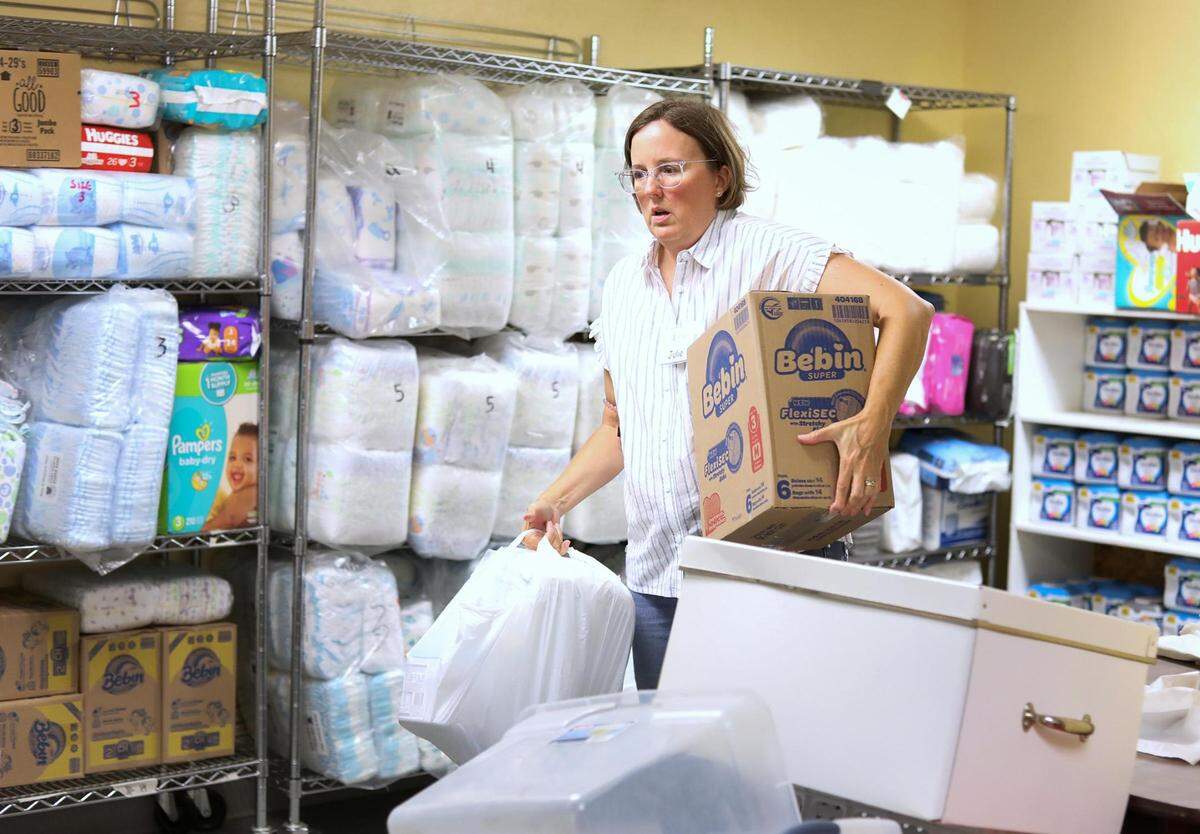
The Junior League of Fort Worth is part of the National Diaper Bank Network, partnering with local agencies to supply diapers to families in need. The nonprofit procures the diapers through diaper drives, fundraising and purchasing them at wholesale cost, then it provides them to partnering agencies at no cost to them or the families who receive them.
Shay Gipson, president of the Junior League of Fort Worth, said the nonprofit has worked with more than 130 agencies since it founded the diaper bank in 2020. Over the past five years, 3.9 million diapers have been distributed, and the demand has continued to grow, she said. From June to October of this year alone, more than 585,000 diapers have been distributed.
“We just perceive that there’s an ongoing demand unmatched by the supply of diapers that are available at little to no cost to the community,” Gipson said. “It’s inflation, cost of goods going up, but also just resources going down. People don’t have the resources they had six months ago right now, and we’re seeing that.”
Gipson said child care obstacles and diaper insecurity are common topics of conversation. They’re part of a bigger cycle that can keep families impoverished, she said. If a parent is unable to drop their child off at a child care program because of diaper insecurity, then they can’t go to work. If they can’t go to work, they can’t pay their bills.
“Child care is already not affordable. So if you take an unaffordable child care option and pair it with a need for diapers, you’re almost in a lose-lose situation,” Gipson said.
Diapers cut into budget for child care providers
Federal officials have called the child care system “a textbook example of a broken market” with high costs for families and low wages for early educators. Providers see minimal profits, and the diaper gap doesn’t help the shaky financial structure of the overall system.
Although most programs expect parents to supply their own diapers, Tarrant County child care providers say they find themselves filling the gaps to avoid turning families away.
Carmeia White, owner of Kami’s Home Daycare in Arlington, said she keeps an extra supply of diapers and wipes on hand. She’ll also go out of her way to buy additional diapers for certain families she serves when needed. She’s seen inflation put financial strain on families, especially in recent years.
“With milk and everything, it’s just so expensive. Diapers are expensive, and the wipes. Everything is so expensive right now,” White said.
Retha Wilson, owner of Like My Own Childcare center in Fort Worth’s Morningside neighborhood, has a similar policy of supplying diapers on her own dime when needed. She doesn’t turn families away who struggle to provide diapers because she understands they would bring them if they had the means to do so.
“If I ask you to bring them, and they don’t bring them, it means they don’t have them,” Wilson said. “I don’t just keep asking. I give them a few days and see if they come up with them. Usually they come up with three or four, you know, and then we’re back to doing the same thing again.”
Wilson asks parents to bring six to eight diapers per day. She and her staff usually start toilet training at about 20 months old and expect the children to be trained by about 2½ years old. There are children, though, who are 3 years old and older still learning.
Other child care providers — including Green Space Nature Preschool in North Fort Worth, Center for Transforming Lives and Child Care Associates — say they rely on each other, in addition to the Junior League of Fort Worth, to meet the diaper gap.
Green Space Nature Preschool supplies wipes while parents supply the diapers, said CEO and Founder Audrey Rowland. Most keep a supply at the center or have them delivered directly to the preschool. The preschool hasn’t had any parents express difficulty with supplying their own diapers.
“We of course keep extras on hand if needed. Periodically, we have families that need help with food, diapers or extra clothes and we just fill the gap for them. If the need is greater than we can provide, we refer them to the Center For Transforming Lives or other resources for long-term help,” Rowland said. “Although licensing doesn’t specifically indicate how many times per day a child’s diaper must be changed, many centers use the practice of changing every two hours. We just do them as needed.”
In addition to serving families enrolled in traditional child care, the Center for Transforming Lives and Child Care Associates also serve those enrolled in the federal Head Start and Early Head Start program. Qualifying families with children from infant age to preschool age receive free child care services, and some funding is provided for diapers.
Center for Transforming Lives, which operates three child care centers and partners with five other providers in Tarrant, said it also doesn’t turn away families unable to supply diapers, as the nonprofit serves families experiencing homelessness and poverty through multiple services in addition to child care.
“Families who are enrolled in Head Start and Early Head Start services are not required to provide diapers, wipes, etc. All supplies are provided by Center for Transforming Lives. In addition, family advocates work with each family to make sure that they have resources they need at home. Again, if they can’t afford diapers, we will connect them to community resources for ongoing support,” said spokesperson Trish Rodriguez.
“We are very fortunate to have community partners such as the Junior League and individuals who generously donate diapers and other supplies for families we work with, so no one has to go without,” she added.
Child Care Associates fully takes on the expense of diapers and wipes for all of its families. One of the child development nonprofits in North Texas, it operates 14 local centers.
“Families are not expected to bring their own supplies, and if a parent is ever unable to provide something, our staff ensures the child has what they need,” said Executive Director of Child Services Kristy Webb. “CCA also partners with local community organizations to support families beyond the classroom. Each campus has a dedicated Family Engagement Advocate who works closely with families to understand their needs and connect them with community-based resources. For our home-visiting families, CCA partners with the Junior League of Fort Worth Diaper Bank to ensure they also receive ongoing diaper support and essential care items.”