‘You’re going to win’: Crowley ISD, Paul Quinn College team up on middle schools
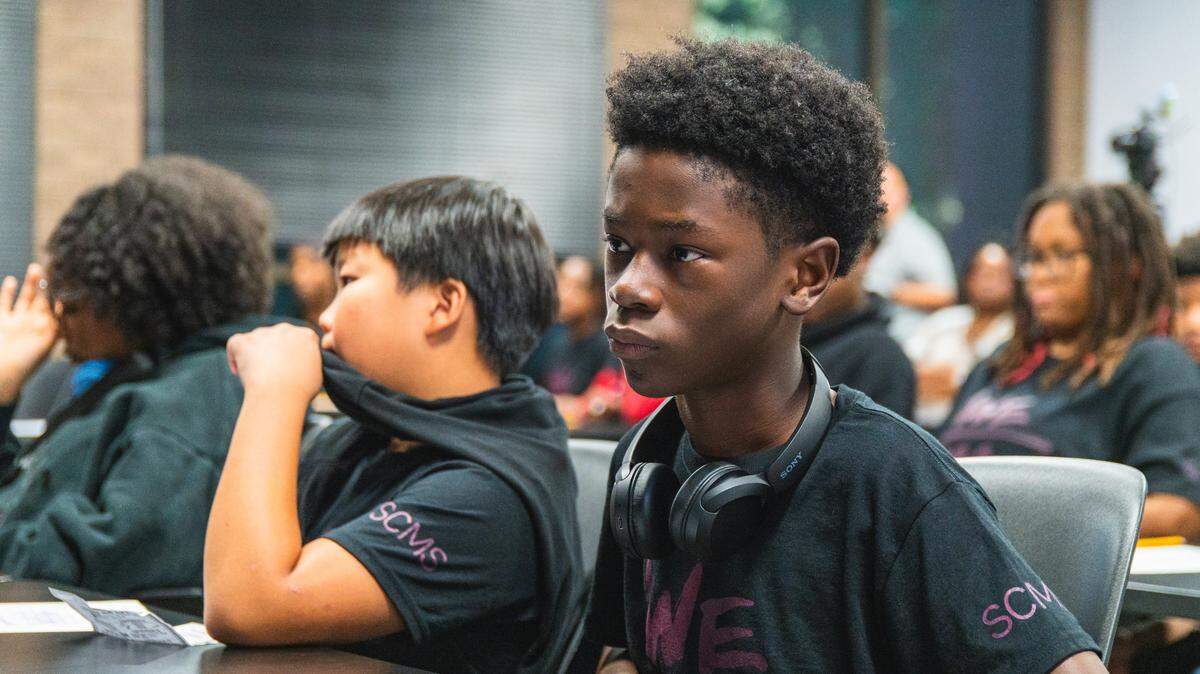
Last Wednesday morning, Antonio Mauldin stood in front of a room full of eighth-graders at Paul Quinn College, trying to get them to look deep into the future.
Although they’re only in middle school, the students already have letters of acceptance to the college, located in southern Dallas. But that acceptance is contingent on a few factors, including graduating high school with a GPA of 3.0 or better.
For students who are only six weeks into eighth grade, high school graduation can seem like a long way off. But Mauldin, the college’s lead admissions and retention coordinator, reminded them that what they do next year will affect the opportunities they have later on. In order to meet that 3.0 threshold, they’ll need to maintain a B average throughout their high school years, he told them. They can’t coast for the first three years and then buckle down when they’re seniors.
“But if you’re extraordinary students, like I think you are, I believe that you can get a 4.0. I think you can get As,” Mauldin told them.
The students were visiting the college as a part of a new partnership between Paul Quinn and Crowley ISD that organizers on both sides hope will help get students to start thinking about college earlier.
Crowley ISD, Paul Quinn College partner on middle schools
Beginning this year, Crowley ISD turned operations at its middle schools over to Paul Quinn’s Quinnite Schools Network under an arrangement known as an 1882 partnership. As a part of that partnership, the college gave letters of acceptance at the end of the last school year to incoming sixth-, seventh- and eighth-graders.
1882 partnerships, so named because they operate based on guidelines laid out in Texas Senate Bill 1882 in 2017, give districts financial incentives to bring in outside partners like foundations, colleges or charter schools to run public school campuses, either with the goal of turning around struggling schools or spurring innovation.
When Paul Quinn and Crowley ISD launched the partnership, district leaders said they hoped it would help get their students thinking about college earlier, and help them see it not so much as a possibility but instead as an inevitability. Natalie Williams, executive director of the college access nonprofit T3 Partnership, said the campus visit was a big part of that goal. T3, also known as Tarrant To and Through, helped organize the visit.
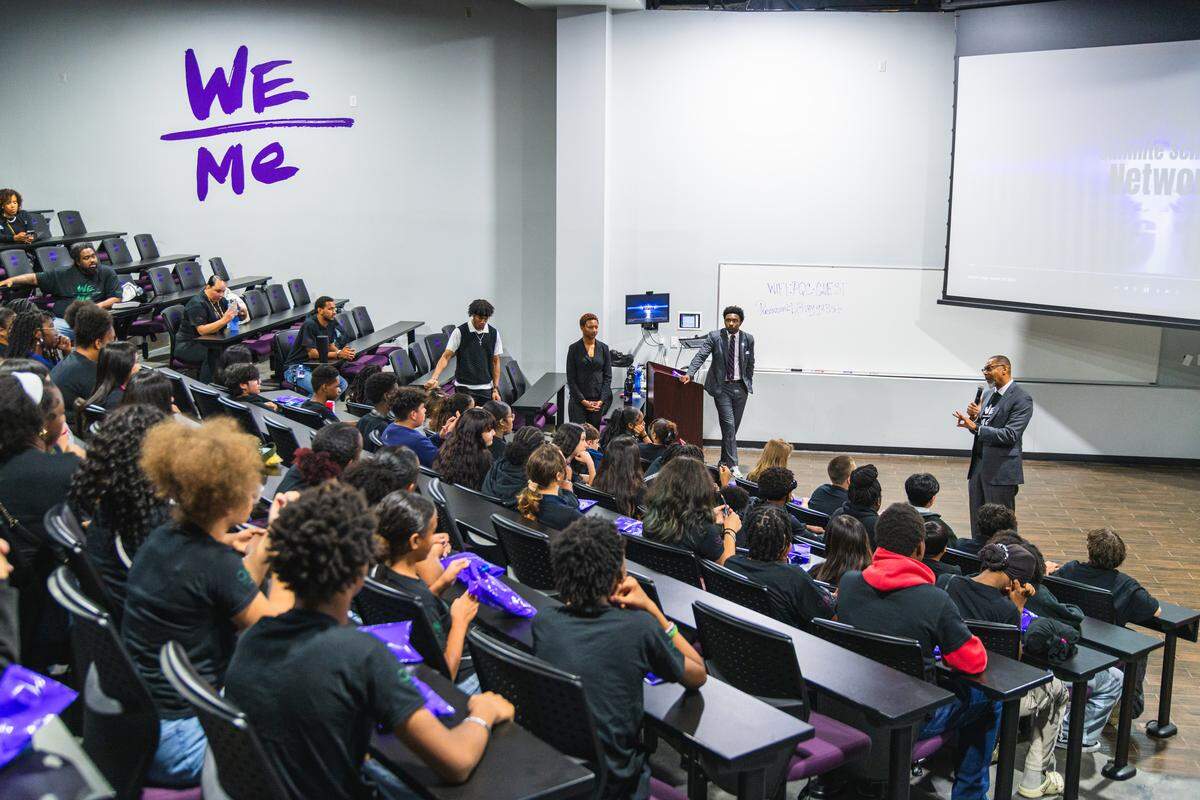
Having students begin visiting college campuses when they’re in middle school helps demystify the college experience, Williams said. When students get a chance to see what a college class looks like early on, it’s easier for them to picture themselves there. And in doing so, they’re more likely to think about their pathway through high school and into college.
It’s critical to get those students thinking in those terms early on, Williams said, because decisions they make when they’re in middle school can have an impact on their college options. For example, students who take Algebra I in eighth grade are more likely to go on to college after high school, she said.
Michael McFarland, superintendent of Crowley ISD, said middle school is the time when students start to feel more influence from their peers than from teachers or parents. By starting the college conversation earlier, McFarland said he hopes the district can nudge that peer pressure in a positive direction. If students have a good experience during campus visits like the one last Wednesday, they’re more likely to talk to their friends about college plans. As those conversations continue, more students will begin to see college as a viable option after high school, he said.
Those early conversations can also help students avoid getting into a situation where their options are limited because of decisions they made earlier in high school, he said. A student who wants to pursue a career in medicine needs to take certain math classes beginning in middle school, he said. If that student doesn’t make that decision until their sophomore year of high school, it may be too late, he said.
Although the partnership has been in planning stages for more than a year, work began in earnest at the beginning of this school year. McFarland said the district began with eighth grade this year, and officials plan to expand programs down to seventh and sixth grades in the coming years.
Although innovation is the main goal of the partnership, McFarland said he hopes to see academic returns, as well. The district’s middle schoolers have trailed behind the rest of the state in reading and math for years. McFarland acknowledged that the district needs to improve academic performance in middle school, and said the partnership with Paul Quinn has the potential to help students gain ground academically.
“We know innovation is going to help us to identify opportunities out there that we may not have known existed in the past,” he said.
Crowley ISD students get glimpse of college life in Dallas
Ean and Ethan Taylor, twin brothers in eighth grade at Summer Creek Middle School, took part in a group discussion about the events leading up to the drafting of the Declaration of Independence during their morning session at Paul Quinn. Ean said the discussion was exciting because they got to see what a college class looks like while they were going over material they’d already covered in their social studies classes.
Ethan agreed. The class was a good opportunity for him to show his own knowledge while hearing others’ viewpoints, he said. It was also a good chance to learn about concepts in history that he wasn’t familiar with, he said.
Both brothers said they liked seeing how professors at the college try to encourage students to offer input and participate in discussions. College is a part of both brothers’ plans for the future — Ean wants to be a lawyer and Ethan wants to be an art teacher or a pediatrician — and both said they liked getting a chance to see what life on a college campus is like.
College, K-12 partnerships are a natural fit, Paul Quinn president says
Although it took a good deal of planning to get Paul Quinn and Crowley ISD working together on the same plan, public schools and higher education aren’t as different as many people think, said Michael Sorrell, president of the college. Both are filled with students who are trying to improve their prospects for life and educators who are passionate about lifelong learning.
The key difference is that in higher education, those educators are working with adults who have narrowed down what they want to do with their lives, Sorrell said. So it’s the job of college professors to help students get to a place where they can achieve those goals and support themselves and their families. In K-12 schools, teachers try to help students build the foundations of those dreams. But at both levels, students represent the hopes and aspirations of their families and communities, he said.
That commonality makes a partnership between colleges and school districts a natural fit, Sorrell said. Higher education partners are uniquely positioned to convey the message to students from an early age that they have potential, and if they’re willing to work hard enough, they’re bound to reach their goals, he said.
“What we’re trying to do with those students is to teach them to believe in the inevitability of their own success,” Sorrell said. “‘You’re going to work hard enough to win, period. So if you’re willing to work hard enough to win, you’re going to win. And we’re proud to teach you how to win.’”