Florida expanded school vouchers two years ago. What can it tell us about Texas?
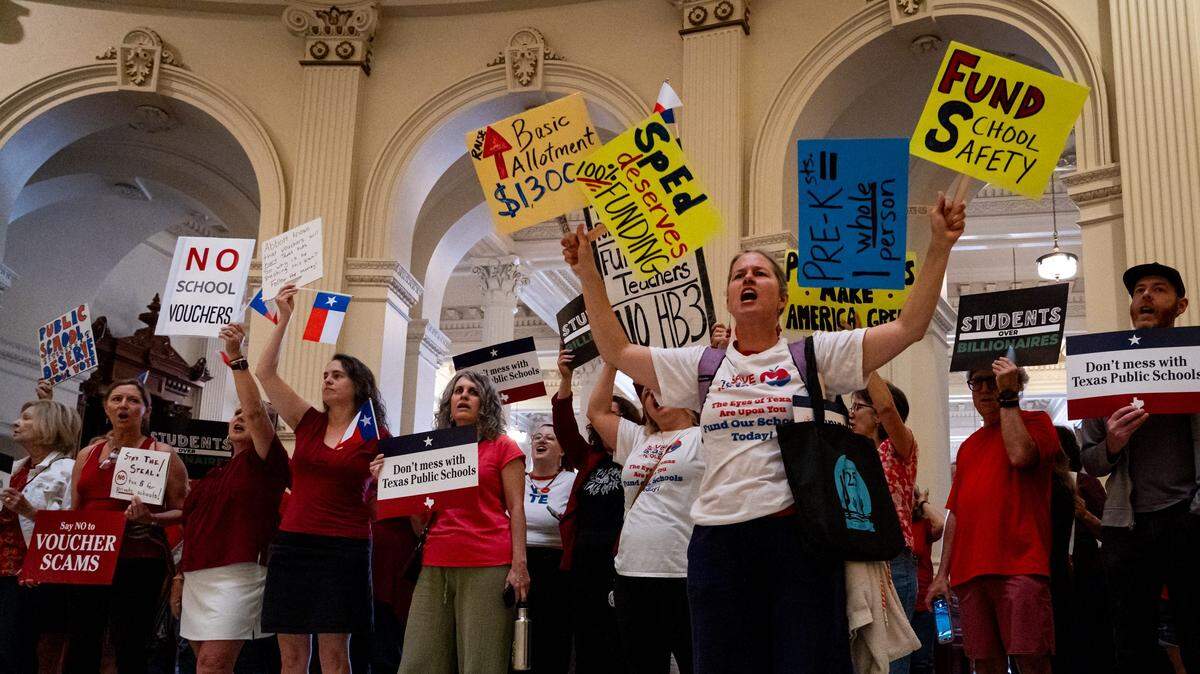
When Gov. Greg Abbott signed Texas’ billion-dollar school voucher plan into law this month, he said the program would immediately become one of the biggest in the nation.
But Texas isn’t the first big state to launch a universal private school choice plan. In 2023, Florida lawmakers expanded an existing school voucher program, making every student in the state eligible to apply.
Two years later, Florida’s program offers a preview of where Texas may be headed.
Since the expansion, Florida’s program has been massively popular. This year, the number of Florida students receiving school vouchers surpassed 500,000. Florida Gov. Ron DeSantis has said that total represents about a third of the school vouchers awarded nationwide.
But that growth carries a high price tag. As students opt for private schools, school districts lose revenue. School leaders in Florida say shrinking budgets are already leading to program cuts, teacher layoffs and larger class sizes.
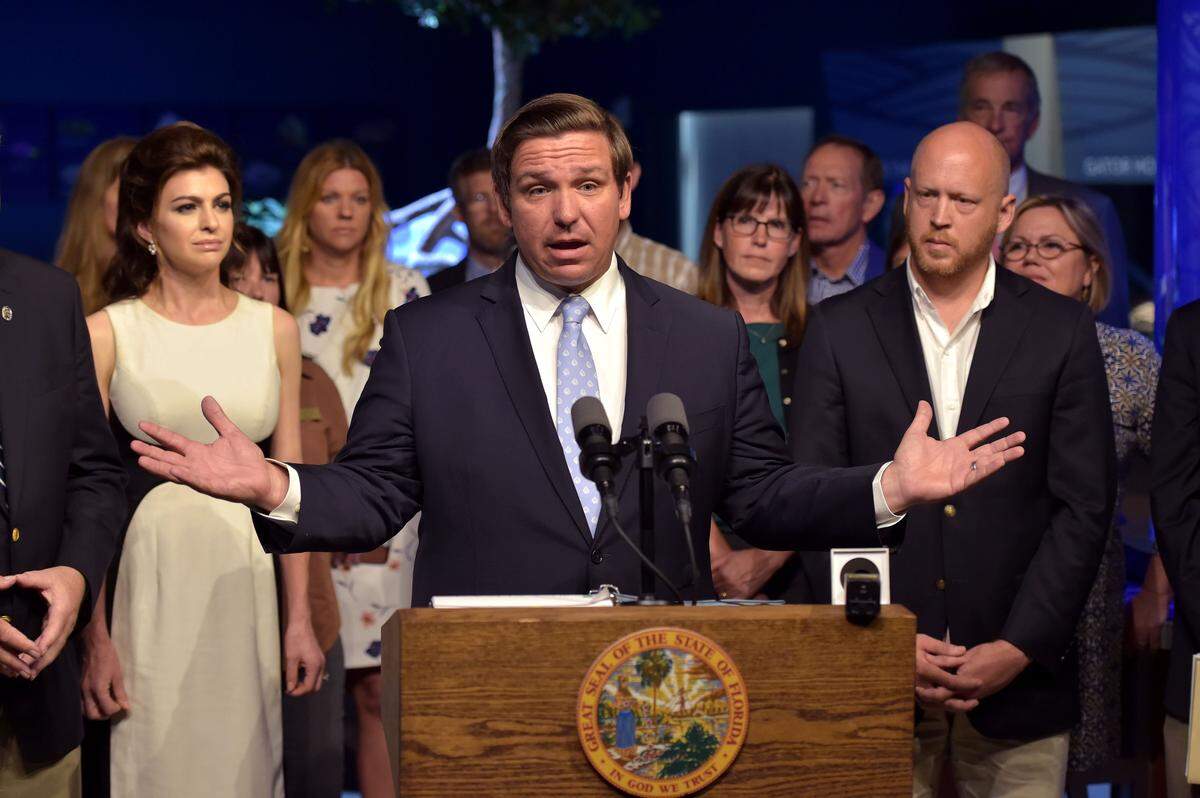
Greg Abbott touts Texas school voucher plan
Gov. Greg Abbott signed Texas’ new education savings account program into law earlier this month. The $1 billion voucher-like program will give families roughly $10,000 to put toward private school tuition. All students in the state are eligible to apply, as long as they are U.S. citizens or were admitted into the country lawfully.
The bill had a long road to Abbott’s desk. Republican leaders have made the policy a priority for years, but they ran up against opposition from Democrats and rural Republicans, who worried such a program would drain money from public schools. But after a bill failed to pass the Texas House of Representatives in 2023, Abbott supported a slate of primary challengers looking to unseat anti-voucher Republicans. At a May 3 signing ceremony in Austin, Abbott told a crowd of supporters that the program would give families more freedom to decide how they want their children educated.
“These families, and thousands more, have been yearning to choose a school that best fits their child,” Abbott said. “Now, they have that option.”
Florida private school vouchers see rapid growth
The Texas plan immediately joins Florida’s as one of the nation’s biggest school choice programs. Florida has two main private school choice programs: Florida Tax Credit Scholarships and Family Empowerment Scholarships, both of which families can use to pay private school tuition. Both programs were originally targeted at helping students from low-income families get out of failing public schools. But in 2023, Florida Gov. Ron DeSantis signed a bill eliminating eligibility requirements, opening the program up to all students in the state.
The change led to rapid growth in the number of students taking school vouchers. Between the 2022-23 school year and this year, the number of students receiving Family Empowerment Scholarships doubled, and so did the cost — the state awarded about $2.8 billion in scholarships this year, compared to $1.4 billion the year before the program expanded.
In January, the left-leaning Florida Policy Institute released an analysis showing that vouchers and tax credits will cost the state roughly $4 billion this year. Voucher spending grew to account for nearly a quarter of the state’s education budget this year, according to the analysis. The institute projects the program will continue to grow, as a cap on the number of homeschool students receiving vouchers is set to be lifted in 2027.
Norín Dollard, senior policy analyst for the Orlando-based think tank, said school districts are beginning to feel financial pressure as a result of the growth of the voucher program. In Orlando, Orange County Public Schools officials have announced plans to lay off more than 800 teachers. District officials in Pasco and Pinellas counties, in the Tampa Bay area, have also said they expect to eliminate positions, although both districts have said those cuts won’t translate into layoffs. Districts have also had to make cuts to programs like International Baccalaureate and Advanced Placement, both of which allow students to earn college credit while they’re still in high school, she said.
If the growth of school voucher programs continues, Dollard said she worries it will threaten the very existence of public school districts in Florida. That’s a problem, she said, because no other entity has the ability to fill the void public schools would leave if they went away. Traditional public schools serve a number of roles that private schools don’t, she said. They act as centers for cultural transmission, where older generations pass social values on to younger ones. In rural areas, they’re often the only community hubs. And in Florida and parts of the Texas Gulf Coast, they often serve as hurricane shelters.
Early Florida voucher program led to public school gains
In a study published in 2023, researchers from the University of Rochester; the University of California, Davis; and Emory University looked at the impact of Florida’s voucher program on students who remained in public schools between the 2002-03 and 2017-18 school years — five years before the scholarship program expanded. The researchers analyzed standardized test scores, as well as other, non-academic factors like suspension rates and chronic absenteeism.
Researchers found that, as the years passed and the voucher program grew, public school students saw better outcomes. Test scores improved and suspensions and absenteeism both declined. While those results were reflected across the board, they were most pronounced among students in low-income families.
In the study, the researchers identified a few possible explanations for their results. It’s possible that, faced with increased competition from private schools, public school districts made improvements that led students to do better academically and kept families more engaged. But there are other possible factors, as well, researchers wrote. As public school enrollments declined, districts lost funding. But it’s possible that those enrollment declines also led to smaller class sizes, which generally leads to better academic performance.
But David Figlio, a University of Rochester professor and the study’s lead author, cautioned against assuming that Texas will see anything similar to the results outlined in the paper. The data the researchers analyzed comes from before Florida made the state’s voucher program universal. The difference between a program that’s relatively narrowly targeted to low-income students and one that’s open to all students is a big one, he said. It’s possible that Florida’s public schools are now dealing with effects that differ considerably from the ones found in the study, he said.
“I’m not saying that this has no bearing at all for universal voucher programs,” said Figlio, a professor at the University of Rochester’s Warner School of Education. “It’s just that I think your mileage may vary.”
Another key difference is the makeup of districts in Florida compared to those in Texas. Unlike most states, Florida has county-wide school districts, meaning many of its districts are huge. For example, while Miami has less than a quarter of the population of Houston, its school district, Miami-Dade County Public Schools, has almost twice as many students as Houston ISD. That matters, Figlio said, because bigger, countywide districts have an easier time moving resources around to where they’re needed. So they may be better equipped to deal with enrollment declines and the funding cuts that come with them, and minimize the impact on students who remain in the district, he said.
Vouchers, school budget cuts lead to frustration
Sue Woltanski, an education advocate and board member in the Monroe County Public Schools, said the growth of school voucher spending has caused the district to have to make tough decisions. The county encompasses the Florida Keys as well as a broad, largely uninhabited swathe of the southwestern tip of the state that includes Everglades National Park.
Woltanski, who emphasized that she wasn’t speaking on behalf of the district, said it’s frustrating that state leaders didn’t listen to local school officials and board members who warned them that an expanded voucher program would harm local school districts. In 2023, Woltanski told a Florida House of Representatives subcommittee that state lawmakers were underestimating how much the program would cost, and that local school districts would bear the brunt of it.
Two years later, Woltanski said that prediction has come true. Class sizes in Monroe County have grown because the district can’t afford as many teachers as it once did. And across the state, students are losing access to programs that help them get a head start on college.
“I always tell people, I’m going to get a tattoo on my forehead that says, ‘I told you so,’” she said.
This story was originally published May 12, 2025 at 5:30 AM.