
Study shows revenue projections for Keller ISD split; audit finds problems with budget
Former leaders in the Keller school district made unrealistic assumptions and overestimated attendance and revenue projections, leading to a $35 million shortfall in the general fund, according to an independent audit.
The district hired Chicago-based RSM consultants in May 2024 to perform a budget compliance review in response to deficits, irregularities and recent employment changes in the central office.
The firm presented its findings during the school board’s regular meeting Jan. 30.
The Keller school district is expected to begin the 2025-26 school year with a $9.4 million deficit stemming from increased expenses and declining revenue, the latter of which is largely the result of decreased student enrollment and low per-pupil funding from the state.
The state provides school districts with $6,160 per student, using average daily enrollment to determine the total amount. That per-pupil number hasn’t changed since 2019, despite inflation, and John Allison, the district’s chief operating officer, said the allotment would need to increase by more than $1,400 per student to maintain the same funding levels from six years ago.
Over that same six-year period, Keller’s fund balance — essentially the district’s checking account balance — declined by approximately $35 million. Today it stands at around $47 million, just above the “critical level” of $46.5 million, according to Allison.
“We don’t have a lot of wiggle room,” he said.
RSM found that Keller’s revenues exceeded its expenditures from 2016 until 2021. By 2023, the budget shortfall was nearly $30 million. Consecutive deficits resulted in the Texas Education Agency downgrading the Keller school district’s fiscal rating from a B to a C. It also received a “negative” rating from Moody’s.
RSM found no evidence of impropriety, but it found that former superintendent Rick Westfall and the former CFO were not transparent in the budget process while taking an aggressive approach to revenue projections, mistakenly believing that enrollment would increase after COVID. They also believed that more revenue would come from the state legislature, but that did not materialize, the firm found.
Westfall led the district from 2017 until his resignation in 2023. He was replaced by Tracy Johnson, who parted ways with the district this week.
Following the budget analysis, the district hired Austin-based educational consultants MoakCasey to conduct an analysis on the revenue impact of a split district along U.S. 377.
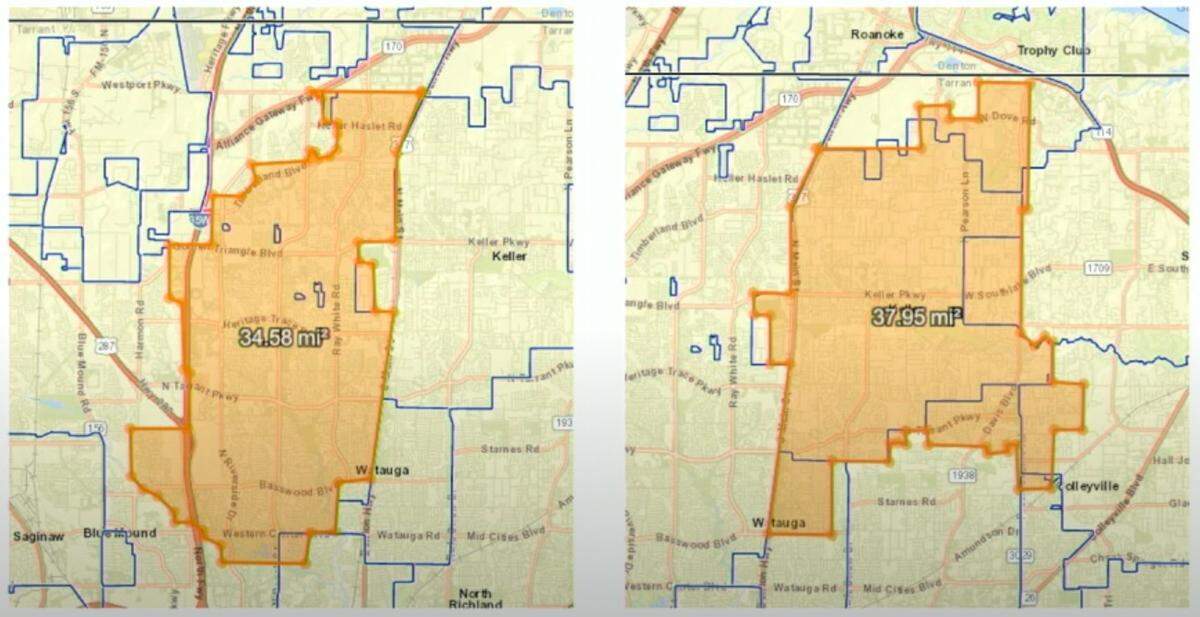
Keller is the fourth-largest school district in Tarrant County, with more than 34,000 students in Keller, Fort Worth, Colleyville, Haltom City, Hurst, North Richland Hills, Southlake, Watauga and Westlake; 27 of its 42 campuses are in Fort Worth, where almost 70% of the district’s residents live.
Every district school in Keller, Colleyville and Southlake received an “A” rating from the state in 2022, the most recent accountability scorecard, while only three Fort Worth campuses earned the highest mark.
If Keller was split in two, the western half would have an average daily attendance of 21,718 students, and the eastern half would have an average daily attendance of 9,105, according to the consultants.
According to Josh Haney, MoakCasey’s senior vice president of finance, the current levels of state and local funding would remain roughly the same for each side of a divided district: $10,204 per student on the west side and $9,244 in Keller.
That is because, according to Haney, “funds follow the student.”
The MoakCasey report showed that the western side of the district would receive significantly more state money for services like special education, compensatory education for low-income students and bilingual education, owing to the differences in demographics between the east and west. However, as Haney noted, that wouldn’t directly impact funding for individual campuses since those are precisely the types of funds that “follow the student.”
MoakCasey’s findings spurred district board trustee Joni Shaw Smith to ask, “If revenues will stay about the same ... why would we want to split?”
That question was met by applause from those in the audience.
Smith went on to ask about the potential negative impact of the split on expenditures, such as service contracts that would need to be renegotiated, possibly at a higher rate, after the division. Haney said that MoakCasey wasn’t tasked with looking at expenditures, so the firm had no answers.
Five of the Keller school district’s seven trustees live in the city of Keller. Joni Shaw Smith and Chelsea Kelly live in Fort Worth. They are the only board members who have spoken out against the plan to split.
During a meeting on Jan. 16, President Charles Randklev announced committees would study a proposal to split the district.
Ashley Fiddelke, a resident who spoke during public comments, pointed to rankings compiled by the analytics site Niche showing all but four of the 25 highest-performing school districts in Texas have fewer than 25,000 students.
However, the Katy school district, which is ranked seventh in Texas, has an enrollment of more than 92,000, so it’s unclear how much of an impact enrollment has on performance.
Other pro-split residents, as well as some board members, said the split would allow for more direct oversight of schools, although the trustees did not elaborate on what that would look like.
This story was originally published January 30, 2025 at 8:46 PM.