As enrollment declines, Fort Worth ISD task force looks at which schools to close
Last Thursday evening, Erikah Daley sat in a school cafeteria poring over a map of a large swathe of eastern Fort Worth, trying to figure out which schools to keep and which ones to shut down.
Daley was part of a team of community members tasked with making decisions about the future of schools in the Fort Worth Independent School District’s Eastern Hills pyramid. Daley, a special education teacher at Lowery Road Elementary School, pointed to three elementary schools, all at 70% capacity or less. If the district combined those three schools into a single campus that was closer to full, it could be a better use of resources, she said.
But doing so would mean that consolidated campus took in students from a broader geographic area. That would mean bus routes to and from school would be longer. Even a 20-minute bus ride can be too long for some kindergartners, she said. It’s a difficult question to answer, Daley said, and one the district will be grappling with for months.
Daley and her group of Eastern Hills teachers and parents are one of several teams looking at the same questions in all parts of Fort Worth ISD as a part of a district facilities task force. Like many districts across the country, Fort Worth ISD has lost enrollment over the past decade, forcing district leaders to confront difficult decisions, including possible school closures. Looking at enrollment data for schools in the Eastern Hills area, Daley acknowledged that those are tough decisions. But with so many classrooms sitting empty, the district has to do something.
“In anything that you do, you want to make sure you’re using your resources wisely,” Daley said. “And it looks like we’re not doing that.”
FWISD faces declining enrollment
Fort Worth ISD’s enrollment has declined 17% since 2016, driven by a combination of increased competition from charter schools, declining birth rates and housing patterns. The district isn’t alone: Across the country, revenue losses associated with enrollment declines are forcing school systems to make difficult financial decisions, including closing campuses.
The issue Daley and her team identified — making better use of resources versus keeping bus routes manageable for young students — is one example of the kinds of tradeoffs Fort Worth ISD is facing everywhere. At a time when enrollment isn’t expected to rebound, school leaders say the district has more classroom space than it needs. District officials have acknowledged that any solution to the problem is likely to include school closures and consolidations.
But doing so creates logistical challenges like longer bus routes. Campus closures are also hard to sell to community members, many of whom see those schools as neighborhood landmarks that are worth preserving.
It’s a challenge the district has already faced: Earlier this year, district leaders released a list of small and under-enrolled middle schools it was considering closing. All six campuses were targeted for improvements as a part of the district’s 2021 bond package, but district leaders proposed instead using that money to build bigger, consolidated campuses and closing the older schools. But after community pushback, the district’s school board abandoned the idea last May.
In addition to the middle school consolidation issue, Fort Worth ISD’s board earlier this year commissioned a $1 million study looking at the district’s facilities needs including “rightsizing recommendations” which are expected to include school closures. District officials initially said they expected to present a facilities report to the board before the end of the year, but later pushed that target date back, saying they wanted to allow more time for public input.
Survey finds community support for school closures
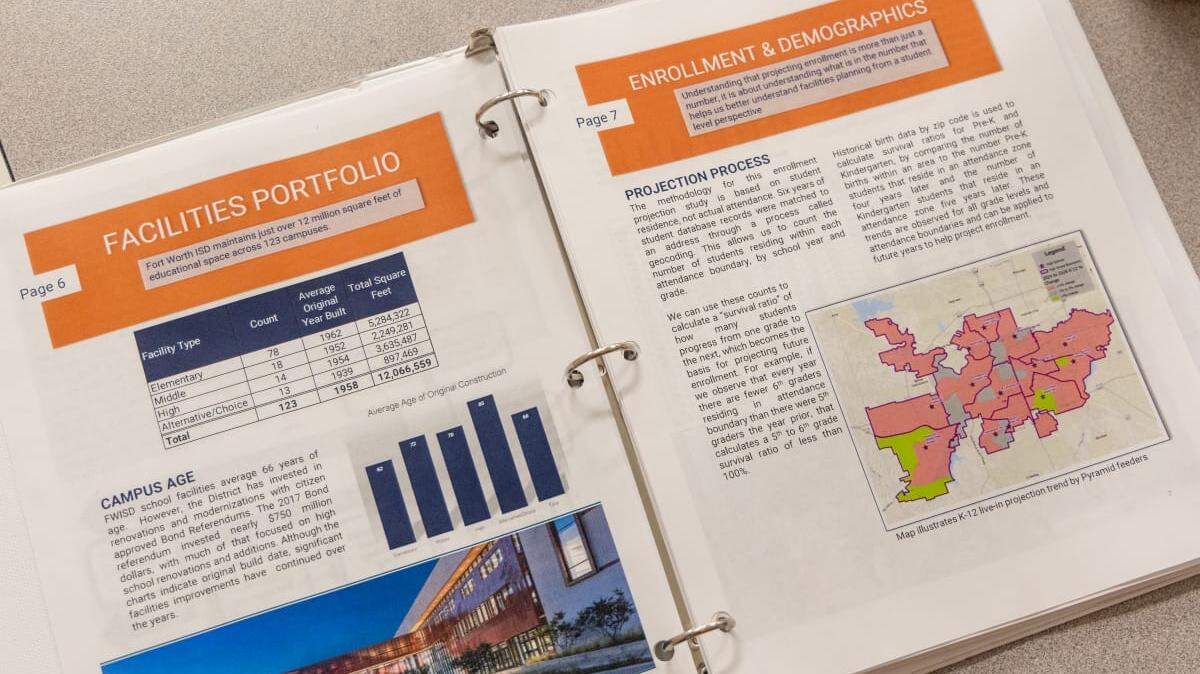
Kellie Spencer, the district’s deputy superintendent, said the facilities study brought together enrollment data and projections, as well as information about the ages, conditions and square footage of every campus in the district. The district presented that information to the task force at its first meeting last month.
At last week’s meeting, task force members received the results of a community survey the district fielded earlier this fall. Of the roughly 1,100 Fort Worth ISD residents who responded, 46% said they agreed with reducing the number of buildings in the district. Only 25% were opposed, and the remaining 29% said they were unsure.
Task force members put together options for each of the district’s feeder pyramids, plus other buildings like schools of choice and district-level service centers. Nothing that came out of Thursday’s meeting is a final plan — the task force has two more meetings scheduled next year, and each proposal will go through several iterations before the district finalizes a plan. District leaders also plan to hold more community meetings in several parts of the city to talk with community members about their needs and concerns.
Spencer said the district’s first priority is providing adequate educational opportunities for its students. To do that, district leaders need to balance a number of variables, including how many students live in each neighborhood now, whether that number is expected to grow or decline over the next decade, and whether the district’s existing buildings are adequate to meet their needs.
When campuses are under-enrolled, it limits the district’s ability to provide those educational opportunities, Spencer said. The special programs a school offers can be one of the main factors driving student achievement, she said — extracurricular activities like fine arts or athletics are the main thing keeping many students engaged at school. But when a school is under-enrolled, it becomes more financially complicated to offer those programs. By consolidating low-enrollment schools into larger campuses, the district can improve its extracurricular offerings, she said.
Spencer acknowledged that school closures are often hard for communities to stomach. Many students in the district go to the same schools their parents and grandparents attended. If school closures have to happen, the best thing district leaders can do is to be transparent about why, she said. That means going into neighborhoods and talking with parents and other community members about what’s at stake, she said. Still, she said, those conversations will be difficult.
“No matter how you approach it, it’s an emotional process, because there are community ties to those buildings,” she said.
Ken Bowens, another member of the group looking at options for the Eastern Hills pyramid, said it would take some adjustment if one of his kids’ schools ended up slated for closure. Bowens has kids at John T. White Elementary School and Meadowbrook Middle School.
Still, Bowens said, the district needs to do what’s best for all students, and it’s the task force’s job to make sure the district’s decisions reflect what the community needs. When the time comes to announce a plan, Bowens said, the district needs to be as transparent as possible about what’s coming. That’s especially important if the plan includes school closures, he said.
“We’re making big decisions,” he said. “That’s the main thing — make sure you get the decisions right, and make sure that the community knows.”