Too many Fort Worth ISD students miss too much school. How much does reading suffer?

At about 100 campuses across the Fort Worth Independent School District, more than one in five students missed at least 10% of school days during the last school year, district records show.
The district isn’t alone: Schools nationwide saw a substantial uptick in the number of students who racked up too many absences following the pandemic, a trend education leaders and researchers call chronic absenteeism.
Experts say that when more than 20% of students at a campus are chronically absent, it hinders academic progress even for students with good attendance. Education leaders worry that higher rates of absenteeism may be derailing the strategies districts are using to close gaps in students’ skills and knowledge left by remote learning.
“There’s not a place in the United States that isn’t facing some challenges with chronic absenteeism coming out of the pandemic,” said Robert Balfanz, a research professor at the Johns Hopkins University School of Education.
Chronic absenteeism spiked after pandemic, AP data shows
Researchers define chronic absenteeism as missing 10% or more of school days, roughly 18 days per school year. Chronic absenteeism differs from truancy in a few key ways. While truancy deals only with unexcused absences, research into chronic absenteeism looks at all instances in which students missed school for any reason, whether it was excused or unexcused. Conversations about truancy also tend to be punitive, focusing on legal consequences for parents of students who rack up too many absences, while those about chronic absenteeism focus on dealing with barriers that keep kids out of school.
Nationwide, chronic absenteeism nearly doubled after the pandemic, climbing to 28% of all students during the 2021-22 school year, according to attendance data compiled for the Associated Press by Thomas Dee, a professor in Stanford University’s Graduate School of Education.
In Fort Worth ISD, chronic absenteeism peaked during the 2021-22 school year, when 36% of students missed at least 10 percent of school days. During the 2022-23 school year, that figure dropped to 28% — a marked improvement, but a rate that district officials are quick to acknowledge is still too high. During the 2018-19 school year, the last year before the pandemic began, only about 17% of kids in the district were chronically absent, records show.
Even with those district-wide improvements, the picture still looks far worse at some campuses, according to data released by the district in response to a records request by the Star-Telegram. At Eastern Hills and Polytechnic high schools, more than half of all students missed at least 10% of the 2022-23 school year, district records show. And at Success High School, the district’s campus for overage and under-credited students, nearly two-thirds of students were chronically absent last year.
Nationwide, chronic absentee rates likely contributed to declines in student performance, according to an analysis released in September by the National Council of Economic Advisors and the National Center for Education Statistics. In schools across the country, scores plummeted in 2022 on the National Assessment of Educational Progress, commonly known as the Nation’s Report Card, erasing decades of progress. Among 13-year-olds, average math scores fell to levels not seen since the 1990s, while average reading scores fell to roughly where they stood in 2004.
According to the analysis, the uptick in chronic absenteeism nationwide was large enough to account for 36-45% of the declines in reading and 16-27% of the declines in math. The analysis includes the caveat that other factors like student mental and physical health, other familial responsibilities and other demands on students’ mental and physical resources could also be driving both increased absenteeism and declining academic achievement. In any case, analysts wrote, dealing with the problems keeping students out of school will be a key piece of academic recovery from the pandemic.
“Ultimately, whether chronic absenteeism is a symptom or a cause — or both — of ongoing academic disruption, the evidence is clear that the road to recovery runs through the classroom,” analysts wrote.
Like other districts across the state, Fort Worth ISD began offering intensive tutoring to students who failed any section on the state test after lawmakers passed a requirement that they do so in 2021. The requirement was one of a handful of policies aimed at helping students regain the academic ground they lost during the pandemic. But when students miss school, they also miss those tutoring sessions, in addition to the regular classroom instruction they get during the school day.
One of Fort Worth ISD’s main strategies for re-engaging students who racked up too many absences is placing staffers called family engagement specialists at campuses across the district. The specialists make calls to families of absent students, talking with them about what’s keeping their kids out of school and helping connect them with solutions. District officials have credited those specialists with helping thousands of students improve their attendance. But those positions are funded by federal COVID relief dollars, and that money expires in September. Officials haven’t said whether the district will be able to continue that program once the money runs out.
Effects of chronic absences can spill over to other students
Speaking on a webinar with education journalists in November, Balfanz, the Johns Hopkins professor, said research indicates that when 20% of students at school are chronically absent, it begins to affect even those students who attend school regularly. That’s at least in part because teachers at those schools are working with a different group of students every day, he said. That leaves them with the unenviable choice of going back to cover the material that absent students missed while others wait, or going on without those students and telling them to ask a friend what they missed, he said.
For many districts across the country, the 2021-22 school year was supposed to mark the return to in-person learning. But Balfanz said that was also the year when the chronic absenteeism crisis became apparent. Nationwide, about two-thirds of students went to schools in which at least 20% of students were chronically absent, compared to about a quarter of students before the pandemic began. Likewise, nearly two-thirds of schools had chronic absenteeism rates above that 20% threshold that year, up from 28% of schools before the pandemic.
One key strategy for getting more kids in school every day is restoring connections with students and their families that were broken during the pandemic, Balfanz said. Students are far more likely to show up when they believe there’s an adult at school who knows them and cares about them and that they’re engaged in important, meaningful activities at school, he said.
Schools also need to focus on student health and mental health in a more systematic way coming out of the pandemic, Balfanz said, since those issues are often major barriers keeping kids out of school. The most important thing, he said, is that districts take a multi-pronged approach to solving the problem. Chronic absenteeism is a complicated issue that will take more than one strategy to solve, he said.
“When we have those levels of chronic absenteeism, there’s really no single strategy that’s going to turn it around,” Balfanz said.
States also have a role to play in solving the problem, Balfanz said. Before the pandemic, chronic absenteeism was mainly an issue in large urban school districts. Since then, it’s become a greater concern in suburban, small-town and rural districts, as well, he said. States need to support efforts to re-engage students in districts that have never had to deal with the issue before, and also in districts where the problem has become even more acute than it was, he said. States can provide support by investing in effective programs or offering training and coaching for district leaders, he said.
Cesar Chavez finds strategy for bringing absent kids back to school
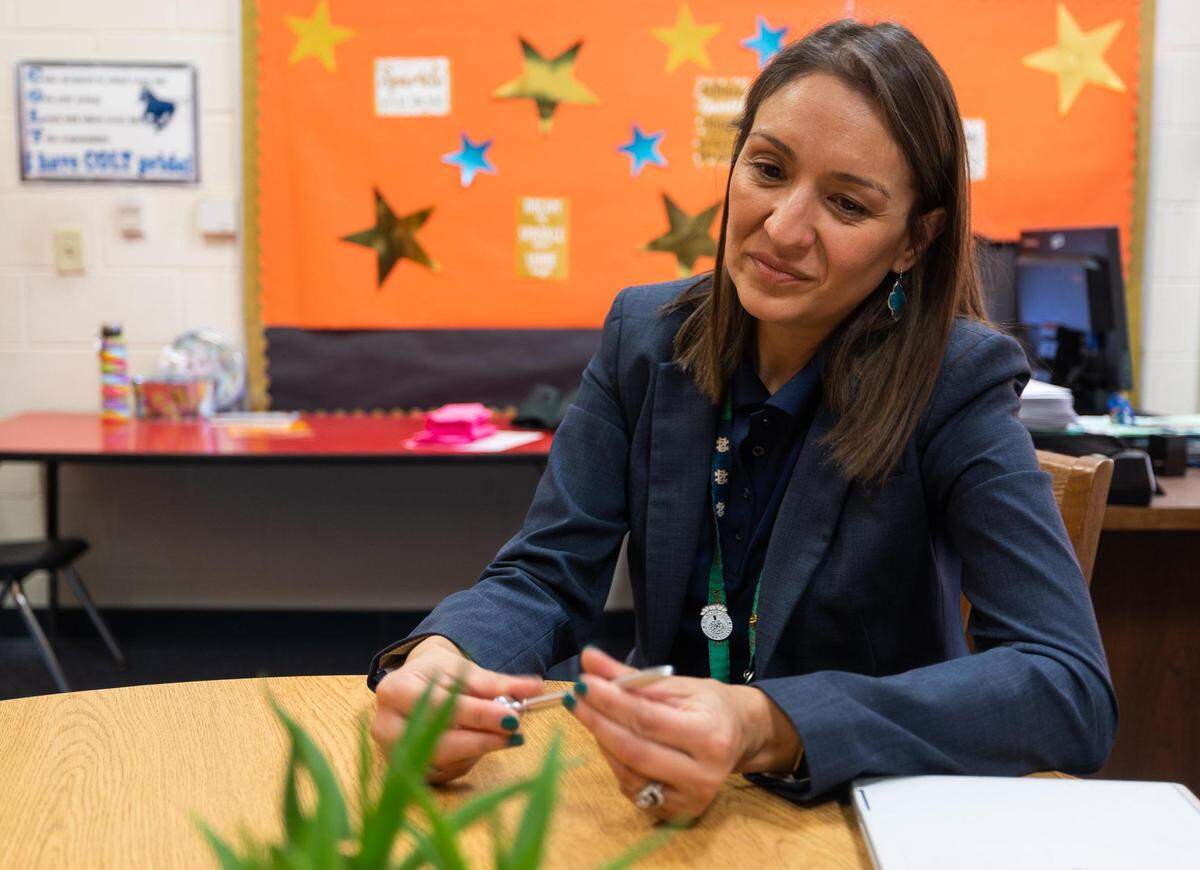
Monica Ordaz, principal at Cesar Chavez Elementary School in Fort Worth, said she noticed a difference on her campus when the school’s chronic absenteeism rate began to decline. More than a quarter of all students at Cesar Chavez missed 10 or more days during the 2021-22 school year, district records show. At the beginning of the current school year, only 13% of students were chronically absent.
When the problem was at its peak, teachers told Ordaz that they had to spend more time each week not only reviewing the material that students missed, but also re-teaching classroom norms like where students were supposed to turn the assignments in and when they could get up to sharpen their pencils, she said. Those minutes they spent on review represented lost time they were supposed to use teaching new material, Ordaz said, and the need for constant reteaching was a source of stress for teachers.
Ordaz said campus leaders tried a number of different strategies to re-engage missing kids before landing on one that worked. Like many campuses, Cesar Chavez has a family engagement specialist who makes daily calls to the parents of absent students. Generally, those calls happen beginning at about 10 a.m., after teachers take daily attendance. But after noticing how many students were absent over and over, Ordaz asked teachers to compile lists of students who were either chronically absent or at risk of falling behind if they missed school. They made cards for each of those students that included contact information for their parents.
At the beginning of each day, teachers place cards for any of those students who are missing in mailboxes outside the classroom doors. The school’s family engagement specialist and counselor walk the school’s hallways every morning collecting those cards, then call the parents of those absent students. Making those calls first thing in the morning instead of later on does two things, Ordaz said: It sends a message to families that their kids are important to the school, and it allows school leaders to reach those parents early enough in the day that they might still be convinced to get their kids to school that morning.
If campus leaders can’t get in touch with parents by phone, or if they don’t have any luck getting kids back to school, Ordaz, the school counselor and the family engagement specialist visit the parents at home. Often, parents are alarmed to see their kids’ principal on their doorstep, she said, but she tries not to approach the situation in a punitive way.
In many cases, kids missed school days because of some issue in their family that’s disruptive, but solvable, she said. If a family’s vehicle breaks down and the parents can’t afford to fix it, or if the parents are going through a divorce and the student is living across town, it may keep the student out of school for a time, she said. But those situations aren’t so dire that they can’t be resolved. In those cases, school leaders can sometimes offer help, including enrolling the student in another school that’s more convenient or finding solutions to transportation issues, she said.
In other cases, families have more intractable problems like addiction, mental health issues or homelessness, Ordaz said. But there are also families who don’t get their kids to school because they don’t make it a priority, she said. In many cases, parents of kids who have missed too many school days don’t understand how far outside the norm they are, she said. In other cases, they know exactly what the problem is, she said, and the act of explaining it makes them realize what they need to do.
“They now hear themselves telling another adult, ‘I’m not putting my child to sleep on time,’” she said. “Just them hearing that, it’s like an awakening.”
Ordaz said she also thinks the shift to remote learning at the beginning of the pandemic broke the norm of the five-day school week. Many parents saw their kids participate in remote learning only sporadically, and realized that nothing catastrophic happened as a consequence of it. That left some parents with the impression that it isn’t that important to get their kids to school every day, she said.
Some parents have told Ordaz that they keep their kids at home some days, but have them do something educational, like read a book or work with math programs online. But even if the kids are spending the day learning, the district’s curriculum isn’t set up in a way that allows for students to drop in and out, she said. Each concept students learn builds on lessons that came before it, she said, so if a student stays home for a few days, they’ll be lost when they come back.
In the most egregious cases, schools still have to hold parents accountable when kids don’t show up to school, Ordaz said. There’s been at least one case where the district took one of her families to truancy court after exhausting all other options, she said. But she tries to approach each family assuming there’s a problem that can be solved, and working with them to figure it out.
“We’re really there just with an attitude of listening, because it’s always something different,” she said. “Every single family has a different reason for their chronic absences.”