Fort Worth parents group pushes for more information on kids’ academic progress
A parent advocacy group is calling on Fort Worth schools to give parents better access to information about how their kids are doing in school.
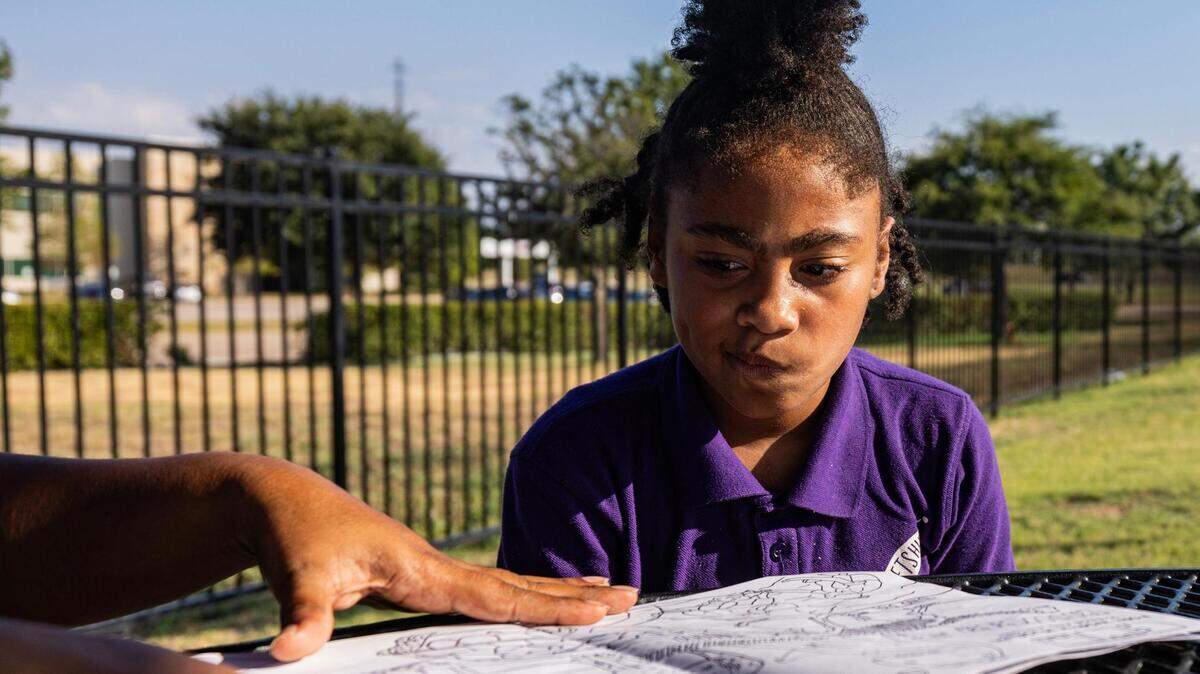
Parent Shield Fort Worth released a report Wednesday outlining findings from a series of literacy clinics the group held over the summer. The report also included recommendations for boosting literacy rates among the city’s public school students.
Among other things, the group said parents need access to information like their kids’ MAP test results and STAAR scores — data that can give them a more complete look at their kids’ academic progress than they can see in report cards alone. That information needs to be presented in a form that’s clear enough for parents to act on it, the group said.
“If it’s full of jargon, it’s not going to do us any good. You’re just wasting trees,” said Trenace Dorsey-Hollins, the group’s director. “So we need something that’s easy for us to understand.”
Most kids score below grade level in reading on assessments
The group released the report during a webinar Wednesday evening. It was based on data collected last July during a series of reading check-ins the organization sponsored in locations across Fort Worth. During the check-ins, certified teachers administered reading assessments and talked with parents about the results. The results mirrored Fort Worth students’ performance on last spring’s STAAR exam: 64% of kids scored below grade level on the assessments, compared to 66% who didn’t meet grade level standards on the state test.
During the clinics, about two-thirds of parents said they relied on report cards for information on their kids’ academic progress. A recent Star-Telegram analysis of district and state data shows a mismatch between report cards and state test scores: Large majorities of third-graders in school districts that serve parts of the city got As and Bs in reading and language arts during the last school year. But about 66% of the city’s third-graders didn’t score on grade level in reading on this year’s STAAR exam.
The mismatch between the grades students get on their report cards and the scores they get on state tests isn’t unique to Fort Worth. In a national survey fielded last March, 80% of parents said their kids brought home all As and Bs on their report cards. But only about a third of fourth-graders across the country were either proficient or advanced in reading in 2022, according to the National Assessment of Educational Progress, sometimes known as the Nation’s Report Card. School officials say report cards are based on a number of data points besides test scores, including other factors like daily assignments and projects. But some education advocates say the mismatch can leave parents with no idea when their kids are struggling.
Fort Worth student struggled for years before dyslexia diagnosis
Melony Watson is one of those parents. Speaking during Wednesday’s webinar, Watson said she noticed her daughter Trinity Struggled to read when she was in second grade. Watson told Trinity’s teacher that she was concerned, but the teacher assured her that the girl was fine, and that many students who started school during the pandemic were a bit behind. Trinity was on her school’s A-B honor roll, so Watson assumed her daughter was where she needed to be.
But when Trinity was in third grade, Watson noticed her first-grader could read more proficiently than Trinity. So she pushed to have her daughter take an evaluation at school. The evaluation showed something that Watson had suspected for some time: Trinity has dyslexia.
Watson said she’s angry that her daughter was in third grade before anyone at school noticed she was struggling to read. But now that she knows, Watson said she’s been more proactive about communicating with Trinity’s teacher and making sure her daughter gets what she needs. She also makes sure to talk to Trinity about how things are going at school, she said. When Trinity brings home a bad grade on an assignment, Watson talks about what concepts she didn’t understand and works with her to fill in those gaps. Even though she’s in a better place now, Watson is still upset that Trinity was allowed to struggle for so long.
“I can’t even put into words how it feels to know that we’re sending our children to get an education that they’re not getting,” she said.