
North Texas parents joining movement to opt out of high-stakes testing
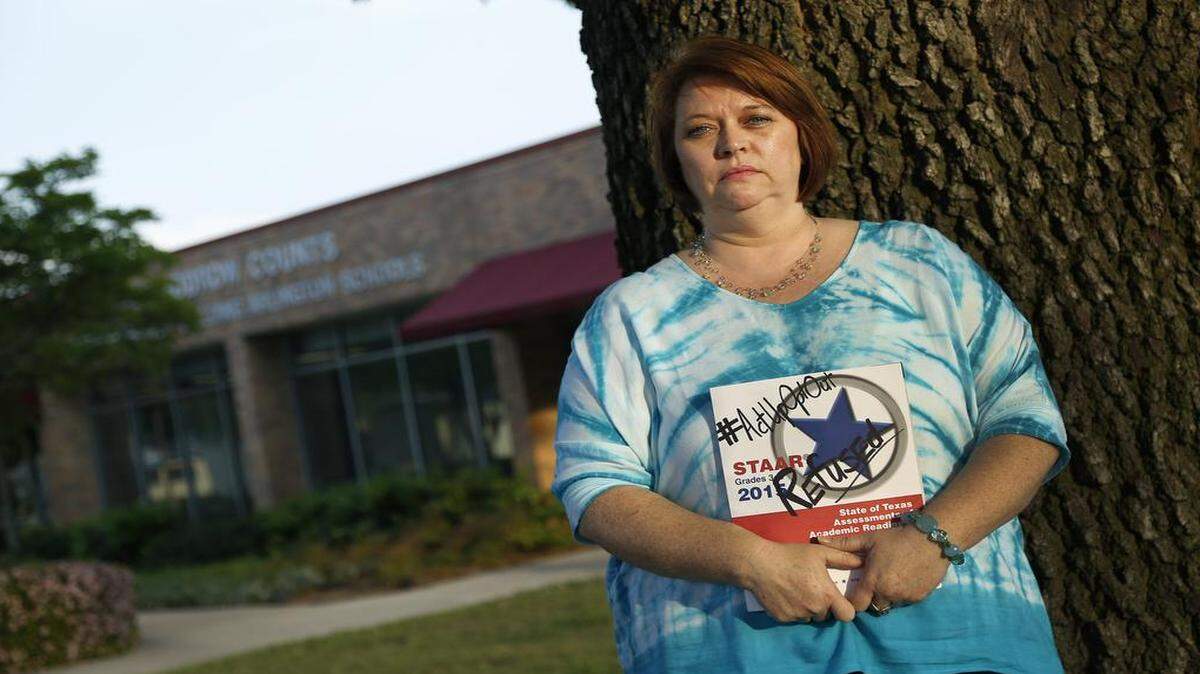
Amid STAAR testing season, North Texas parents are joining thousands of others nationwide who are fed up with standardized testing and, in protest, are opting their children out of it.
Arlington mom Kim Martinez, a kindergarten teacher, has kept her children out of tests before and plans to do so again next week during the State of Texas Assessments of Academic Readiness tests. Josi Lauritzen of Richardson is active with a group called Richardson ISD Parents Opting Out of STAAR and is also keeping her children out of next week’s tests.
“We are following the movement across the country,” Lauritzen said. “We are not hurting anyone. We are practicing civil disobedience.”
The Texas Education Code says it’s illegal to take kids out of testing, but the law doesn’t include a means of enforcement.
Discontent with the tests — called “high-stakes” because they can determine grade promotion, graduation, teacher effectiveness and whether a school should be taken over by the state — is widespread.
“It puts too much pressure on teachers, students, everyone involved,” Martinez said. “It’s a little moment in time, and they want to judge your whole school and your teaching staff on that one moment in time.”
Some school district leaders are frustrated as well. “I think the testing is punitive. It causes teachers to not be allowed to teach and causes them to have to teach to the test,” Arlington school board President Bowie Hogg said.
In dramatic fashion Thursday night, Arlington trustees approved and signed a resolution urging the Legislature to end high-stakes tests and allow school boards to use their own accountability systems.
Robert Schaeffer, public education director of FairTest, the National Center for Fair & Open Testing, said opt-out movements are active in Texas, Louisiana, New York, Colorado and New Jersey.
“It’s a huge national movement trying to reduce testing overkill,” Schaeffer said.
In New York: “Thousands of Students Expected to Opt Out of N.Y. State Tests,” says a headline in The Wall Street Journal. The issue is expected to be among those brought up at a Save Texas Schools rally in Austin on Saturday.
In 2013, the Legislature, agreeing that students had too many state tests, reduced the number taken by high school students. Through House Bill 5, a massive education bill, the number of end-of-course state exams required for graduation dropped from 15 to five.
This year, House Bill 2804, introduced by Rep. Jimmie Don Aycock, R-Killeen, would eliminate STAAR tests in science, social studies and writing and require school districts to draw up assessments in those subjects. The bill is pending in the House Public Education Committee, which Aycock chairs.
People shouldn’t be surprised to find that the movement has strong support from teachers, principals and superintendents, Schaeffer said.
Martinez said, “We as teachers should be held accountable, but not through standardized testing. If peoples’ livelihood depends on it, you’re going to see an uptick in [cheating] and it’s not good for the team aspect of teaching, either.”
Testing the law
Third- through eighth-graders are preparing to take STAAR tests in math, social studies, reading and science beginning Monday. The annual tests are aimed at measuring knowledge of a variety of subjects. STAAR replaced the Texas Assessment of Knowledge and Skills, or TAKS.
Last year, Martinez had both her children sit out the STAAR tests with little repercussion, she said. Her older son was an eighth-grader at the time.
She said a “zero” or an “absent” designation for STAAR assessments is added to a student’s permanent record.
“It’s not a part of their letter grade at all and doesn’t show up anywhere on their report card,” Martinez said. “My older son ended up taking math and English. He didn’t take the other two. He was in eighth grade, and it didn’t affect anything. He’s now in ninth grade, taking [Advanced Placement] classes.”
But spokeswoman for the Texas Education Agency said opting out is illegal.
“By law you legally cannot opt your student out of testing,” said DeEtta Culbertson. “You can opt them out of classes for certain things, but you can’t opt them out of testing.”
State law says a parent is entitled to remove a child temporarily from a class or activity that conflicts with the parent’s religious or moral beliefs, if the parent gives the teacher a written statement authorizing the removal.
It also says parents are not entitled to remove a child from a class to avoid a test.
“This section does not exempt a child from satisfying grade level or graduation requirements in a manner acceptable to the school district and the agency,” says the code.
No enforcement
But parents are learning that the law doesn’t include any means of enforcement, said Scott Placek, a Round Rock attorney and parent against overtesting.
In many cases, parents write a letter to school officials saying the child isn’t going to take the tests. Placek said school leaders typically respond by citing the education code and telling them that their children must take the tests.
Placek said parents are responding, “ ‘No, we don’t and we are not going to.’ ”
They typically keep their children home on test days and test makeup days. If school leaders present students with a test, many children mark them with word refuse and turn them back in, he said.
Placek said he hasn’t heard of any instances in which a child who opted out was held back.
“There is nothing they can do about it,” Placek said. “The law provides no means to force a child to take an assessment.”
Concern for all children
Martinez said she plans to opt her fourth-grade son out of taking all the STAAR assessment tests this year.
“My main concern is not just my child, but my concern is for all children,” Martinez said. “I see kids beside themselves, and I’ve heard of some of them throwing up.”
Lauritzen, whose children attend school in Richardson, north of Dallas, said she has informed school officials her daughter won’t be testing either.
“I don’t agree with it morally,” Lauritzen said. “It’s not in the students’ best interest.”
She is active with the Facebook group Richardson ISD Parents Opting Out of STAAR and said she won’t be intimidated by school leaders quoting from the education code. She said she has reviewed her options with an attorney.
Who is with us on Monday?
Posted by Richardson ISD Parents Opting Out of STAAR on Thursday, April 16, 2015
Martinez told the Arlington school board about her decision to opt out her children and said she wants her son to be learning while other students take the tests, rather than having to take the day off.
Culbertson said the structure of classroom days for a student not taking the test is left to “local control,” but the law, Texas Education Code Section 39.023, requires the district to administer the test if the child comes to school on test day.
Area districts are referring parents to the law if the issue surfaces.
For example, as of Friday morning, the Hurst-Euless-Bedford school district had received three letters requesting opt-outs for students in elementary school. The H-E-B parents received a letter citing the education code.
Other area districts are prepared to give parents similar information.
“The Fort Worth ISD Board of Education has instructed that the district will conform with state law in such matters,” a district spokesman said, citing the same passages from the law.
Parents getting on board
As test time neared in Texas, the grassroots group Texas Parents Opt Out of State Tests saw an uptick in traffic on its Facebook community page, surpassing 18,000 likes last week.
Lauritzen said her Richardson group’s Facebook page also had an increase in likes, from 544 on Tuesday to 688 on Friday morning.
“The movement is definitely growing,” said Kathryn Pole, assistant professor of literacy studies in the University of Texas at Arlington Department of Curriculum and Instruction. “Since the early days of No Child Left Behind, in the mid-2000s, there were small pockets of parents who resisted standardized tests, but over the past three years we’ve seen a dramatic rise in the number of parents choosing to opt out of these tests.”
A better way
A think tank called the Texas High Performance Schools Consortium was established by 2011 legislation to inform the governor, Legislature, state Board of Education and education commissioner of ways to improve learning and develop the next generation of accountability systems.
“We are focusing our efforts on what is next,” said Karen Rue, superintendent of the Northwest school district, which is part of the consortium.
Generally speaking, the consortium looks for a more holistic approach — one that considers testing but also takes into account factors such as community feedback, certification programs, advanced placement and dropout rates.
Rue said the district is working on a local accountability measure even as students continue to take the STAAR tests. The district’s efforts are available to the public on a community dashboard that links to academics, community support and STAAR results.
Changes are already underway at some schools.
The Katy school district near Houston has asked that funding be provided for local assessments that provide more diagnostic information that teachers can use, Pole said.
Wow! Katy, TX, School Board Votes 2 Eliminate HighStakes Tests @DianeRavitch @PedroniTom @BillBoyle24 #miched #optout http://t.co/tgMbMCCAXO
— AM (@DreaMcCoy) April 7, 2015Arlington’s decision
In a letter posted on the Arlington district’s website after the meeting Thursday, Hogg, the school board president, said Texas’ current accountability system is too complex to drive improvement for districts and campuses.
“Assessments should provide standard measures while allowing local superintendents and school boards to control how to respond to those measures,” he said, “but should not cause undue stress to students and families or teacher dissatisfaction and burn-out.”
In the district’s own 28-point assessment system, Hogg said, only two measures are related to STAAR testing. Other student-related measures include participation in rigorous courses and college-bound assessments, percent of students on track to graduate on time, college enrollment and success, and extracurricular and co-curricular participation.
“It is one of the issues we will continue to see grow as parents see the amount of time and stress these tests are causing their kids,” said Steven Poole, executive director of the United Educators Association of Texas, which represents teachers in about 40 area school districts.
Shirley Jinkins, 817-390-7657
Twitter: @shirljinkins
Diane Smith, 817-390-7675
Twitter: @dianeasmith1
This story was originally published April 17, 2015 at 11:04 AM with the headline "North Texas parents joining movement to opt out of high-stakes testing."