Could pre-K put infant and toddler care out of business? Some DFW providers are worried.
Parents across DFW can sign their young children up for pre-K, which started Friday, in several school districts including Fort Worth, and for the first time this year for all parents, Arlington ISD.
But as public school districts expand into the early learning space, reflecting a national effort to offer pre-K to all children, advocates and child care providers are sounding the alarm, fearing that the move could threaten their ability to stay open, and to provide infant and toddler care.
“We’re pretty upset,” said Kishani Mathiasz, who operates child care centers in both Arlington and Fort Worth. “Parents are always going to go for free, so financially we will be taking a hit.”
Providers, including Mathiasz, also question the ability of districts to offer early learning care at the same level as child care centers that have been in the business for decades.
“We are not babysitters. We do provide learning experiences to children; our teachers do brain development,” she said. “But what we feel like when the ISDs are opening these schools, that they’re really not able to provide that care for those younger children.”
“They can barely do the care for the older children,” she added.

But officials from school districts across the Dallas-Fort Worth Metroplex say they are filling gaps they have identified, and are partnering with early education experts to provide these services.
“We have many years of experience with pre-K instruction,” Arlington schools Superintendent Marcelo Cavazos told the Star-Telegram at a ceremony announcing pre-K expansion. “We know the space and we know the efforts that need to be made for early childhood and we worked with our community to make sure that access is something that we’re mindful of.”
Some providers still have their doubts.
Child care providers cast doubt on districts’ academic abilities
Child care providers say the substandard performance of school districts makes them wary of their entry into the early learning space.
“We have to figure something out, and I am willing to talk about (schools providing early education) as an option, especially as school systems struggle to maintain enrollments,” said Audrey Rowland, who runs a nature preschool in Fort Worth. “But as a protector and advocate for early childhood, I say if you can’t do what you’re supposed to be doing well enough to keep it going, then stay out of my lane.”
“You can’t have my industry because yours is failing,” she added.
Mathiasz also pointed to subpar scores in schools as a reason she doesn’t want students she would care for directed away from her centers.
“They’re not capable of handling these kids,” she said. “They’re not going to teach these kids the things that we are teaching, because we nurture them, we love them, we care for them, but I don’t think that’s going to be given to them at a public school.”
“Public school is all about numbers right now.”

Nedra Washington Goss, the president of the DFW chapter of the Black Child Development Institute, who is skeptical of public schools entering into the early learning space at all, said she is especially concerned for minority children.
“How are the children faring right now?” she asked. “How are Black children performing in Fort Worth ISD? How are Hispanic families performing?”
Fort Worth Chief Academic Officer Marcey Sorensen said that the district takes the role of educating its youngest learners seriously and will be looking for credentialed experts in early childhood education to staff its new program.
“We would want highly qualified people, we would want people who are certified, we would want people who are engaged in evidence-based and research-based pedagogy and practice,” she said. “As we partner with organizations and make decisions about folks that we’re partnering with, obviously, we would want to make sure that we were aligned.”
But beyond the question of teaching, experts say the already broken economics of child care pose a unique challenge as pre-K expansion catches on in communities across the nation.
Pre-K expansion could threaten existing child care
Child care providers provide care for infants, toddlers and preschool-aged children.
But they can only care for four infants at a time, while they can care for up to 18 preschool-aged children, making those students financially necessary in order for the providers to stay in business.
Dan Wuori, senior director of early learning at the Hunt Institute, said this “upside down economic problem” of child care is what makes the universal pre-K question so tricky.
“It’s almost impossible for providers to provide infant care in particular, in a way that realistically even breaks even,” Wuori said. “The way that child care … compensates for that loss of income, essentially … is through services to older children, where there is a little bit more of an opportunity with larger groups of preschoolers, to teach them something.”
“The bottom line is that older preschoolers are very important to the economic viability of the child care industry,” he said.
A 2015 micro-study by Camp Fire First Texas, an education nonprofit that works with Fort Worth ISD as well as early learning centers, found that there were unintended consequences when Fort Worth rolled out universal pre-K.
In the study, 80% of child care centers reported an impact on the financial stability of their program and 18% of all providers reported that without the 4-year-olds in their program, they are likely to close.
Other unintended consequences included rising tuition and a decline in quality for private providers.
Seven years after the study, not much has changed, said Lyn Lucas, senior vice president of early education and program evaluation at Camp Fire.
“What the cost modeling looks like for child care has not changed,” Lucas said. “And because there haven’t been any significant changes, ... we felt those consequences and we really felt it through COVID. Now there’s a child care crisis, because we are just really slow and reticent to do the hard work of fixing the bigger problem, which is the system and putting the supports in at a large level.”
With no changes to the system, the impacts seen in Fort Worth are likely to play out in the coming months in Arlington, Lucas said.
The impacts years out are still being seen, with centers observed by Camp Fire combining classrooms with multiple age groups, since they are unable to afford teachers to staff separate classrooms, or justify multiple teachers with fewer pre-K aged students to serve.
Centers are also serving more students per teacher, something that dilutes quality, but becomes necessary to maintain finances.
“That’s a huge impact on quality,” Lucas said. “But other things include the ability to be able to pay for professional development, and the kinds of professional development or the supplies and the kinds of food they can afford to buy.”
Providers need a voice at the table
Mathiasz said she declined partnering with Arlington ISD when she was approached in 2019 after seeing no benefit to her center or children.
Bethany Edwards, the director of the Early Learning Alliance in Tarrant County, said that having the voices of providers at the table could lead to a solution that is beneficial to all parties.
“I think it is possible that we can do this expansion without cutting the feet off from under our current workforce,” she said. “But I think that needs to be a very thoughtful process where members of the actual current workforce are involved in the decision making.”
If it is done poorly, the well-intentioned effort could backfire.
Rowland said it could actually end up widening gaps.
“It leaves this huge gap in accessibility, and it also closes child care businesses, so it’s a real concern,” she said. “But the system is broken as it is, so it’s not like doing nothing is going to help.”
Rowland said the existing infrastructure of the schools could make them a good option for bridging the gap.
Child care deserts make more options a necessity
Large swaths of Fort Worth ISD and other Tarrant County school districts are in child care deserts, or areas with little to no access to high-quality, affordable child care.
With staffing shortages and COVID related closures, that problem has become more dire.
According to an analysis by the advocacy organization Children At Risk, There are fewer than five seats in subsidized child care centers in southwest Fort Worth for every 100 children of working parents.
Across Texas, the advocacy organization’s analysis of child care provider data and census data found that there are an estimated 123,000 more low-income children with working parents than available subsidized seats in child care centers and registered homes.
Using existing school property to house early learning centers is one solution to that problem, advocates say.
Cavazos, the superintendent of Arlington ISD, told the Star-Telegram at a ceremony announcing the expansion of pre-K to all 4-year-olds that the economic threat posed to the child care sector in Arlington was an early consideration.
“We’re mindful of that,” he said. “But we also know that, regardless, there’s a gap in service. And that’s the reality. And when we can provide the service to ... 4-year-olds, we have to step up.”

Cavazos said there have been ongoing partnerships and conversations with child care providers throughout the city.
Sorensen, the chief academic officer for the Fort Worth school district, said that the gaps in service allow for the district to enter the early learning sector without doing harm.
Fort Worth ISD, which has had universal pre-K since 2014, is taking steps toward opening several infant-and-toddler centers at existing elementary schools.
“I think first you just always have to acknowledge that there’s always enough room at the table for everybody to join,” Sorensen said. “There are enough issues for all of us to tackle together.”
Sorensen said the district views itself as an element in a mixed-delivery approach.
“There’s not a one-size-fits-all child care that every mom or every family wants,” she said. “So that discussion is important for all of us to be at the table to say, do we have enough quality seats in the community? And who’s then providing those seats? And what do those seats look like?”
Nonprofit bridges divide between child care providers and schools
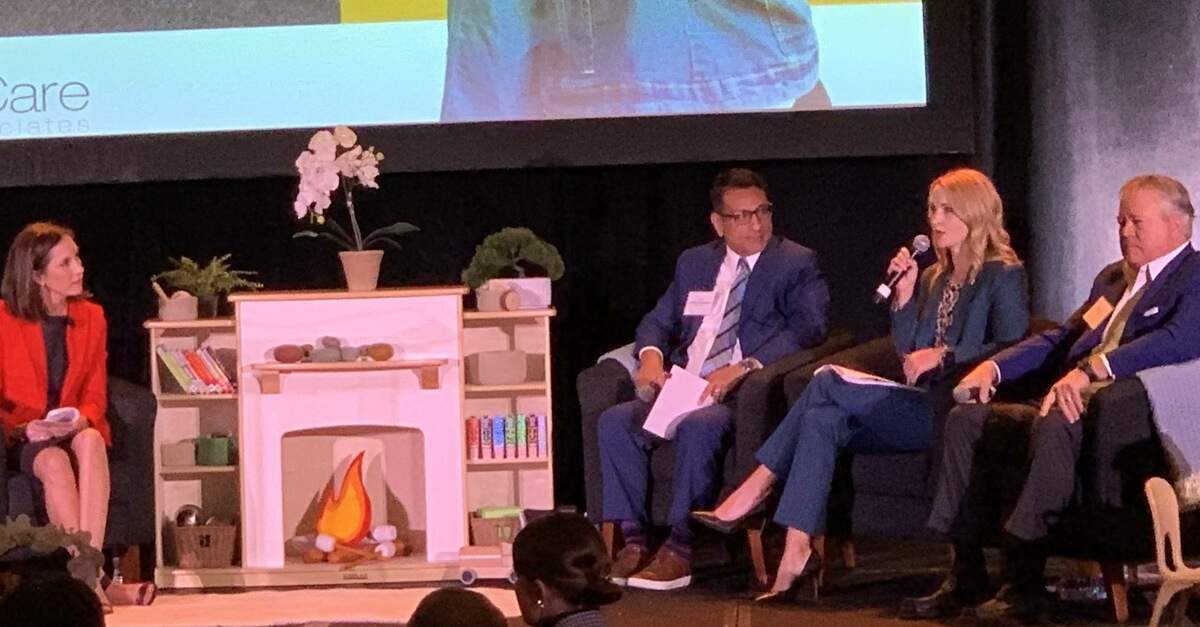
The linchpin at the center of the debate in Tarrant County is Child Care Associates, a nonprofit that is heading up county-wide child care reforms and is one of the largest single child care providers through the operation of 20 campuses, including head start programs.
“For years, Child Care Associates has been working towards a coordinated (age) 0-5 approach for early learning that includes schools, child care centers, child care homes, parent education, home visiting and Head Start (and) Early Head Start,” Kara Waddell, CEO of Child Care Associates, said. “This is a topic many states and many communities are rethinking, and we need to ensure the needs of children and families are at the center of these efforts.”
CCA has created a model that could act as a blueprint for the collaborations that maintain the existing child care sector, while filling gaps with partnerships, like one the organization has with Crowley ISD serving area students through Head Start and Early Head Start programs.
The district program, which has been operating for several years now, was an immediate success in the community, with pre-K enrollment doubling after the expansion, according to school officials.
Parents who had nowhere else to turn embraced the opportunity to send their children to child care in the same building their siblings attended for school.
Gilda Abakah, who spoke with the Star-Telegram last year, was pregnant with her second child when she went to one of her friends looking for help with child care.
“I desperately needed help,” she said. “I had been going around for some time and the cost was quite expensive.”
Rowland, the nature preschool operator, said this model could work if replicated at other schools
“I think Crowley ISD is really getting it right by being strategic about where they put early child care programs and handing over the decision making around that program to the early childhood professionals of Child Care Associates,” she said. “When you walk into Hargrave Elementary’s early learning center, it feels different than when you walk into the other side of the building.”
Shawneequa Blount, the director of early childhood at Crowley schools, told the Star-Telegram in October of last year that contrary to competing with neighboring centers, the district was looking for ways to help them improve quality and attract students.
“Our goal now is to start to share resources with some of the smaller centers, share curriculum resources, share professional development resources, because again, we just know that this work is super important,” she said. “We’re not competing for kids, we’re just wanting to make sure that by the time that kid gets to kindergarten, no matter what their path was before, or how they got there, that they had an opportunity to have a good experience in our program or a smaller local child care program.”
Lyn Lucas of Camp Fire said that there is a way for pre-K expansion to coincide with the child care workforce — but that it will take time and effort.
“Camp Fire is not against ... encouraging children to go to pre-K in an ISD if it is a high-quality pre-K,” she said. “But it has got to happen right alongside a thoughtful approach to how we’re going to make sure the (ages) 0 to 3 space is also taken care of.”
This story was originally published April 4, 2022 at 5:00 AM.