Fort Worth school board will soon have 2 new members. Can they help rebuild trust, focus?
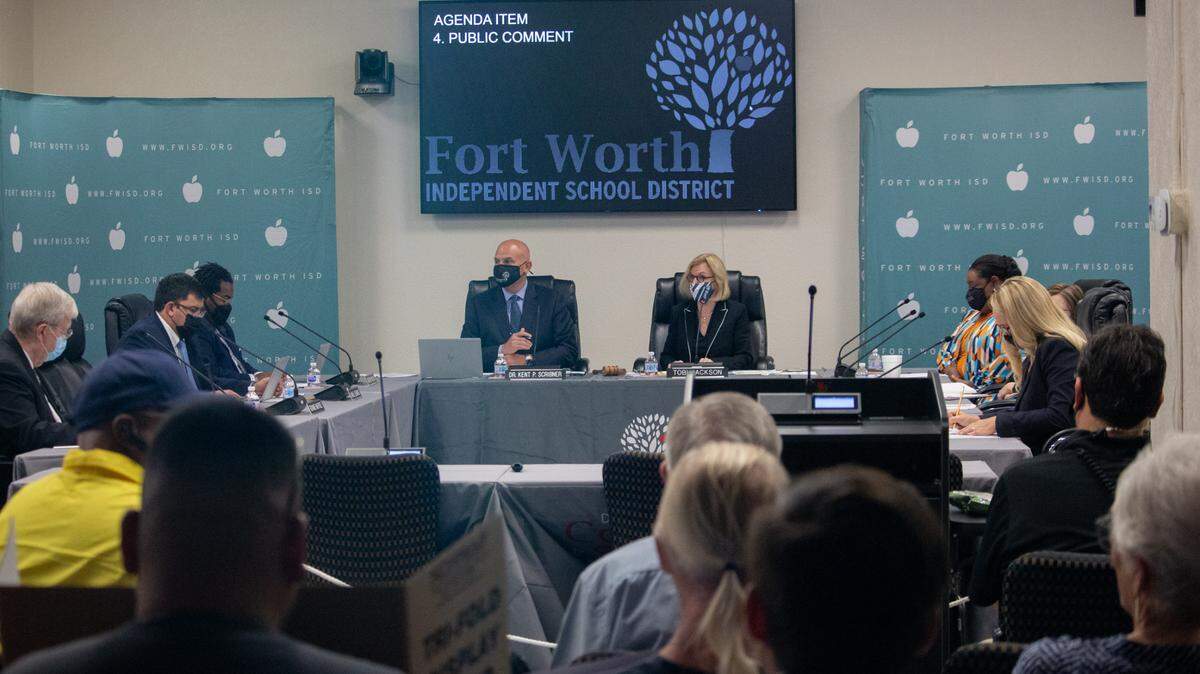
Fort Worth school and city leaders say an upcoming election to fill two seats on the district’s Board of Trustees is an opportunity for the board to set aside distractions and refocus on academic support for students to recover ground lost during the pandemic.
Trustee Jacinto Ramos, who was elected to the board in 2013, announced this month that he plans to step down from his seat once a replacement is selected. Trustees voted Tuesday to call a special election to fill the seat on May 7. Ramos, a former board president, said he was stepping down to allow “a new generation of leaders” to continue the board’s work.
“It will require that each member of our board dedicate themselves to working diligently and committing significant time to address the issues that we face,” he said.
The district was already scheduled to hold a special election on May 7 to fill the seat of former trustee Daphne Brookins, who died in November at 53.
Early voting begins April 25.
New trustees will be “a shot in the arm”
Board President Tobi Jackson said the board’s current members have complementary viewpoints, and they generally do a good job of bringing all those views together when making decisions about the district. Jackson said she was optimistic about the two new trustees, whoever they may be. She expects they will provide a fresh perspective on issues facing the district and work well with current board members.
“I think they are going to be a shot in the arm of energy,” Jackson said.
Jackson said restoring public trust in the district needs to be a priority for the board. The public is concerned about the state of public schools nationwide, not only in Fort Worth, she said. She wants parents to understand that the district is ready to serve any student who lives in the district, and that Fort Worth schools offer programs and schools of choice that other districts don’t.
The board has three main duties: hire and monitor the superintendent, review and update district policies and set the district’s budget. Board members also talk with community members about their priorities and concerns for the district.
As a way to build trust and community engagement, the board is planning a series of sessions to help community members understand the roles of the trustees and district staff, Jackson said. The board will also hold community listening sessions during the search for a replacement for Superintendent Kent Scribner, who announced his retirement earlier this year, she said.
Scribner originally said he planned to retire at the conclusion of his current contract, which ends in August 2024. But according to an agenda for the board’s March 29 meeting, trustees will begin to negotiate his early exit then.
Jackson said the board will begin interviewing firms to handle the search process for a new superintendent on March 29. The winning firm will begin conducting interviews with district employees, families and business leaders about what the city needs from its school district. Once the new trustees are sworn in, each member of the board will need to be fully engaged in the search process, Jackson said.
Board meetings rife with distractions
District 9 Trustee Roxanne Martinez, who represents areas in central and northeast Fort Worth, said helping students recover from the academic fallout of the pandemic needs to be the board’s top priority. Martinez, who was elected to the board last year, said the new trustees will need to familiarize themselves with those issues quickly.
Last June, the Texas Education Agency released state assessment data highlighting the impact of school shutdowns and remote learning on students statewide. In the Fort Worth school district, fewer students in third through eighth grades met or approached grade level in reading or math in the spring of 2021 compared to the spring of 2019, according to the report. More than twice as many eighth-graders failed to perform on grade level in math compared with the previous year, the report showed.
Those numbers mirrored statewide trends: the number of students who didn’t meet grade level increased from 2019 to 2021 across all grade levels and subjects except English I and II, the agency reported.
The board also must find ways to contend with teacher and staff shortages in the district, Martinez said. Since Jan. 1, teachers and support staff have had to quarantine nearly 4,000 times after testing positive for the virus or coming in contact with someone who was sick, according to the district’s COVID-19 dashboard. Schools have drafted librarians, reading coaches and administrative staff to cover classes when a substitute wasn’t available to fill in for an absent teacher.
“We’re seeing this all across the nation,” Martinez said. “It’s not just a Fort Worth problem.”
Martinez and District 7 Trustee Michael Ryan have been on the board for only eight months. In that time, Brookins has died and Ramos has announced plans to resign. Martinez said it’s been “a challenge” for trustees to get on the same page about issues facing the district.
In that time, the boardroom has been roiled by distractions, she said, making it even more difficult to stay focused on the district’s priorities. But despite those distractions, Martinez said she thinks trustees agree about the district’s goals. She pointed to a new literacy curriculum that’s being adopted in schools district wide. Everyone on the board seems optimistic about the new reading framework, she said.
Public comment sections in recent school board meetings have devolved into shouting matches over the district’s response to the COVID-19 pandemic, the district’s equity work and critical race theory, an academic framework that education leaders in Fort Worth and across the state have repeatedly said isn’t taught in K-12 classrooms.
During a board meeting last June, public comments stretched on for more than two hours as hundreds of parents and political activists flooded the building to protest what they alleged was the teaching of critical race theory. Adults in the crowd shouted insults as others spoke, and, outside the building, a verbal confrontation erupted between students in the district and protesters.
Mayor seeks focus on student outcomes
Fort Worth Mayor Mattie Parker said she thought the board had lost focus on the key issue of academic outcomes “because of all the noise politically.” Parker said she’d like to see the board return its focus to what the board can do to support students academically.
The pandemic’s effect on academics has been dire, Parker said. But students in the district struggled academically even before the COVID-19 pandemic, Parker said. In 2019, the year before the pandemic forced school closures nationwide, just 35% of students in the Fort Worth school district scored on grade level or better in reading on STAAR exams. Parker said she’s particularly worried about outcomes for students of color and students in poverty.
Among other challenges, the new trustees will participate in the hiring process for a new superintendent. Parker said she’d like to see the district consider non-traditional candidates, such as a CEO, to fill the position. The new superintendent will need to be someone with strong leadership skills, Parker said, and it would make sense to consider a leader from the private sector who could work alongside academic experts in the district.
The new superintendent will also need to have tough conversations with parents in the district, Parker said. She said she thinks the district suffers from a lack of trust between parents and district leaders. The new superintendent will need to have the skills to rebuild that trust, she said.
PTA: less emphasis on STAAR scores
Ken Kuhl, vice president of advocacy for the Fort Worth ISD Council of PTAs, said he hopes the new trustees can help find ways to counter narratives about student achievement in the district.
Many of those narratives are based on the district’s performance on STAAR exams, which Kuhl described as “a flawed single test on a single day.” Student achievement must always be paramount, Kuhl said, but he doesn’t think state test scores are the best yardstick to measure it. The council has called for a school accountability system that reviews school performance more broadly and takes family engagement into account, and places less emphasis on state test scores.
Kuhl, whose daughter is in third grade at South Hi Mount Elementary School, said he hopes the new trustees find ways to include parent and teacher voices in the search for a superintendent. He also hopes they’re ready to find ways to help students overcome the mental health challenges the pandemic has created.
Pandemic learning loss: ‘It’s a crisis’
Brent Beasley, president of the nonprofit Fort Worth Education Partnership, said he hopes the board will return to a “laser focus” on academic improvements, particularly helping students recover from COVID-19 learning loss.
The partnership released a report in August showing that students in all parts of Fort Worth, from the wealthiest communities to the poorest, lost ground academically during the pandemic. Declines in performance in more affluent parts of the city roughly mirrored those in schools in poorer areas, according to the report.
But because schools in wealthier areas performed better on state testing before the pandemic began, those students still fared better on state tests last year than their counterparts in other parts of the city.
“I think it’s a crisis,” Beasley said. “If there’s a flood and people are stuck on their rooftops, the water rising below you, the only priority is getting them rescued off the roofs.”
The candidates
District 4 candidates are Wallace Bridges, a community liaison; Brian Dixon, 41, a physician; Trischelle A. Strong, 22, a corrections officer. Candidate filing for the District 1 seat ends Monday. Aaron Garcia, 32, a police officer, and Camille Rodriguez, 53, a podiatrist, have filed.
This story was originally published March 25, 2022 at 5:00 AM.