After fleeing Afghanistan, family hopes for safer life in Fort Worth
Hiqmatullah Nazari and his family are adjusting to a new normal. Life in Fort Worth is bringing them a sense of security, he said.
Nazari worked as a security guard for foreign forces during the Afghanistan War and fled to the United States when U.S. pulled troops out of the country. His family of four arrived in Texas in January, but they’re still in fear. Nazari said he has two young nephews still living in Afghanistan.
Hundreds of refugees resettle in Tarrant County each year. The tough journey takes them from trauma or unsafe situations to adjusting to life in a new country. Many rely on community and government agencies to help them make the transition as smooth as possible.
Catholic Charities of Fort Worth and Refugee Services of Texas helped resettle 393 refugees in Tarrant County in 2020. Many came from Afghanistan, the Democratic Republic of Congo and Myanmar. The two agencies have many staff who are former refugees.
“Our staff is like the United Nations,” joked Mamadou Diallo, interim director of refugee services at Catholic Charities.
There were 26.6 million refugees around the world as of mid-2021, according to the United Nations Higher Commission on Refugees.
Ronna Huckaby, chief service officer for Catholic Charities of Fort Worth, said the day a refugee arrives signifies the end of a “long, most likely traumatic journey.”
“By creating a safe and secure environment for them to acclimate to their new life, learn English and navigate the workforce, we’re showing them that we’re with them for as long as they need us, while at the same time equipping them with the tools they need to eventually achieve self-sufficiency,” Huckaby said.
Refugee classification
The United Nations Higher Commission on Refugees decides whether a person can be classified as a refugee. The person is screened and referred to a country for resettlement. The screening process can take years.
Homeland Security and other intelligence agencies screen the people who are referred to the United States, and the State Department approves the applications.
Many refugees from Afghanistan waited in Bahrain, Germany, Kuwait, Italy, Qatar, Spain, and the United Arab Emirates before they arrived in the United States.
Nazari’s two young nephews were not able to be a part of the process with the rest of the family. Nazari said they rely on his support to survive.
Adjusting to life in the United States
Refugees receive services as soon as possible, including medical appointments and financial assistance, which helps cover housing and other expenses during a job search.
Cultural orientation helps clients learn about life in the United States. Hope Goldman, community engagement coordinator for Refugee Services of Texas, said refugees learn about customs, how the banking system works and where to get food.
“Anything you can think of, we try to cover,” Goldman said.
Refugee Services of Texas provides mentors to help the newcomers learn English, navigate transportation and shop at grocery stores.
People who settle in the United States are required to take English-Second Language classes. School districts provide ESL classes for students while agencies work to provide classes for adults.
Sudip Adikhari, an education specialist for Catholic Charities, sat with three adults recently in a clubhouse inside a Fort Worth apartment complex. A translator and Adikhari worked to register them for online English-Second Language classes.
ESL classes can help people find jobs and continue their education. In Fort Worth, 35.3% of the population speaks a language other than English at home, and 17.6% of residents were born outside of the United States.
Adikhari said he typically signs up 30 to 40 families each month. Teachers work to provide communication about upcoming classes to students in their first language to help provide better understanding.
Caseworkers helping clients adjust to life in Fort Worth
On a weekday morning, Goldman navigated two shopping carts in and out of aisles of a Walmart Supercenter in Hurst. A group of four men from Afghanistan would soon be moving into their two-bedroom-two bath apartment in Haltom City.
Goldman worked her way through a list of household items. Toothbrushes. Towels. Pots and pans. Bedding. Mop and broom. Items the American culture deem as household necessities. Goldman said some clients are surprised when popular items in their home country are not in the apartments, like rugs and tea kettles.
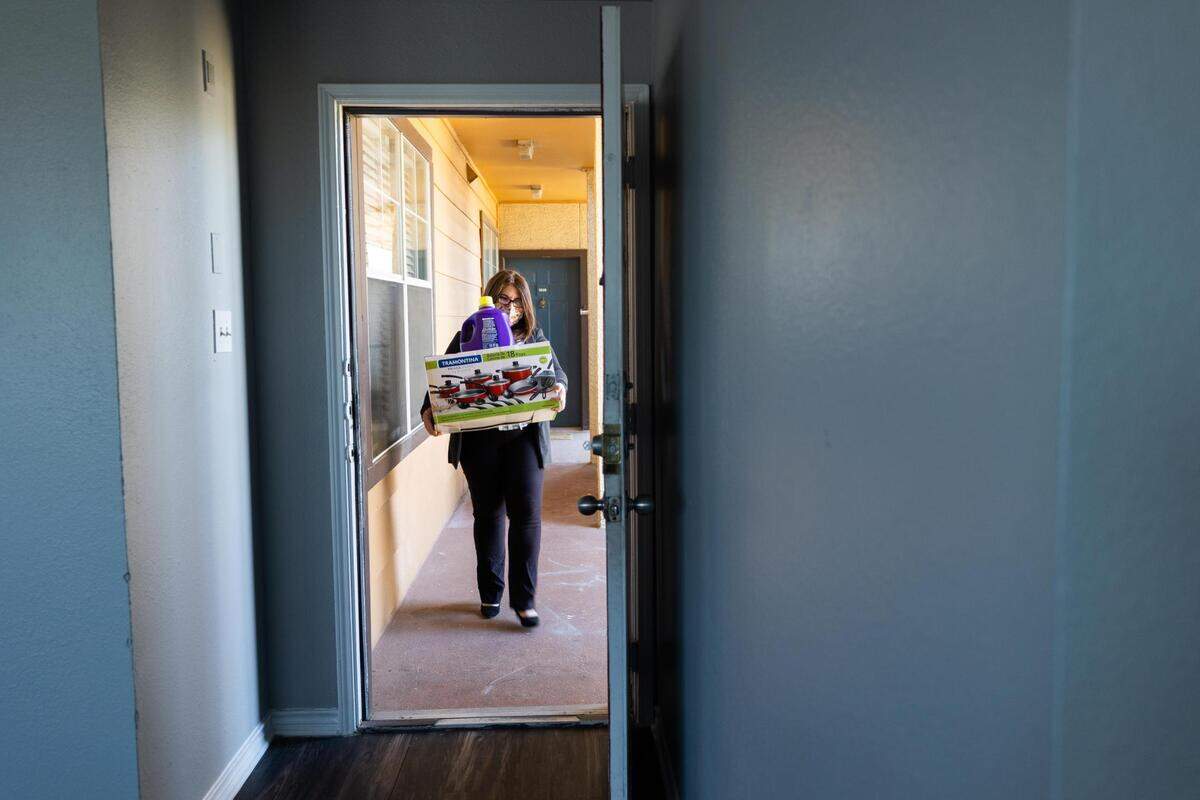
Finding housing is one of the biggest jobs for agencies. Multiple factors determine possible housing options, including the cost of rent and access to community.
Resettlement agencies may have hours to months to prepare for clients depending on when they are notified by the government of a person’s arrival.
Refugee Services of Texas resettles 30% to 40% of the refugees who arrive across the state. Goldman said she has set up as many as 13 apartments in one week for arrivals.
Huckaby, of Catholic Charities, said helping a refugee feel at home is critical.
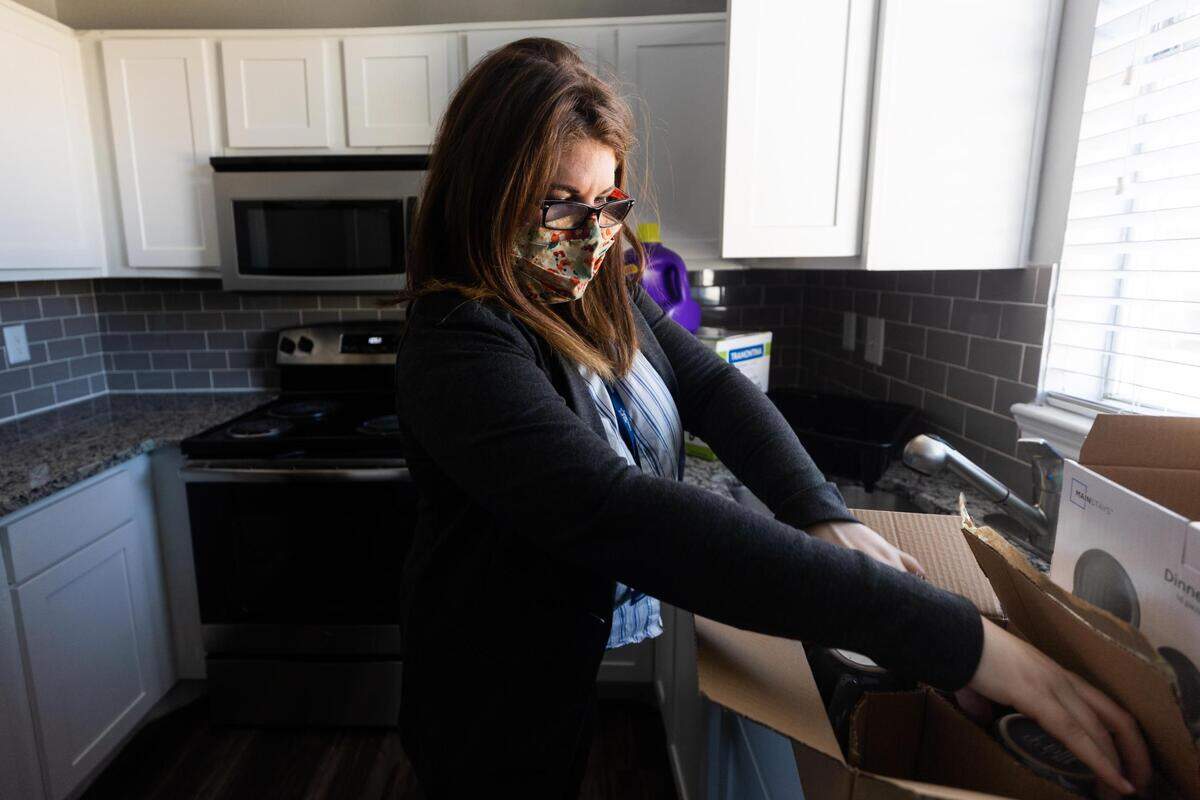
“Before our families even arrive, we secure an apartment for them and outfit it with beds, furniture, dishes and food,” Huckaby said. “It’s so easy to take for granted the things that we’ve been around our entire lives like water or electricity — even refrigerators and stoves.”
Agencies teach clients how to change light bulbs, do the laundry and work the dishwasher in their apartments if they are not familiar with the objects.
Catholic Charities frequently places families in neighborhoods where it can be easy for them to build a community.
While sitting in the Nazari family’s living room, Abdul Mudaber, a caseworker working with Catholic Charities, asks Nazari a series of questions on how the family is adjusting.
Caseworkers frequently visit clients at their homes to help them receive benefits, medical care and address concerns. Nazair told Mudaber the family likes their housing. He said he is waiting for his Social Security card and hopes to get a good job to support the family.
Nazari told the Star-Telegram his two daughters, ages 6 and 8, are unaware about the issues their family is facing. Nazari and his wife want their children to have the freedom to be kids.
The National Child Traumatic Stress Network said refugees, including children, can experience many types of stressors during the resettlement process: trauma, adjustment to a new culture, resettlement stress and isolation.
Nazari’s daughters were excited about starting school in Fort Worth, but also nervous about making friends. Now, the young girls like telling their parents about the food served at school, their PE classes, and animated shows and movies they’ve watched.
What about Ukraine?
Russell Smith, CEO of Refugee Services of Texas, said in a Feb 28. statement that historically many Ukrainians are resettled in the Pacific Northwest.
“However, RST is fully prepared to resettle as many Ukrainian refugees in Texas as are approved for resettlement, should our national refugee partners, working with the U.S. government, authorize our team of professional humanitarians and volunteers to do so.”
The agency said they have resettled a few dozen of Ukrainians in Texas, mostly in the Fort Worth area, since 2014.
Resources
Catholic Charities of Fort Worth: 817-534-0814
Refugee Services of Texas: 817-413-3772